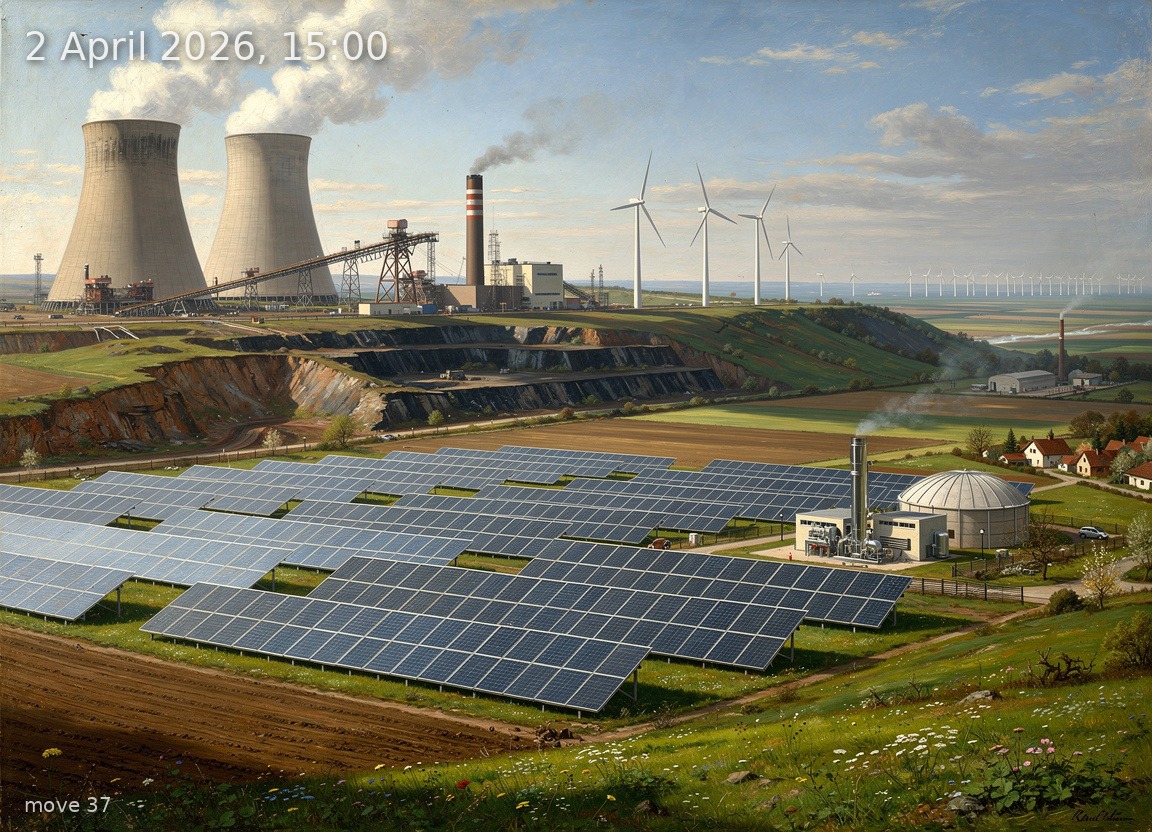
Solar at 30.5 GW leads a 74.7% renewable mix under clear spring skies, with lignite and coal maintaining baseload.
Back
Generation mix
Wind onshore 11%
Wind offshore 7%
Solar 49%
Biomass 7%
Hydro 2%
Natural gas 6%
Hard coal 7%
Brown coal 13%
75%
Renewable share
11.1 GW
Wind (on + offshore)
30.5 GW
Solar
62.9 GW
Total generation
+0.5 GW
Net export
73.8 €/MWh
Day-ahead price
13.6°C / 11 km/h
Temp / Wind speed
Open-Meteo, Kassel (51.3°N 9.5°E)
12.0% / 349.8 W/m²
Cloud cover / Radiation
183
gCO₂/kWh
Image prompt
Solar 30.5 GW dominates the foreground and centre as vast fields of aluminium-framed crystalline silicon photovoltaic panels stretching across gently rolling spring farmland, angled south, glinting brilliantly under intense direct sunlight. Brown coal 7.9 GW occupies the left background as a cluster of massive hyperbolic cooling towers emitting thick white steam plumes into the sky, with conveyor belts and open-pit mine terraces visible at their base. Wind onshore 6.8 GW appears as a line of tall three-blade turbines with white tubular towers on a ridge behind the solar fields, blades turning slowly in moderate wind. Hard coal 4.2 GW sits beside the lignite plant as a smaller coal-fired station with a single tall chimney and rectangular boiler house, thin grey exhaust trailing upward. Wind offshore 4.2 GW is suggested on the far right horizon as a distant row of turbines emerging from a hazy flatland edge implying the North Sea coast. Biomass 4.1 GW appears as a modest industrial facility with a wood-chip storage dome and short stack near the village edge at mid-right. Natural gas 3.8 GW is rendered as a compact combined-cycle gas turbine plant with a single gleaming exhaust stack and heat recovery unit, positioned between the coal complex and the solar fields. Hydro 1.2 GW is a small run-of-river weir with a low concrete dam and foaming tailrace in a stream cutting through the foreground meadow. The sky is almost entirely clear—only 12% wispy cirrus clouds—with brilliant April afternoon sunlight casting sharp shadows from the west-northwest, colour temperature warm but not golden. Temperature 13.6°C: fresh spring green on deciduous trees just leafing out, wildflowers dotting meadow grass, air crisp and luminous. The atmosphere carries a faintly warm, subtly hazy quality suggesting a moderate electricity price—neither oppressive nor perfectly serene. Painted in the style of a highly detailed 19th-century German Romantic oil painting—rich saturated colour, visible impasto brushwork, deep atmospheric perspective—with meticulous engineering accuracy on every turbine nacelle, panel frame, cooling tower curve, and exhaust stack. No text, no labels.