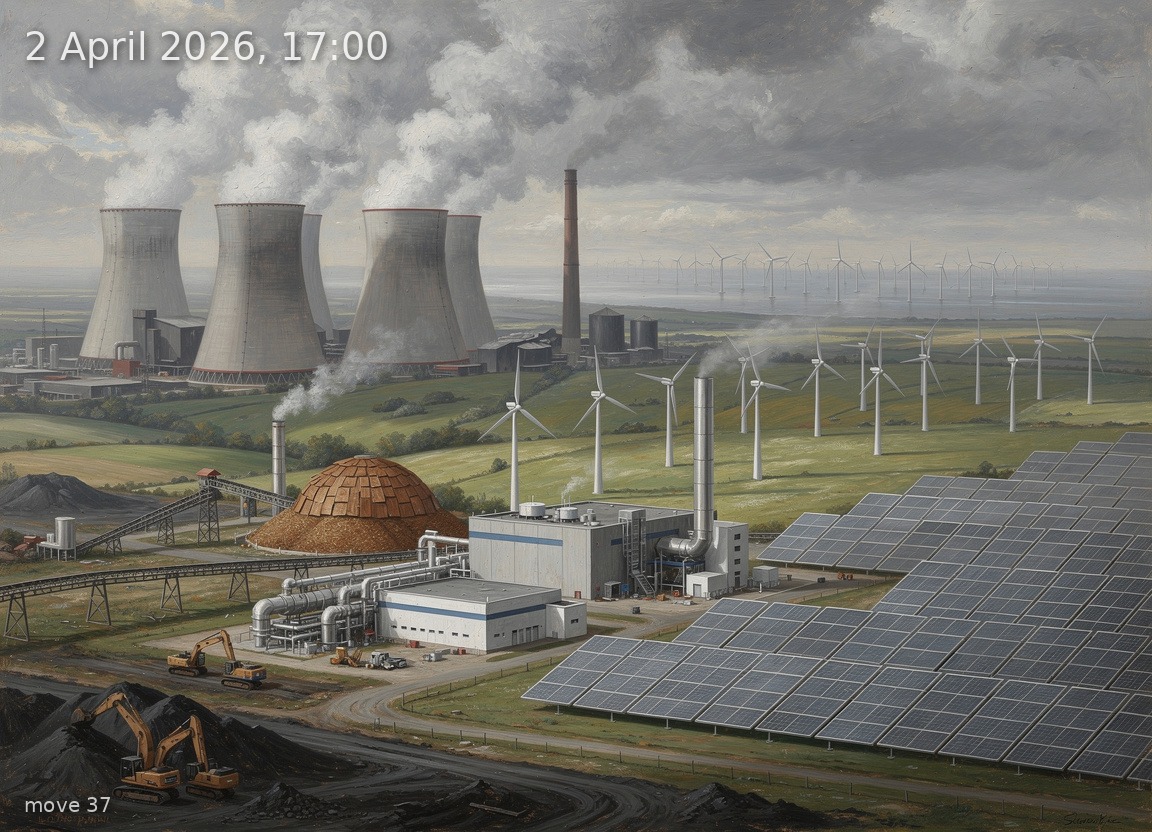
Solar and wind lead at 32 GW but a 15 GW import gap and heavy coal use drive prices above 108 EUR/MWh.
Back
Generation mix
Wind onshore 19%
Wind offshore 8%
Solar 29%
Biomass 9%
Hydro 2%
Natural gas 8%
Hard coal 9%
Brown coal 17%
67%
Renewable share
13.0 GW
Wind (on + offshore)
13.9 GW
Solar
48.0 GW
Total generation
-15.2 GW
Net import
108.8 €/MWh
Day-ahead price
14.1°C / 18 km/h
Temp / Wind speed
Open-Meteo, Kassel (51.3°N 9.5°E)
99.0% / 277.0 W/m²
Cloud cover / Radiation
240
gCO₂/kWh
Image prompt
Solar 13.9 GW dominates the right third of the composition as vast fields of aluminium-framed crystalline silicon PV panels stretching across flat farmland, catching diffuse grey light; wind onshore 9.2 GW and wind offshore 3.7 GW together fill the centre-right as dozens of three-blade turbines on lattice and tubular towers, onshore turbines on green spring hills and a distant row of offshore turbines along a hazy horizon; brown coal 7.9 GW occupies the left quarter as a cluster of massive hyperbolic cooling towers with thick white-grey steam plumes rising into the overcast, beside conveyor belts and lignite stockpiles; hard coal 4.2 GW appears as a smaller coal plant with a tall chimney stack and dark coal bunkers just right of the brown-coal complex; natural gas 3.8 GW is rendered as a compact CCGT plant with a single gleaming exhaust stack and visible heat shimmer beside the coal facilities; biomass 4.1 GW appears as a mid-sized plant with a wooden-chip storage dome and short chimney near the centre; hydro 1.1 GW is a small run-of-river weir with a modest powerhouse along a stream in the foreground. TIME AND LIGHT: 17:00 Berlin dusk in early April — the sun is very low, barely visible, casting a fading orange-red glow along the lower horizon only, while the upper sky is heavy, dark, nearly completely overcast at 99% cloud cover, oppressive and leaden. The atmosphere feels heavy and weighted, reflecting the high electricity price. Spring vegetation is fresh pale green but muted under the thick clouds. Moderate wind at 17.5 km/h stirs grass and causes turbine blades to spin steadily. Temperature 14°C — a cool, damp spring evening. STYLE: highly detailed oil painting in the tradition of 19th-century German Romantic landscape painters such as Caspar David Friedrich and Carl Blechen — rich, moody colour palette of slate greys, burnt sienna, and muted greens, visible impasto brushwork, deep atmospheric perspective with haze softening distant industrial structures. Each energy technology rendered with meticulous engineering accuracy: turbine nacelles, three-blade rotors, PV cell grid patterns, hyperbolic cooling tower geometry, CCGT exhaust stacks. The scene conveys the sublime tension between pastoral landscape and industrial energy infrastructure. No text, no labels.