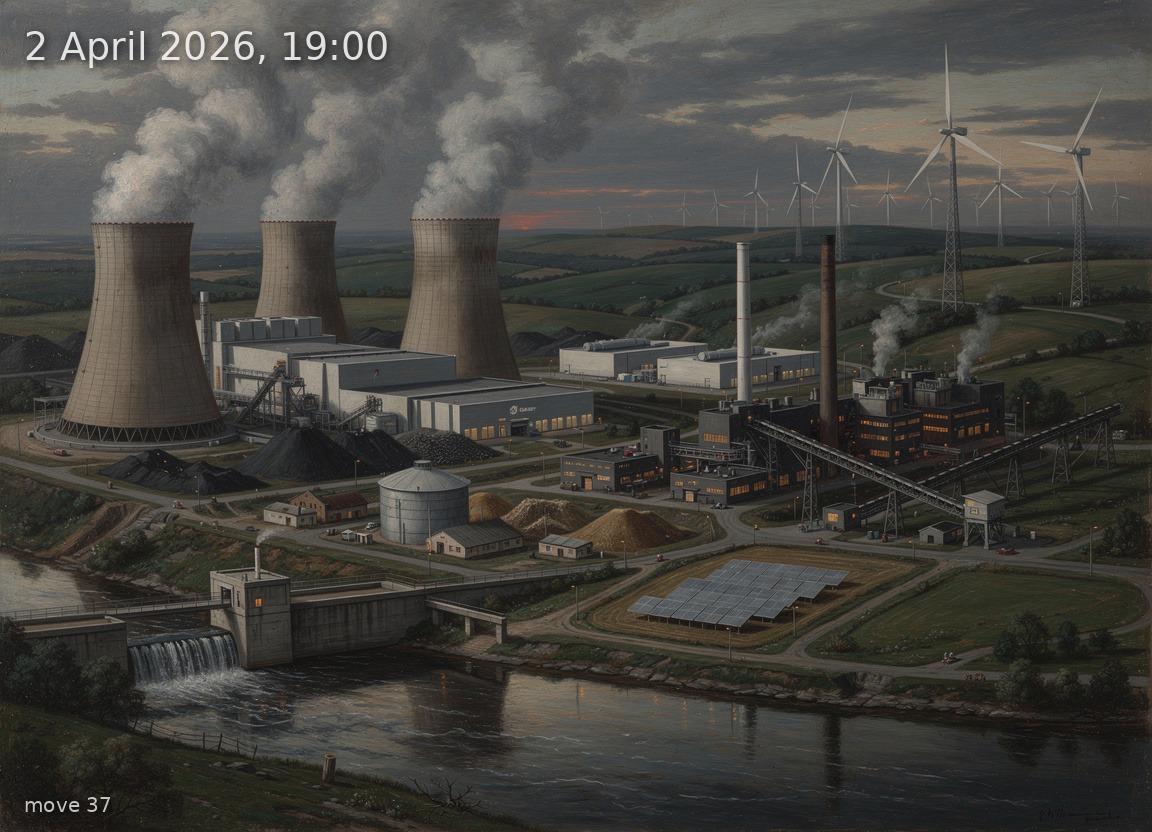
Wind and coal dominate generation as evening demand peaks, driving heavy net imports and elevated prices under overcast skies.
Back
Generation mix
Wind onshore 26%
Wind offshore 9%
Solar 2%
Biomass 10%
Hydro 3%
Natural gas 10%
Hard coal 18%
Brown coal 22%
50%
Renewable share
14.0 GW
Wind (on + offshore)
0.9 GW
Solar
40.4 GW
Total generation
-22.5 GW
Net import
161.8 €/MWh
Day-ahead price
12.0°C / 15 km/h
Temp / Wind speed
Open-Meteo, Kassel (51.3°N 9.5°E)
99.0% / 19.0 W/m²
Cloud cover / Radiation
366
gCO₂/kWh
Image prompt
Brown coal 8.9 GW dominates the left quarter as a sprawling lignite power complex with four massive hyperbolic cooling towers emitting thick steam plumes into the overcast sky; hard coal 7.4 GW sits just right of centre as a cluster of dark industrial buildings with tall chimneys and conveyor belts feeding coal hoppers; wind onshore 10.4 GW spans the entire right third and background as dozens of three-blade turbines on lattice and tubular towers across rolling green hills, rotors turning steadily in moderate wind; wind offshore 3.5 GW appears as a row of turbines on the far-right horizon above a grey sea inlet; natural gas 3.9 GW is rendered as two compact CCGT units with slim single exhaust stacks and small vapour trails, positioned between the coal plants; biomass 4.2 GW appears as a modest wood-chip-fed plant with a rounded silo and low chimney near the coal complex; hydro 1.0 GW is a small run-of-river weir with a concrete powerhouse visible along a river in the middle ground; solar 0.9 GW is a tiny, barely visible cluster of aluminium-framed crystalline PV panels on a field, reflecting no sunlight, dull and grey. The sky is a heavy, oppressive blanket of 99% cloud cover at dusk — the last fading orange-red glow clings to the lowest horizon line while the upper sky darkens to deep slate grey and charcoal. Early spring vegetation: fresh but muted green grass, bare-branched deciduous trees just beginning to bud, at 12°C. Transmission pylons and high-voltage lines stretch across the mid-ground connecting facilities. The atmosphere is dense, weighty, slightly hazy from industrial emissions, conveying the strain of peak evening demand. Style: highly detailed oil painting in the tradition of 19th-century German Romantic landscape painting — rich, layered colour with visible impasto brushwork, dramatic atmospheric depth and chiaroscuro lighting from the industrial glow against the darkening sky. Meticulous engineering detail on every turbine nacelle, cooling tower, and smokestack. No text, no labels.