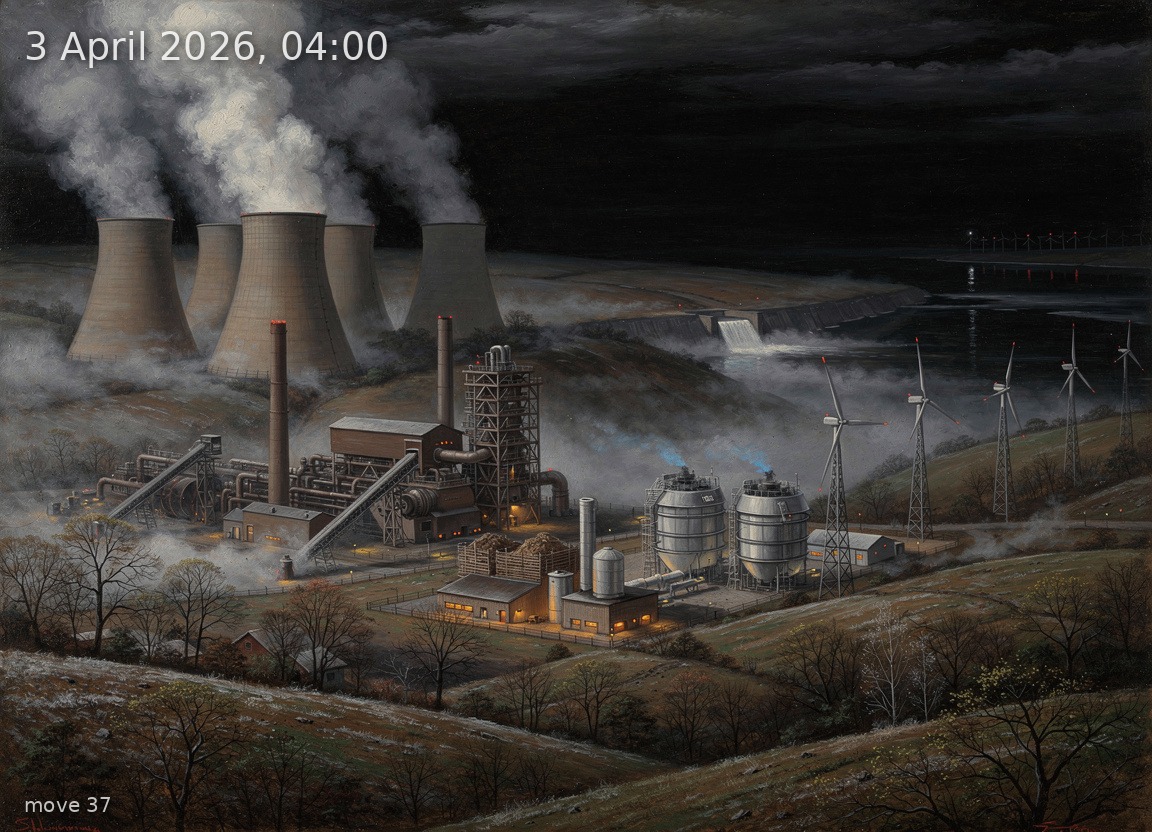
Pre-dawn thermal dispatch and moderate wind cannot meet 43.8 GW demand, driving 11.7 GW net imports at high prices.
Back
Generation mix
Wind onshore 24%
Wind offshore 6%
Biomass 13%
Hydro 3%
Natural gas 20%
Hard coal 16%
Brown coal 18%
46%
Renewable share
9.5 GW
Wind (on + offshore)
0.0 GW
Solar
32.1 GW
Total generation
-11.8 GW
Net import
120.2 €/MWh
Day-ahead price
6.0°C / 6 km/h
Temp / Wind speed
Open-Meteo, Kassel (51.3°N 9.5°E)
100.0% / 0.0 W/m²
Cloud cover / Radiation
366
gCO₂/kWh
Image prompt
Brown coal 5.8 GW dominates the left quarter as a cluster of massive hyperbolic cooling towers with thick white steam plumes rising into the black sky; hard coal 5.1 GW sits just right of centre as a sprawling power station with conveyor belts, coal bunkers, and a pair of tall chimneys emitting thin grey smoke; natural gas 6.4 GW occupies the centre-right as three compact CCGT plant blocks with slim single exhaust stacks and faint blue-tinged gas flares; wind onshore 7.7 GW stretches across the right third of the scene as a long ridge of three-blade turbines on lattice towers, their rotors turning slowly in light wind; wind offshore 1.8 GW appears as a small cluster of turbines on the far-right horizon above a dark estuary; biomass 4.2 GW is rendered as a modest wood-chip-fed cogeneration plant with a single squat chimney and warm amber glow from its furnace building, positioned between the coal and gas plants; hydro 1.1 GW appears as a small dam structure with illuminated spillway in the far background valley. Time is 04:00 — complete darkness, deep black sky with total 100% cloud cover hiding all stars, no twilight whatsoever, no sky glow. The only illumination comes from sodium-orange industrial lighting across the power stations, red aviation warning lights atop every chimney and turbine nacelle, and the warm amber glow from facility windows. The landscape is early-spring central German rolling hills with bare deciduous trees just beginning to bud, sparse frost on the ground reflecting the industrial light, temperature 6°C giving a chilly mist low over the terrain. The atmosphere feels heavy and oppressive — thick overcast pressing down, haze and steam merging into the cloud base, evoking the high electricity price. Painted in the style of a highly detailed 19th-century German Romantic oil painting — rich impasto brushwork, deep chiaroscuro between the glowing industrial facilities and the surrounding darkness, atmospheric depth with layers of mist receding into the distance, the dramatic tension of Caspar David Friedrich meets industrial realism. Meticulous engineering detail on every structure: turbine nacelles with correct three-blade rotors, aluminium cladding on gas turbine housings, the parabolic curves of cooling towers rendered with architectural precision. No text, no labels, no human figures.