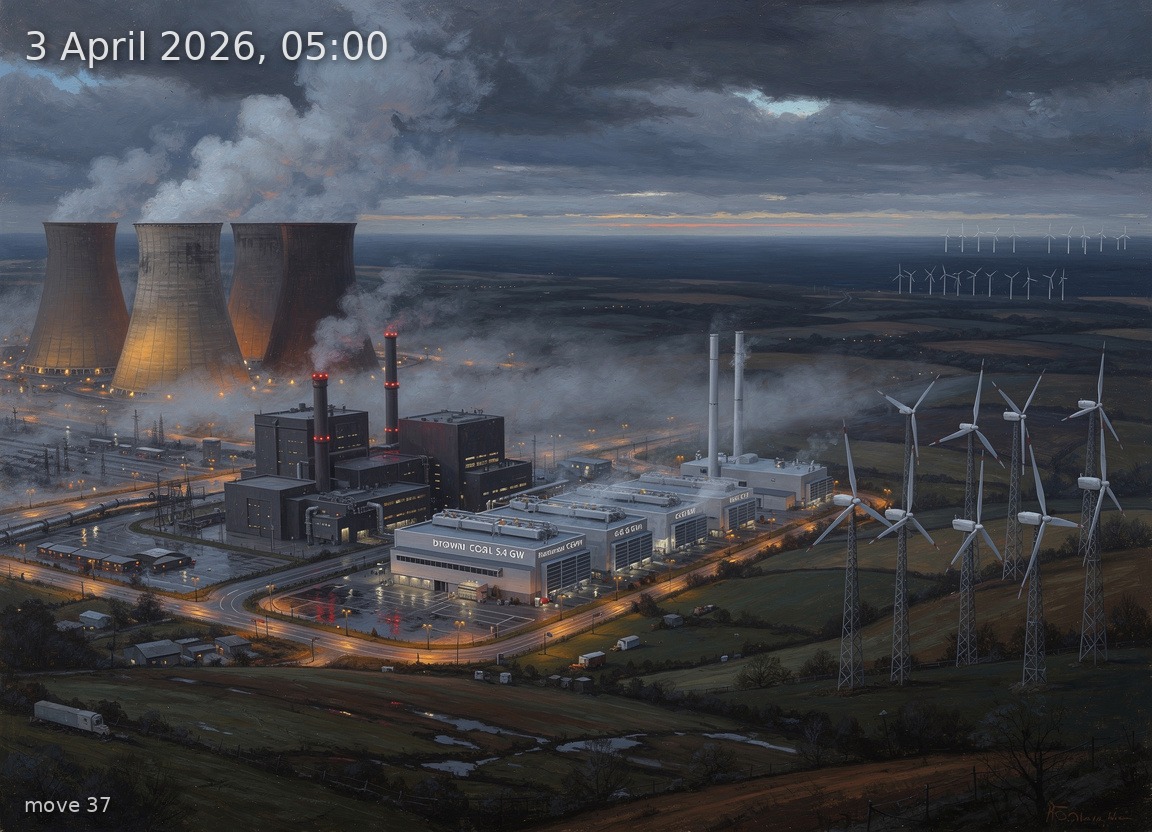
Coal, gas, and moderate wind share a pre-dawn load gap requiring 12.2 GW net imports under full cloud cover.
Back
Generation mix
Wind onshore 23%
Wind offshore 6%
Biomass 13%
Hydro 3%
Natural gas 22%
Hard coal 16%
Brown coal 17%
46%
Renewable share
9.3 GW
Wind (on + offshore)
0.0 GW
Solar
32.0 GW
Total generation
-12.2 GW
Net import
123.4 €/MWh
Day-ahead price
5.5°C / 5 km/h
Temp / Wind speed
Open-Meteo, Kassel (51.3°N 9.5°E)
100.0% / 0.0 W/m²
Cloud cover / Radiation
363
gCO₂/kWh
Image prompt
Brown coal 5.4 GW occupies the left quarter as a cluster of massive hyperbolic cooling towers with thick white steam plumes rising into blackness; hard coal 5.1 GW sits just right of centre-left as a heavy industrial power station with tall square stacks and red aviation warning lights; natural gas 6.9 GW fills the centre as a row of compact CCGT plants with slender single exhaust stacks emitting thin vapour, lit by sodium-orange floodlights; wind onshore 7.3 GW spans the right third as a long line of tall three-blade turbines on lattice towers stretching across rolling hills, their rotors turning slowly in light wind; wind offshore 2.0 GW appears in the far-right background as a small cluster of turbines on the horizon above a dark sea; biomass 4.2 GW is rendered as a mid-ground wood-chip-fired plant with a modest stack and warm interior glow visible through large industrial windows; hydro 1.1 GW appears as a small concrete dam structure in the far left background with water flowing and faint illumination. The sky is deep pre-dawn blue-grey at 05:00, the very first hint of pale steel-blue light creeping along the eastern horizon but no sun visible, the rest of the sky a heavy unbroken overcast pressing down oppressively, reflecting the high electricity price. The landscape is early-spring central German terrain — bare deciduous trees with the faintest buds, damp brown-green fields, patches of frost at 5.5°C. Ground-level fog drifts between the cooling towers. All facilities are lit by harsh sodium-yellow and white industrial lighting, casting long reflections on wet roads. Transmission pylons with high-voltage lines recede into the misty distance, symbolising imports. Highly detailed oil painting in the tradition of 19th-century German Romantic landscape painters — Caspar David Friedrich meets industrial sublime — rich deep colour palette of indigo, slate grey, burnt orange, and warm amber, visible confident brushwork, atmospheric depth and sfumato in the fog layers, meticulous engineering detail on every turbine nacelle, cooling tower ribbing, and CCGT exhaust stack. No text, no labels.