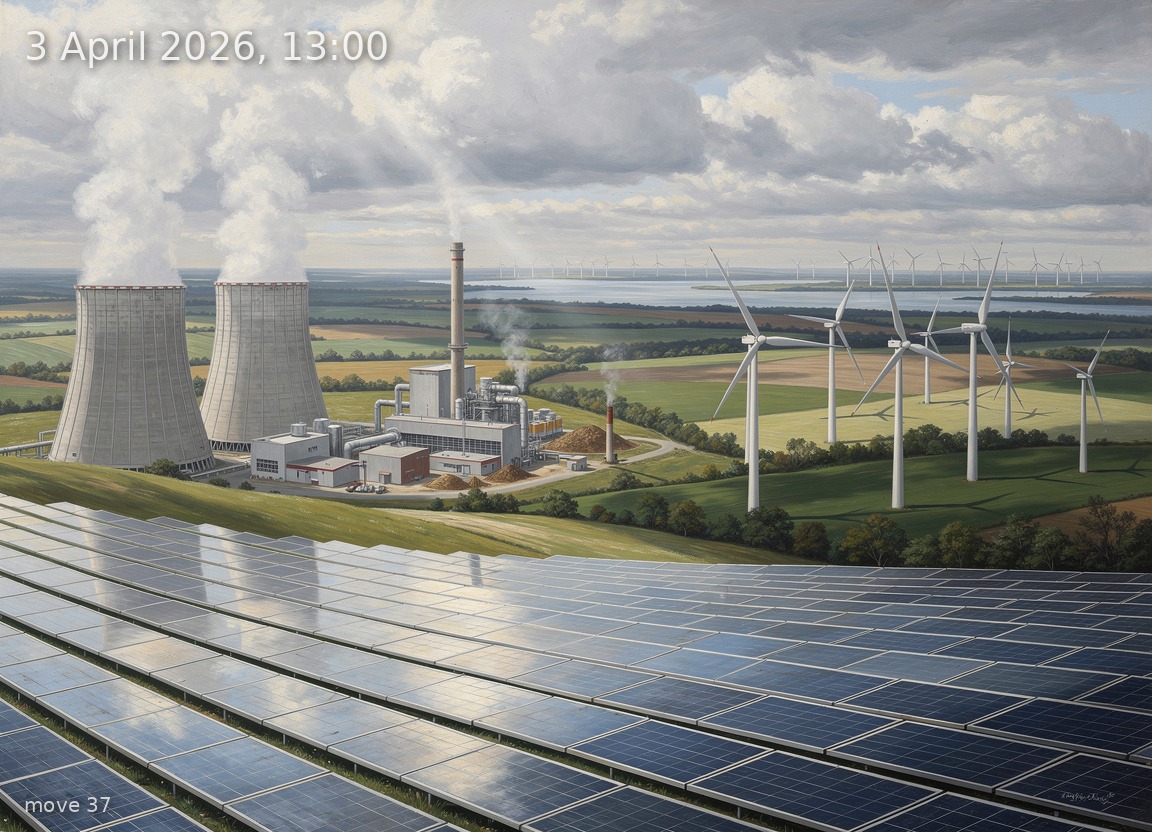
Solar at 31.5 GW and wind at 17.8 GW drive 91% renewables, pushing 7.9 GW of net exports and near-zero prices.
Back
Generation mix
Wind onshore 19%
Wind offshore 11%
Solar 52%
Biomass 7%
Hydro 2%
Natural gas 4%
Hard coal 1%
Brown coal 4%
91%
Renewable share
17.8 GW
Wind (on + offshore)
31.5 GW
Solar
60.0 GW
Total generation
+7.8 GW
Net export
9.9 €/MWh
Day-ahead price
9.9°C / 12 km/h
Temp / Wind speed
Open-Meteo, Kassel (51.3°N 9.5°E)
96.0% / 224.2 W/m²
Cloud cover / Radiation
61
gCO₂/kWh
Image prompt
Solar 31.5 GW dominates the scene as vast expanses of aluminium-framed crystalline silicon photovoltaic panels stretching across more than half the canvas, covering gently rolling spring fields in central Germany. Wind onshore 11.3 GW appears as dozens of tall three-blade turbines with white tubular towers and visible nacelles arrayed across low green hills in the centre-right. Wind offshore 6.5 GW is suggested by a distant line of larger turbines on the hazy horizon above a river or lake. Biomass 4.2 GW is rendered as a cluster of modest industrial buildings with wood-chip storage and a single chimney with thin white exhaust, occupying a small area left of centre. Brown coal 2.5 GW appears as two hyperbolic concrete cooling towers with lazy steam plumes rising on the far left. Natural gas 2.2 GW is a compact combined-cycle gas turbine plant with a tall single exhaust stack and thin heat shimmer, tucked beside the cooling towers. Hydro 1.1 GW is a small dam with spillway visible in a valley in the far background. Hard coal 0.8 GW is a single smaller stack with wispy grey smoke next to the lignite plant. Time of day is early afternoon: full daylight but the sky is almost entirely overcast with a thick, luminous white-grey cloud layer at 96% coverage, yet a bright diffuse glow emanates from above and a sliver of direct sunlight breaks through, casting soft shadows on the panels. The atmosphere is calm, open, and peaceful — reflecting the very low electricity price. Spring vegetation is just emerging: bare branches tipped with pale green buds, early grass in muted yellow-green, temperature around 10°C suggested by cool tones and figures in light jackets. A gentle breeze of 12.5 km/h sets the turbine blades turning at moderate speed and ripples puddles on field paths. Style: highly detailed oil painting in the tradition of 19th-century German Romantic landscape painters such as Caspar David Friedrich and Carl Blechen — rich layered colour, visible confident brushwork, atmospheric depth with sfumato haze in the distance, meticulous engineering detail on every turbine nacelle, every PV panel frame, every cooling tower's concrete ribbing. The composition conveys the vast scale of renewable generation overwhelming the modest fossil remnants. No text, no labels.