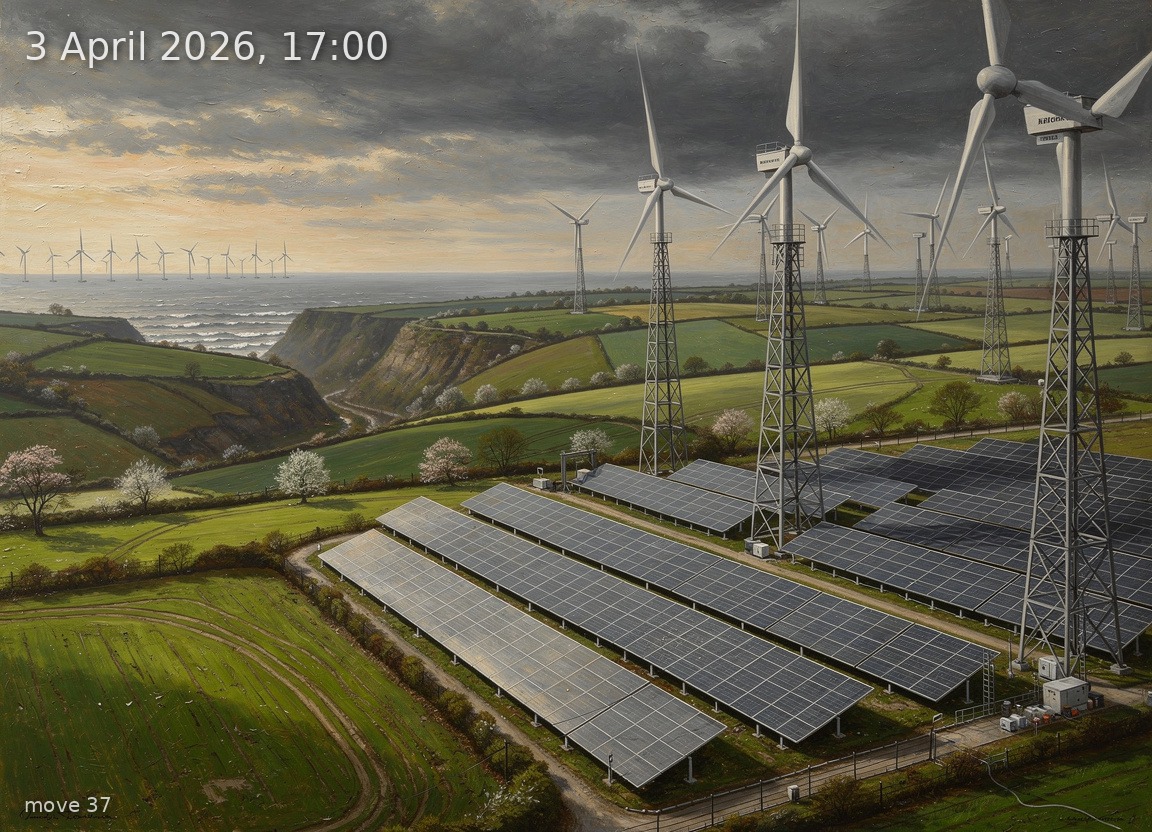
Wind dominates at 25.5 GW with 13.8 GW solar; 91% renewable share with 2.6 GW net import at dusk.
Back
Generation mix
Wind onshore 39%
Wind offshore 13%
Solar 28%
Biomass 9%
Hydro 2%
Natural gas 2%
Hard coal 1%
Brown coal 5%
91%
Renewable share
25.5 GW
Wind (on + offshore)
13.8 GW
Solar
48.6 GW
Total generation
-2.6 GW
Net import
66.8 €/MWh
Day-ahead price
11.9°C / 22 km/h
Temp / Wind speed
Open-Meteo, Kassel (51.3°N 9.5°E)
100.0% / 100.2 W/m²
Cloud cover / Radiation
62
gCO₂/kWh
Image prompt
Wind onshore 19.0 GW dominates the right two-thirds of the scene as vast ranks of three-blade turbines on lattice and tubular towers stretching across rolling green April farmland, rotors spinning vigorously in strong wind. Solar 13.8 GW occupies the centre-right foreground as expansive fields of aluminium-framed crystalline silicon PV panels reflecting the dull overcast sky. Wind offshore 6.5 GW appears in the distant left background as a line of white turbines standing in a grey North Sea horizon glimpsed through a valley gap. Biomass 4.2 GW is rendered as a cluster of modest industrial buildings with wood-chip silos and small steam stacks in the left-centre middle ground. Brown coal 2.4 GW occupies the far left as two hyperbolic concrete cooling towers emitting thick white steam plumes, beside a conveyor belt carrying lignite. Natural gas 1.2 GW sits as a compact combined-cycle gas turbine plant with a single tall exhaust stack and slim vapour trail, just left of centre. Hard coal 0.7 GW is a small dark gantry crane and boiler house with a thin chimney beside the lignite plant. Hydro 0.9 GW appears as a small weir and powerhouse at a river in the right foreground. Time of day is 17:00 dusk in early April: the sky is fully overcast at 100% cloud cover, a heavy uniform grey-white blanket, with a band of muted orange-red glow along the lower western horizon where the sun is setting unseen behind clouds; the upper sky darkens to slate grey. Temperature is mild at 12 °C; early spring vegetation shows fresh pale-green buds on deciduous trees and bright green grass. Wind at 22 km/h bends the grass and stirs the turbine blades with visible motion blur. The moderate 66.8 EUR/MWh price is conveyed through a slightly heavy, brooding but not oppressive atmosphere. Style: highly detailed oil painting in the tradition of 19th-century German Romantic landscape painting—Caspar David Friedrich's atmospheric depth merged with industrial realism—rich earth tones, visible impasto brushwork, dramatic chiaroscuro between the glowing horizon and darkening overcast sky. Meticulous engineering detail on every turbine nacelle, PV cell grid pattern, cooling tower ribbing, and gas-turbine exhaust geometry. No text, no labels.