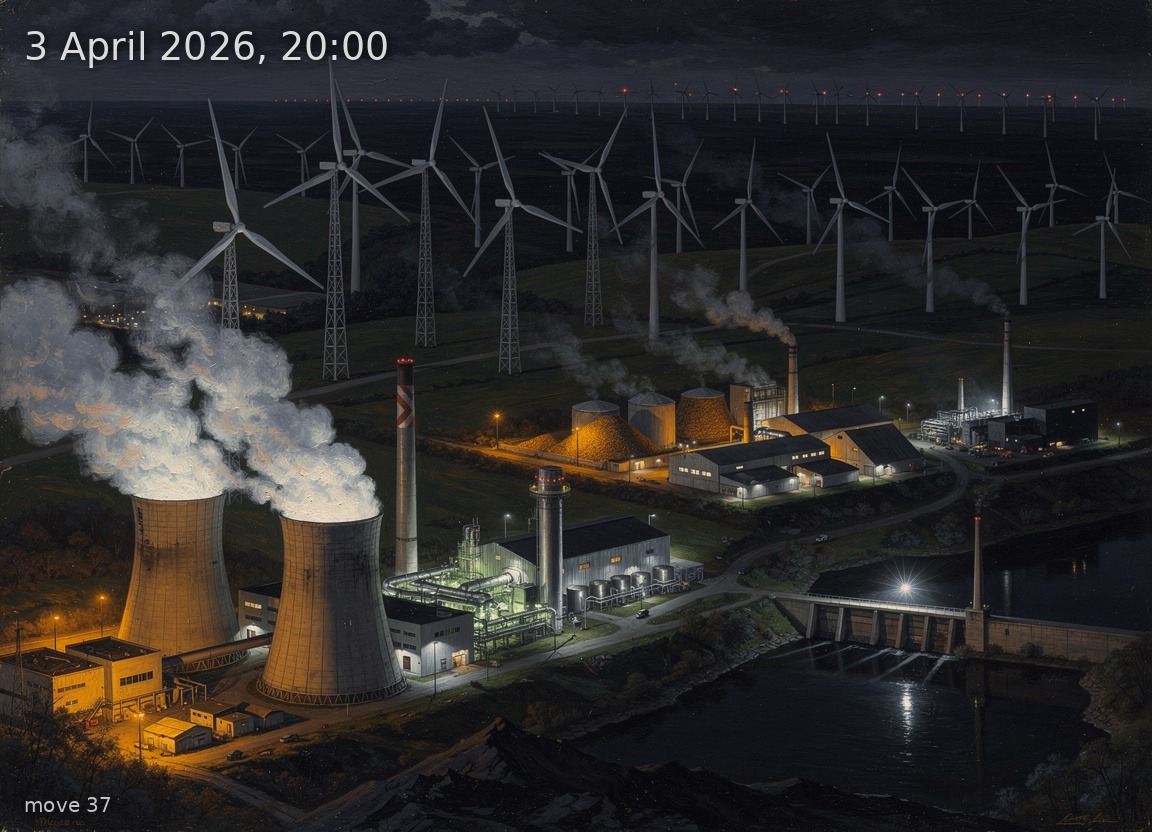
Strong wind dominates at 29.6 GW but zero solar and peak evening demand drive 9 GW net imports and elevated prices.
Back
Generation mix
Wind onshore 55%
Wind offshore 14%
Solar 0%
Biomass 11%
Hydro 2%
Natural gas 8%
Hard coal 2%
Brown coal 8%
82%
Renewable share
29.6 GW
Wind (on + offshore)
0.0 GW
Solar
43.1 GW
Total generation
-8.9 GW
Net import
96.3 €/MWh
Day-ahead price
11.1°C / 19 km/h
Temp / Wind speed
Open-Meteo, Kassel (51.3°N 9.5°E)
97.0% / 1.0 W/m²
Cloud cover / Radiation
121
gCO₂/kWh
Image prompt
Wind onshore 23.8 GW dominates the scene, filling over half the composition with vast ranks of three-blade turbines on lattice towers stretching across rolling central German hills into the darkness; wind offshore 5.8 GW appears as a distant cluster of tall turbines visible on the far horizon, their red aviation warning lights blinking. Brown coal 3.5 GW occupies the lower left as a lignite power station with two massive hyperbolic cooling towers emitting thick white steam plumes lit from below by sodium-orange floodlights. Natural gas 3.4 GW sits adjacent as a compact CCGT facility with a single tall exhaust stack and a faint heat shimmer, illuminated by industrial lighting. Biomass 4.7 GW is represented in the middle-ground as a cluster of smaller industrial buildings with chimneys and wood-chip storage silos, warmly lit. Hydro 1.0 GW appears as a small dam structure with spillway in the lower right, lit by a single floodlight. Hard coal 0.9 GW shows as a smaller coal plant stack behind the brown coal station, with a thin plume. The time is 20:00 in early April — the sky is completely dark, deep navy-black with no twilight glow, heavy 97% cloud cover obscuring all stars, creating a low oppressive ceiling that reflects the amber glow of the industrial facilities below. The wind is strong at 19 km/h: turbine blades spin vigorously, trees along field edges bend and sway, and steam plumes from the cooling towers shear sideways dramatically. Spring vegetation is fresh green but barely visible, caught only in pools of artificial light. The elevated price atmosphere is conveyed through a heavy, brooding, almost suffocating sky pressing down on the industrial landscape. Painted in the style of a highly detailed 19th-century German Romantic oil painting — rich impasto brushwork, deep chiaroscuro contrasts between glowing industrial light and engulfing darkness, atmospheric depth receding into murky distance — yet every turbine nacelle, cooling tower ribbing, gas stack flange, and biomass silo is rendered with meticulous engineering accuracy. No text, no labels.