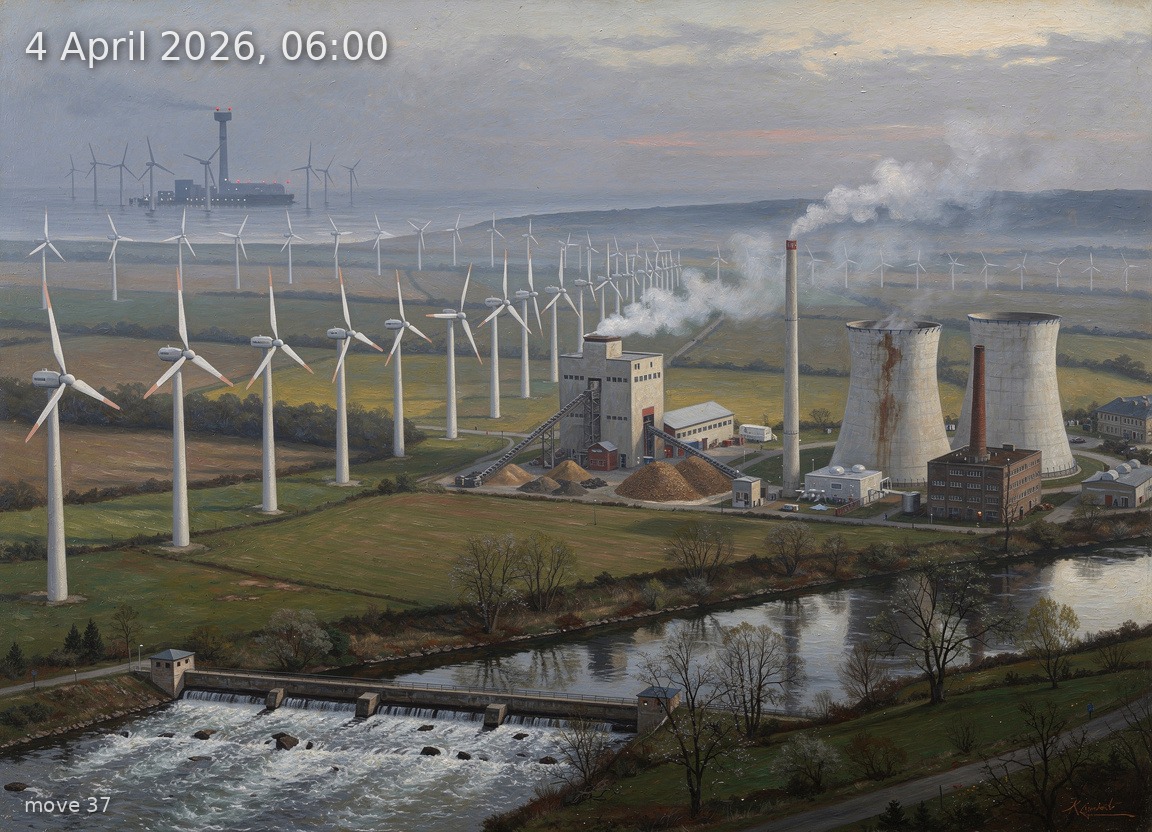
Strong onshore wind drives 87.6% renewables at dawn, creating 5.7 GW net export under overcast skies.
Back
Generation mix
Wind onshore 65%
Wind offshore 12%
Solar 0%
Biomass 8%
Hydro 2%
Natural gas 5%
Hard coal 3%
Brown coal 4%
88%
Renewable share
40.1 GW
Wind (on + offshore)
0.0 GW
Solar
51.8 GW
Total generation
+5.7 GW
Net export
13.4 €/MWh
Day-ahead price
10.1°C / 22 km/h
Temp / Wind speed
Open-Meteo, Kassel (51.3°N 9.5°E)
100.0% / 0.0 W/m²
Cloud cover / Radiation
82
gCO₂/kWh
Image prompt
Wind onshore 33.8 GW dominates the scene, filling roughly two-thirds of the composition as vast rows of three-blade turbines with white tubular towers and detailed nacelles stretching across rolling central German farmland into the deep distance; wind offshore 6.3 GW appears as a distant cluster of larger turbines on the far-left horizon, their red aviation lights glowing faintly above a slate-grey sea; biomass 4.3 GW is rendered as a mid-ground wood-chip power station with a tall rectangular boiler building, conveyor belts, and a modest steam plume; natural gas 2.7 GW sits as a compact CCGT plant with a single slender exhaust stack and visible heat shimmer; brown coal 2.0 GW appears as a pair of hyperbolic cooling towers with thin wisps of condensation, slightly smaller than the gas plant; hard coal 1.7 GW is a single dark boiler house with a square chimney releasing a faint grey trail; hydro 1.0 GW is a small concrete run-of-river weir in the foreground with water rushing over the spillway. Time of day is 06:00 dawn in early April — the sky is a deep blue-grey pre-dawn with the faintest pale luminescence along the eastern horizon, no direct sunlight, no warm tones; cloud cover is total, a thick unbroken overcast ceiling pressing low. Temperature 10°C early spring — bare deciduous trees with just the first pale-green buds, damp meadow grass, patches of morning mist drifting between turbine bases. Wind speed 22.5 km/h is visible in bending grasses, spinning turbine blades captured mid-motion with slight radial blur, and mist streaking horizontally. The low price and abundant supply create a calm, expansive atmosphere — the sky, though overcast, feels open and unhurried. Style: highly detailed oil painting in the tradition of 19th-century German Romantic landscape painters such as Caspar David Friedrich and Carl Blechen, with rich layered colour, visible impasto brushwork, atmospheric aerial perspective deepening into misty blue-grey distances, meticulous engineering detail on every turbine nacelle, cooling tower, and industrial structure, dramatic scale contrast between the human-built structures and the vast landscape. No text, no labels, no people in the foreground.