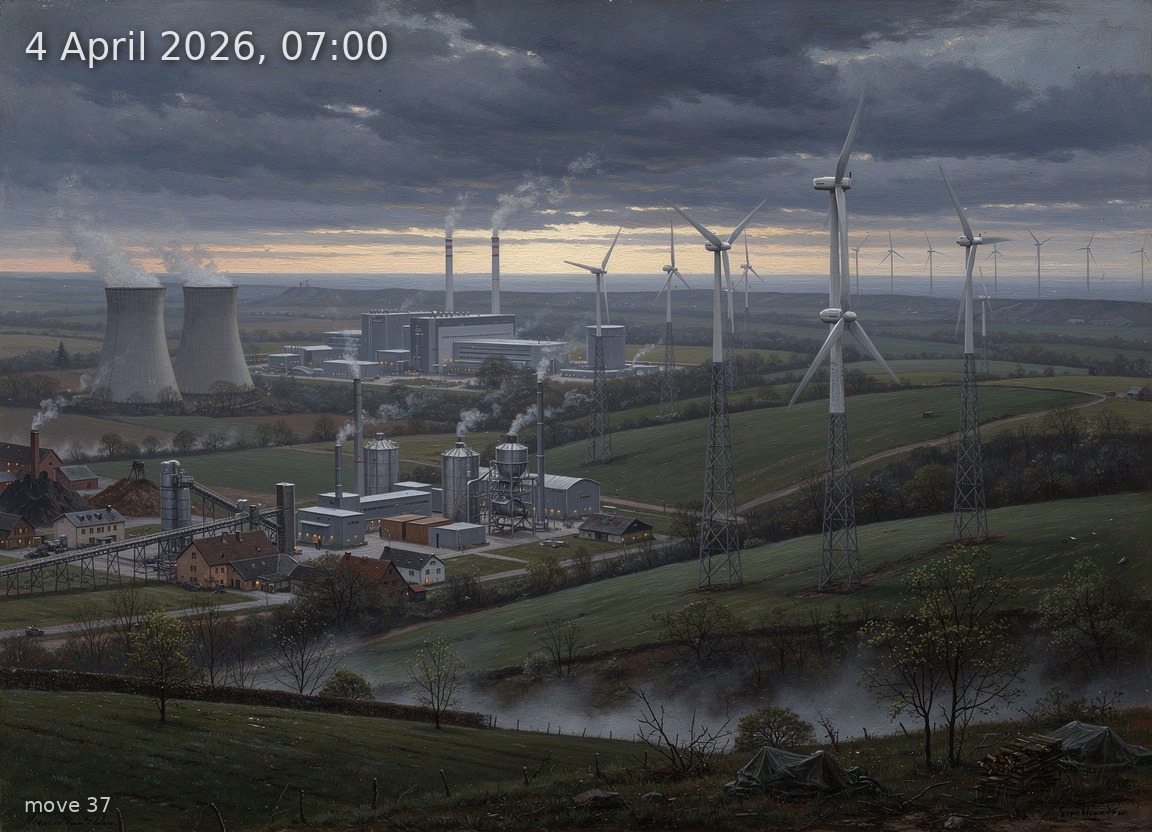
Strong onshore wind drives 86% renewable generation, creating 3.8 GW net export under overcast April dawn skies.
Back
Generation mix
Wind onshore 61%
Wind offshore 12%
Solar 2%
Biomass 8%
Hydro 2%
Natural gas 6%
Hard coal 4%
Brown coal 4%
86%
Renewable share
38.5 GW
Wind (on + offshore)
1.2 GW
Solar
52.4 GW
Total generation
+3.8 GW
Net export
19.3 €/MWh
Day-ahead price
10.0°C / 21 km/h
Temp / Wind speed
Open-Meteo, Kassel (51.3°N 9.5°E)
100.0% / 0.0 W/m²
Cloud cover / Radiation
91
gCO₂/kWh
Image prompt
Wind onshore 32.1 GW dominates the scene as vast ranks of three-blade turbines on lattice and tubular towers stretching across rolling central German farmland, filling roughly 60% of the composition from centre to right, their rotors visibly canted and spinning in strong wind. Wind offshore 6.4 GW appears as a distant row of larger turbines on the far-right horizon, barely visible through haze. Biomass 4.4 GW is rendered as a cluster of modest industrial buildings with wood-chip storage silos and thin exhaust stacks emitting faint white vapour in the left-centre midground. Natural gas 3.2 GW sits as two compact CCGT units with single tall exhaust stacks and low-profile turbine halls in the left midground, small plumes of steam rising. Brown coal 2.2 GW occupies the far left as a pair of hyperbolic cooling towers with modest steam plumes and a visible lignite conveyor belt, proportionally small. Hard coal 1.9 GW is rendered as a single smaller coal plant with a rectangular boiler house and chimney stack adjacent to the brown coal installation. Solar 1.2 GW is represented only as a few barely visible aluminium-framed crystalline silicon panels on nearby rooftops, dark and unreflective under heavy overcast. Hydro 1.0 GW appears as a small run-of-river weir with a low concrete dam visible along a river in the foreground. The sky is early dawn at 07:00 in April — deep blue-grey pre-dawn light with no direct sun, a pale luminous band along the eastern horizon beneath a uniformly overcast 100% cloud ceiling. The air feels cool at 10°C; early spring vegetation — bare branches with first pale-green buds, damp meadow grass, patches of morning mist in low valleys. Wind is tangible: grass bends, loose tarps flutter, turbine blades are motion-blurred. The low price and calm surplus create an atmosphere of quiet abundance — open, spacious, unhurried. Highly detailed oil painting in the tradition of 19th-century German Romantic landscape painters — rich layered colour, visible confident brushwork, atmospheric aerial perspective with misty depth — yet every piece of energy infrastructure is rendered with meticulous engineering accuracy: turbine nacelles, three-blade rotors, cooling tower parabolic profiles, CCGT exhaust geometry. The scene reads as a masterwork industrial landscape painting. No text, no labels.