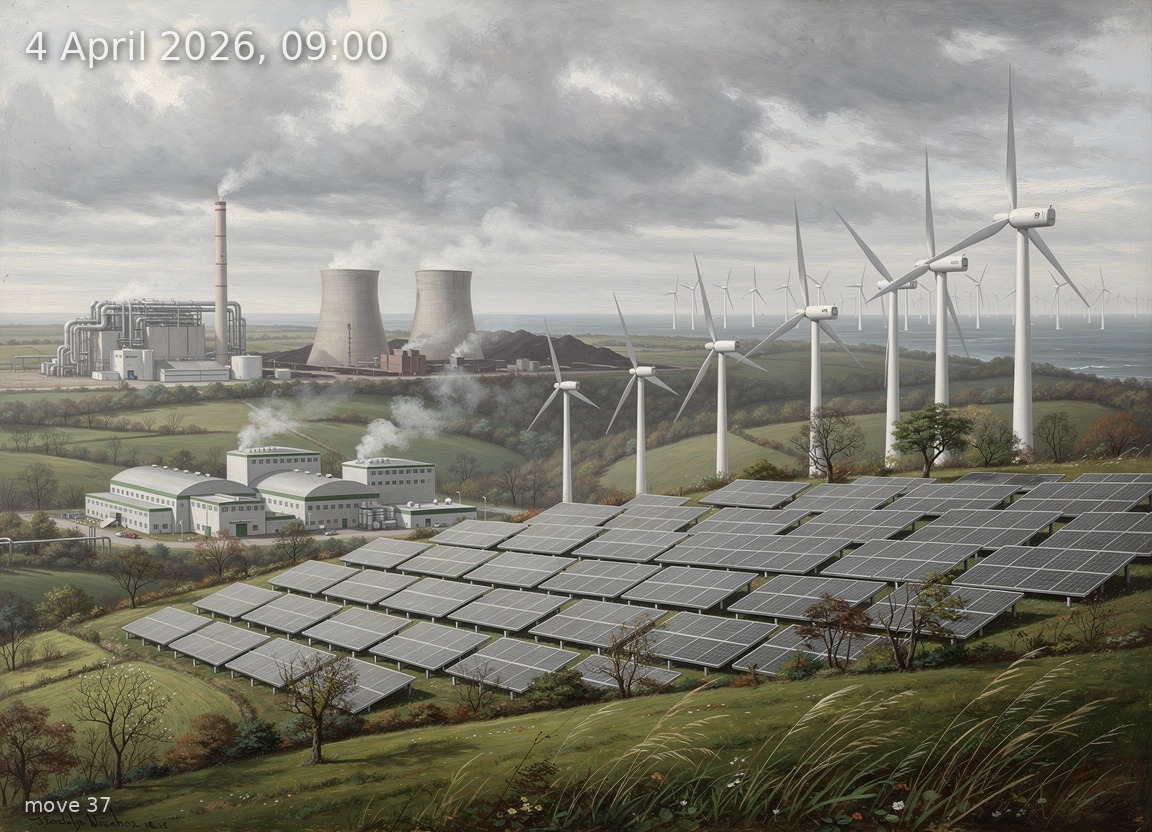
Strong onshore wind drives 86% renewable share and net exports under full overcast, collapsing day-ahead prices.
Back
Generation mix
Wind onshore 48%
Wind offshore 10%
Solar 19%
Biomass 8%
Hydro 2%
Natural gas 6%
Hard coal 3%
Brown coal 4%
86%
Renewable share
33.7 GW
Wind (on + offshore)
11.1 GW
Solar
58.3 GW
Total generation
+4.3 GW
Net export
6.6 €/MWh
Day-ahead price
11.1°C / 20 km/h
Temp / Wind speed
Open-Meteo, Kassel (51.3°N 9.5°E)
100.0% / 0.0 W/m²
Cloud cover / Radiation
90
gCO₂/kWh
Image prompt
Wind onshore 27.9 GW dominates the scene as vast ranks of three-blade turbines with white tubular towers and detailed nacelles stretching across rolling central German hills, occupying roughly half the canvas from centre to right; wind offshore 5.8 GW appears as a distant row of larger turbines on the far-right horizon above a grey North Sea sliver; solar 11.1 GW is rendered as extensive fields of aluminium-framed crystalline silicon PV panels on gentle south-facing slopes in the centre-left foreground, their surfaces reflecting only flat grey light—no sun visible; biomass 4.6 GW is depicted as a cluster of medium-scale wood-chip power plants with green-trimmed buildings and modest steam exhaust at left-centre; natural gas 3.5 GW appears as a compact modern CCGT facility with a single tall exhaust stack and thin vapour plume at the left; brown coal 2.6 GW shows a pair of hyperbolic cooling towers with light wispy steam plumes behind the gas plant on the far left; hard coal 1.9 GW is a smaller conventional power station with a single square stack beside the lignite towers; hydro 1.0 GW is suggested by a small dam and reservoir glimpsed in a valley in the distant left background. The sky is entirely overcast with a uniform blanket of thick stratocumulus clouds, lit by full but diffuse April morning daylight at 09:00—no sun disk, no shadows, a cool silvery-grey luminosity. The air feels damp at 11°C; early spring vegetation covers the hills in fresh pale greens and bare-budding deciduous trees. Wind at 20 km/h animates the turbine blades with visible rotational blur and bends young grasses. The low electricity price evokes a calm, expansive, open atmosphere. Painted in the style of a highly detailed 19th-century German Romantic oil painting—rich layered colour, visible confident brushwork, atmospheric aerial perspective receding into misty distance—yet every turbine nacelle, every PV cell grid line, every cooling tower hyperbolic curve is rendered with meticulous engineering accuracy. No text, no labels.