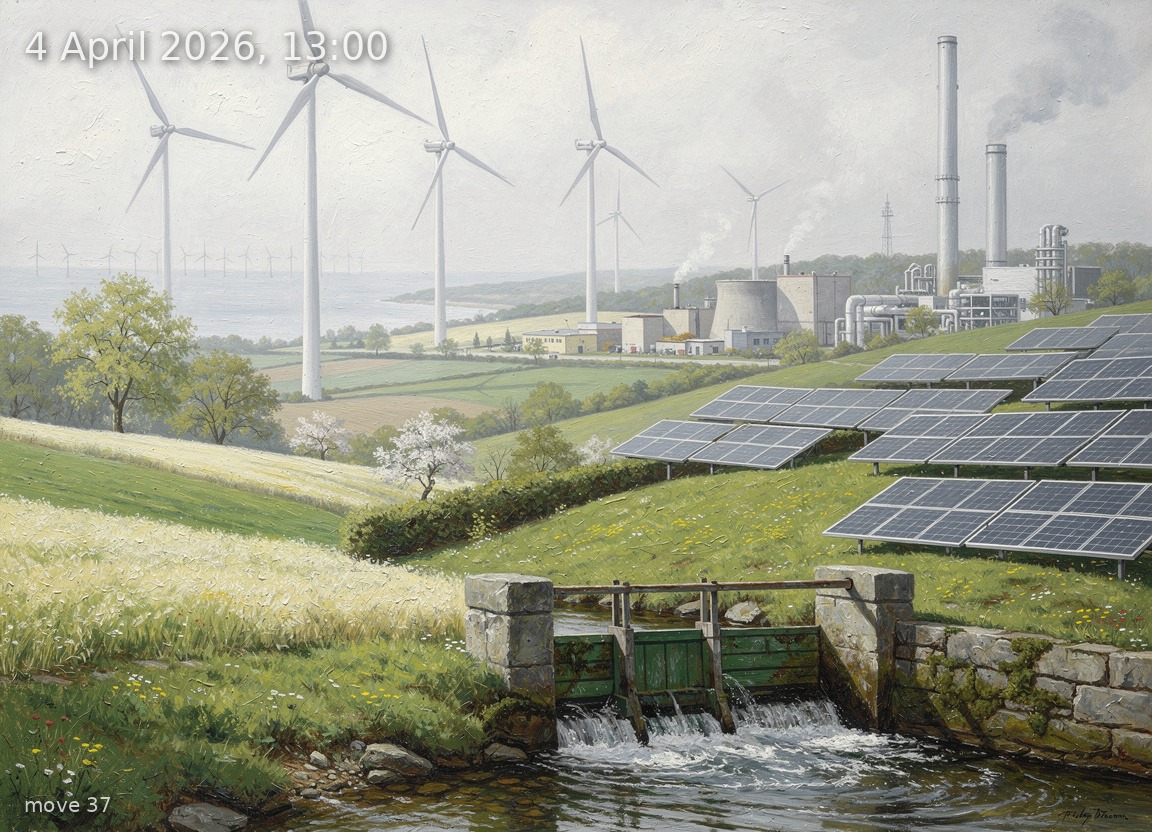
Wind and solar dominate at 48.5 GW combined, driving 9.6 GW net export and a near-zero clearing price.
Back
Generation mix
Wind onshore 34%
Wind offshore 6%
Solar 43%
Biomass 7%
Hydro 2%
Natural gas 4%
Hard coal 2%
Brown coal 3%
91%
Renewable share
25.1 GW
Wind (on + offshore)
26.9 GW
Solar
62.9 GW
Total generation
+9.6 GW
Net export
-0.0 €/MWh
Day-ahead price
13.1°C / 17 km/h
Temp / Wind speed
Open-Meteo, Kassel (51.3°N 9.5°E)
100.0% / 161.5 W/m²
Cloud cover / Radiation
58
gCO₂/kWh
Image prompt
Solar 26.9 GW dominates the right half of the canvas as vast fields of aluminium-framed crystalline silicon PV panels stretching across gentle green spring hillsides under diffuse midday light filtered through full overcast; wind onshore 21.6 GW fills the centre-left as dozens of tall three-blade turbines with white tubular towers and nacelles, blades turning steadily in moderate wind across rolling farmland with early April pale-green wheat; wind offshore 3.5 GW appears as a distant row of turbines on a hazy horizon line at far left; biomass 4.2 GW is rendered as a cluster of mid-scale wood-chip CHP plants with modest chimneys and small steam wisps in the middle distance; natural gas 2.6 GW sits as a compact modern CCGT facility with twin exhaust stacks and minimal exhaust plumes tucked behind a hedgerow; brown coal 2.0 GW appears as a pair of hyperbolic concrete cooling towers with thin, nearly transparent steam wisps, partially obscured behind spring trees at far left background; hard coal 1.0 GW is a single smaller coal stack barely visible beside the cooling towers; hydro 1.1 GW is a small run-of-river weir with green mossy sluice gates on a stream in the foreground. The sky is uniformly overcast at 100% cloud cover yet bright—flat white-grey cumulus layer lit from above, 13°C spring atmosphere, no direct sun visible but strong diffuse illumination casting soft shadowless light. Vegetation is early spring: fresh pale-green buds on deciduous trees, bright green meadows, a few wildflowers. The atmosphere is calm and open, reflecting the near-zero electricity price. Highly detailed oil painting in the tradition of 19th-century German Romantic landscape painters—Caspar David Friedrich meets industrial modernity—rich colour palette of soft greens, cool greys, and creamy whites, visible impasto brushwork, atmospheric aerial perspective with depth receding to a misty horizon, meticulous engineering detail on every turbine nacelle, panel frame, and cooling tower. No text, no labels.