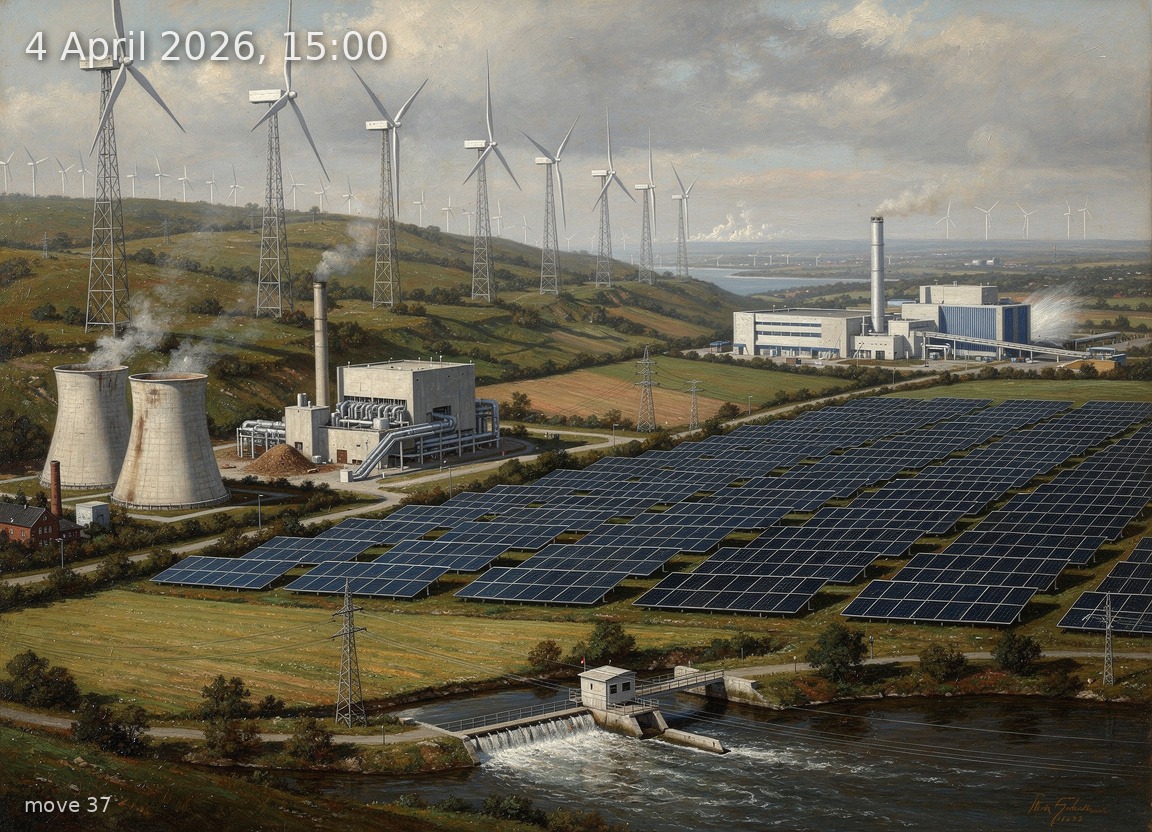
Wind and solar together exceed 46 GW under overcast skies, pushing net exports to 4.7 GW and clearing price to zero.
Back
Generation mix
Wind onshore 36%
Wind offshore 5%
Solar 41%
Biomass 7%
Hydro 2%
Natural gas 4%
Hard coal 1%
Brown coal 3%
92%
Renewable share
23.3 GW
Wind (on + offshore)
23.2 GW
Solar
56.4 GW
Total generation
+4.7 GW
Net export
0.0 €/MWh
Day-ahead price
14.0°C / 14 km/h
Temp / Wind speed
Open-Meteo, Kassel (51.3°N 9.5°E)
100.0% / 107.5 W/m²
Cloud cover / Radiation
54
gCO₂/kWh
Image prompt
Solar 23.2 GW dominates the right half of the scene as vast fields of aluminium-framed crystalline silicon photovoltaic panels stretching across gentle rolling farmland toward the horizon; wind onshore 20.6 GW fills the upper-left and centre-left as dozens of tall three-blade turbines with white nacelles and lattice towers marching across hilltops, blades turning steadily in moderate wind; wind offshore 2.8 GW appears in the far background-left as a cluster of turbines rising from a misty distant plain suggesting the northern coast; biomass 4.2 GW is rendered as a medium-sized wood-chip power station with a squat industrial building and a single exhaust stack emitting light grey steam, placed in the centre-left middle ground; natural gas 2.0 GW appears as a compact CCGT plant with a slender exhaust stack and modest heat shimmer, tucked behind the biomass facility; brown coal 1.9 GW is depicted as a pair of hyperbolic cooling towers with thin wisps of white steam, small in scale, positioned at the far left edge; hard coal 0.6 GW is a single small smokestack barely visible behind the cooling towers; hydro 1.1 GW is a low weir with a small powerhouse along a river winding through the centre foreground. The sky is entirely overcast — a uniform blanket of pale grey-white clouds with no blue patches and no direct sunlight, yet the scene is fully lit in the flat, bright, diffuse daylight of a mid-afternoon spring day under total cloud cover. The landscape is early spring: fresh green grass emerging, budding deciduous trees, a few patches of yellow rapeseed beginning to bloom. Temperature is mild at 14 °C — no frost, no haze. The atmosphere is calm and expansive, reflecting a zero-price hour: the air feels open, unburdened, spacious. Rendered as a highly detailed oil painting in the tradition of 19th-century German Romantic landscape masters — rich impasto brushwork, luminous atmospheric depth, meticulous engineering detail on every turbine nacelle, every PV module frame, every cooling tower's parabolic curve — a grand industrial pastoral. No text, no labels.