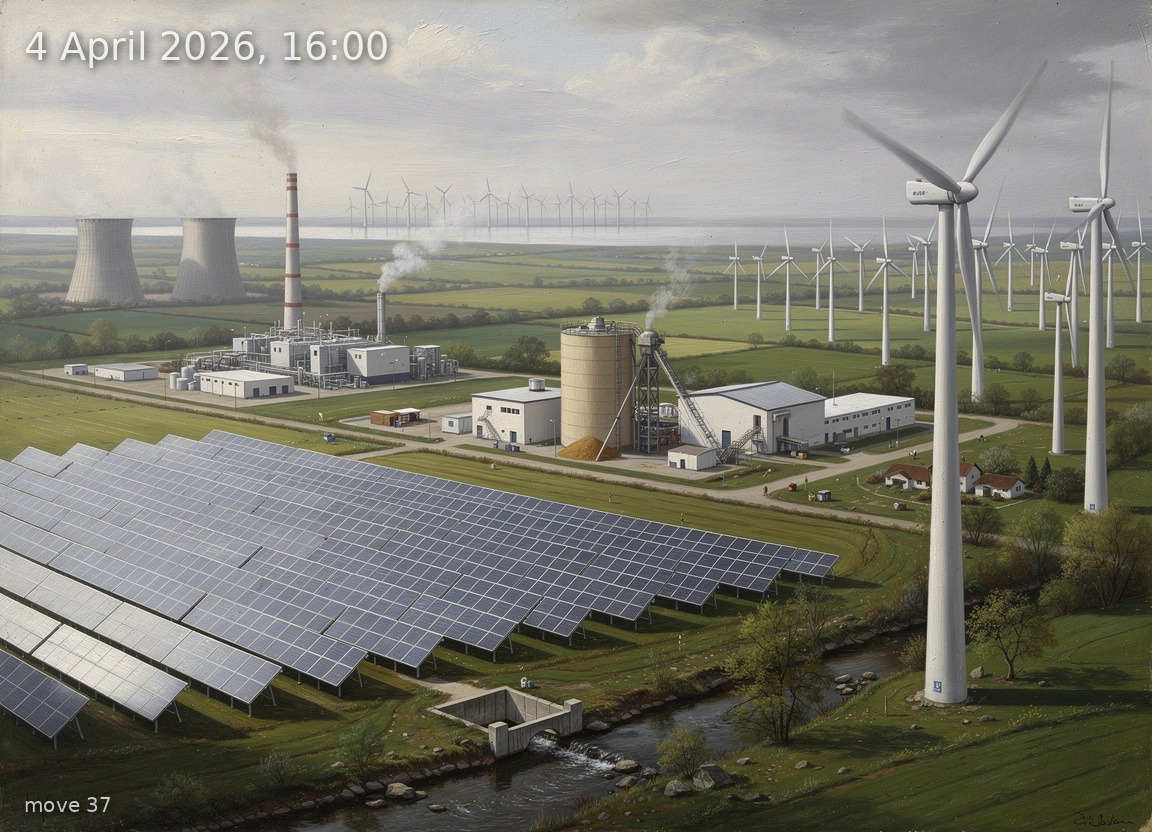
Wind onshore and diffuse solar dominate at 91% renewable share, pushing day-ahead prices to 10.7 EUR/MWh under full overcast.
Back
Generation mix
Wind onshore 38%
Wind offshore 5%
Solar 37%
Biomass 8%
Hydro 2%
Natural gas 4%
Hard coal 1%
Brown coal 4%
91%
Renewable share
22.2 GW
Wind (on + offshore)
19.0 GW
Solar
51.0 GW
Total generation
-0.6 GW
Net import
10.7 €/MWh
Day-ahead price
13.1°C / 14 km/h
Temp / Wind speed
Open-Meteo, Kassel (51.3°N 9.5°E)
100.0% / 36.0 W/m²
Cloud cover / Radiation
60
gCO₂/kWh
Image prompt
Wind onshore 19.6 GW dominates the right half of the scene as vast ranks of three-blade turbines with white tubular towers and detailed nacelles stretching across rolling green spring fields; solar 19.0 GW fills the centre-left foreground as enormous arrays of aluminium-framed crystalline silicon PV panels on open farmland reflecting soft grey light; offshore wind 2.6 GW appears as a distant cluster of taller turbines on the far horizon above a faint river; biomass 4.2 GW is rendered as a mid-ground industrial facility with a tall wooden-chip silo and a modest steam stack; natural gas 2.0 GW appears as a compact CCGT plant with a single slender exhaust stack and faint heat shimmer near the left edge; brown coal 1.9 GW is a pair of small hyperbolic cooling towers with thin wisps of steam in the far left background; hard coal 0.7 GW is a single smaller conventional stack barely visible behind the lignite towers; hydro 1.0 GW is suggested by a small weir and penstock structure along a stream in the near foreground. The sky is entirely overcast with a thick uniform blanket of pale grey clouds, full April daylight at 16:00 — bright but completely diffuse, no shadows, no direct sun, soft even illumination. Temperature is mild at 13°C: fresh green grass, early spring buds on scattered deciduous trees, a calm unhurried atmosphere. Wind at 13.7 km/h gently bends the grass and slightly blurs turbine blade tips in motion. The low electricity price is reflected in an open, serene, uncrowded composition with generous sky. Highly detailed oil painting in the tradition of 19th-century German Romantic landscape painters — Caspar David Friedrich's atmospheric depth merged with meticulous industrial-engineering accuracy: visible brushwork, rich layered colour in greens, greys, and muted silvers, luminous cloud texture, each technology rendered with correct engineering detail including turbine blade profiles, panel cell grids, cooling tower parabolic curves, and CCGT exhaust geometry. No text, no labels.