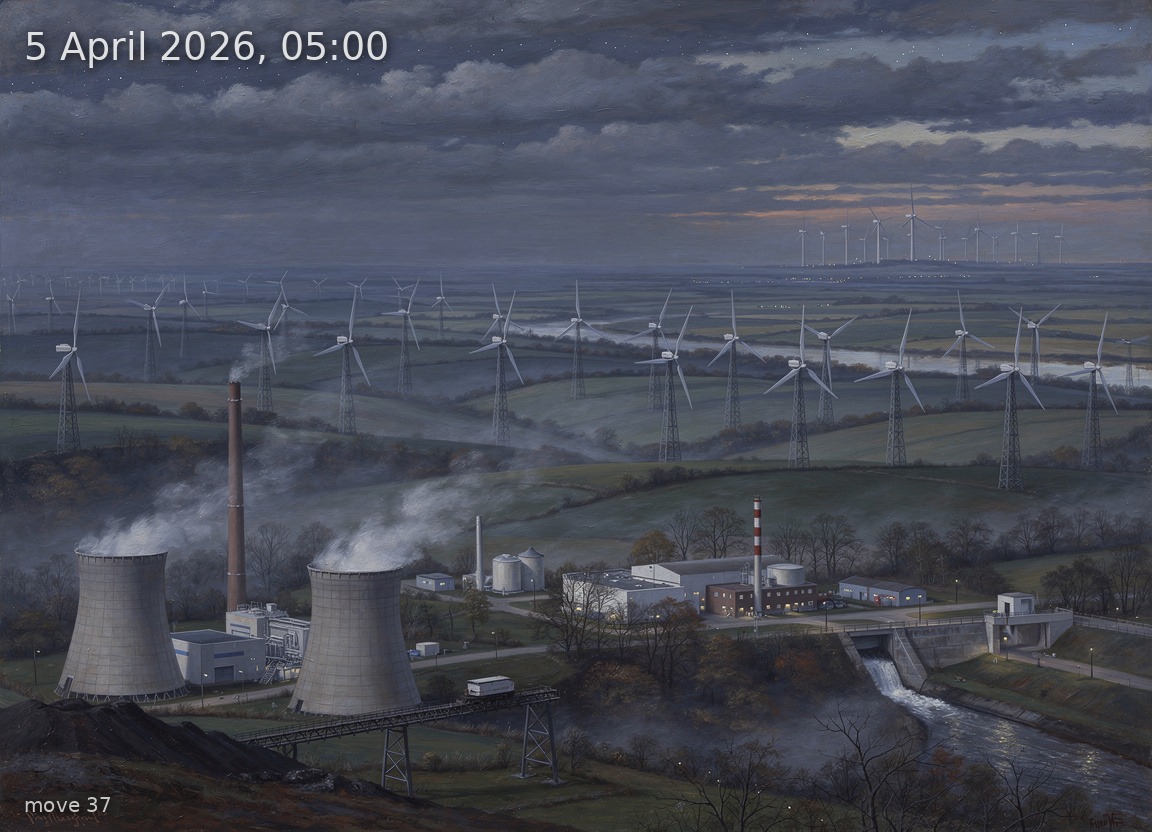
Strong onshore wind drives 90% renewable generation at 05:00, pushing 14.6 GW of net exports and prices negative.
Back
Generation mix
Wind onshore 70%
Wind offshore 11%
Biomass 8%
Hydro 2%
Natural gas 4%
Hard coal 2%
Brown coal 4%
90%
Renewable share
42.9 GW
Wind (on + offshore)
0.0 GW
Solar
53.3 GW
Total generation
+14.7 GW
Net export
-2.0 €/MWh
Day-ahead price
10.5°C / 26 km/h
Temp / Wind speed
Open-Meteo, Kassel (51.3°N 9.5°E)
100.0% / 0.0 W/m²
Cloud cover / Radiation
65
gCO₂/kWh
Image prompt
Wind onshore 37.3 GW dominates the scene as vast rows of three-blade turbines with lattice towers and detailed nacelles stretching across rolling central German hills, occupying roughly 70% of the panorama; wind offshore 5.6 GW appears as a distant cluster of taller turbines on the far horizon line above a faint suggestion of the North Sea coast; brown coal 2.0 GW occupies the lower-left as a pair of hyperbolic cooling towers emitting thin steam plumes beside a lignite conveyor; natural gas 2.0 GW sits beside them as a compact CCGT facility with a single tall exhaust stack and modest heat shimmer; hard coal 1.1 GW appears as a smaller conventional power station with a single rectangular chimney; biomass 4.2 GW is rendered as a mid-sized industrial plant with cylindrical silos and a low smokestack, set among bare early-spring trees; hydro 1.0 GW is suggested by a small dam structure with a spillway gleaming faintly in artificial light at the far right edge. Time is pre-dawn 05:00 in early April: the sky is deep blue-grey with the faintest pale luminescence creeping along the eastern horizon, no direct sunlight, no orange glow, stars still faintly visible overhead through breaks that barely exist in the 100% overcast—heavy layered stratus clouds blanketing nearly the entire sky. The wind is clearly strong at 26.5 km/h: turbine blades show motion blur, grass and young spring vegetation bend visibly, steam plumes from the cooling towers shear sharply sideways. Temperature is mild at 10.5°C—no frost, early green growth on the hillsides, bare branches beginning to bud. The negative price and calm energy surplus lend the atmosphere a serene, open, unhurried quality despite the overcast. Sodium-orange streetlights and warm industrial lighting illuminate the power stations from below. Rendered as a highly detailed oil painting in the tradition of 19th-century German Romantic landscape painters—rich, deep colour palette of navy, slate-blue, muted green and amber; visible impasto brushwork; atmospheric depth with misty layers receding into distance; meticulous engineering accuracy on every turbine nacelle, cooling tower, and exhaust stack. No text, no labels.