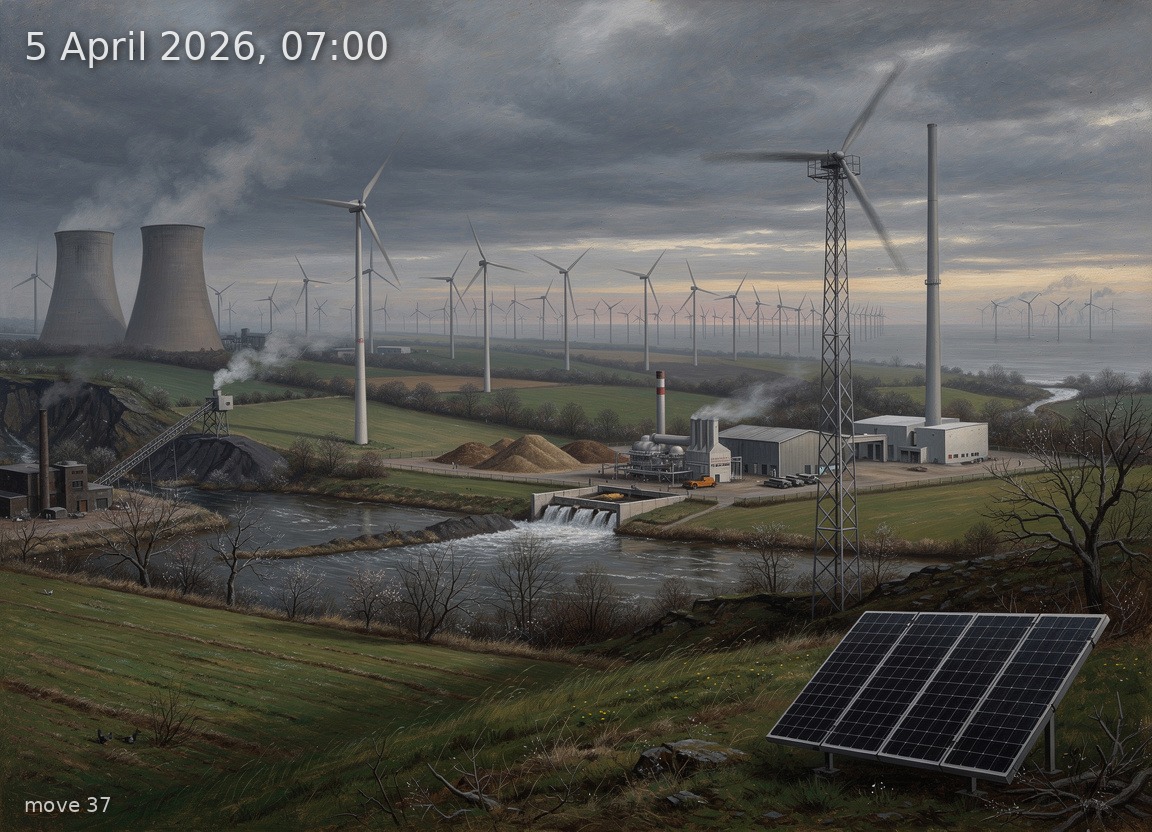
Massive onshore wind dominance at 38.8 GW drives 16.8 GW net export and negative prices under full overcast.
Back
Generation mix
Wind onshore 67%
Wind offshore 9%
Solar 5%
Biomass 8%
Hydro 2%
Natural gas 4%
Hard coal 2%
Brown coal 4%
91%
Renewable share
44.2 GW
Wind (on + offshore)
2.8 GW
Solar
57.7 GW
Total generation
+16.8 GW
Net export
-1.3 €/MWh
Day-ahead price
10.5°C / 30 km/h
Temp / Wind speed
Open-Meteo, Kassel (51.3°N 9.5°E)
100.0% / 0.0 W/m²
Cloud cover / Radiation
60
gCO₂/kWh
Image prompt
Wind onshore 38.8 GW dominates the scene, filling roughly two-thirds of the panorama as hundreds of three-blade turbines on lattice and tubular steel towers stretching across rolling central-German farmland, rotors spinning hard in strong wind, blades visibly blurred with motion. Wind offshore 5.4 GW appears in the distant background right as a cluster of larger turbines rising from a hazy grey sea horizon. Biomass 4.5 GW is rendered as a mid-ground wood-chip-fed power station with a modest stack and wispy white exhaust plume. Solar 2.8 GW is shown as a small field of aluminium-framed crystalline silicon panels in the near foreground, their surfaces dark and matte under the overcast, reflecting no sunlight. Brown coal 2.1 GW occupies the far left as a pair of hyperbolic cooling towers with thin, lazy steam plumes, flanked by a conveyor belt of lignite. Natural gas 2.1 GW sits beside the lignite plant as a compact CCGT block with a single slender exhaust stack, barely any visible exhaust. Hard coal 1.0 GW is a smaller single stack with a tiny dark plume at the scene's leftmost edge. Hydro 1.1 GW appears as a small run-of-river weir and powerhouse along a swollen stream in the middle ground. The sky is dawn at 07:00 in early April: deep blue-grey pre-dawn light brightening to pale steel-grey near the eastern horizon, entirely overcast with a thick unbroken cloud layer, no sun visible, no warm colours. The landscape is early spring—bare deciduous trees just starting to bud, fresh green grass on fields, patches of last winter's brown. Wind bends the young grass and rattles bare branches. The atmosphere feels calm and expansive despite the powerful wind, reflecting the negative electricity price—open, unburdened, almost serene. Highly detailed oil painting in the tradition of 19th-century German Romantic landscape art—Caspar David Friedrich meets industrial realism—rich tonal palette of greys, slate blues, muted greens, and earth tones, visible confident brushwork, atmospheric perspective fading the offshore turbines into mist, meticulous engineering accuracy on every turbine nacelle, every cooling tower curve, every PV cell grid. No text, no labels.