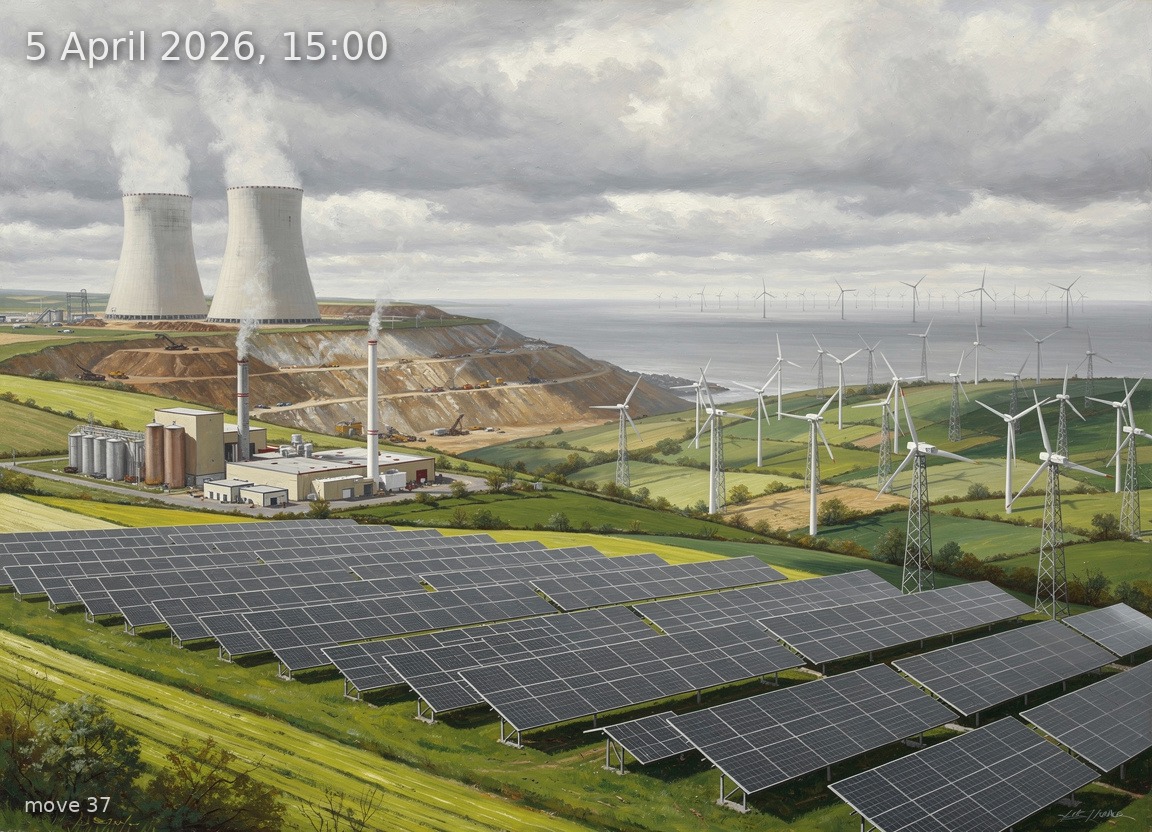
Wind (39.4 GW) and solar (27.7 GW) drive 33.7 GW net exports and deeply negative prices under full overcast.
Back
Generation mix
Wind onshore 44%
Wind offshore 8%
Solar 36%
Biomass 5%
Hydro 1%
Natural gas 2%
Hard coal 1%
Brown coal 3%
94%
Renewable share
39.4 GW
Wind (on + offshore)
27.7 GW
Solar
77.0 GW
Total generation
+33.7 GW
Net export
-66.9 €/MWh
Day-ahead price
15.8°C / 30 km/h
Temp / Wind speed
Open-Meteo, Kassel (51.3°N 9.5°E)
100.0% / 92.8 W/m²
Cloud cover / Radiation
43
gCO₂/kWh
Image prompt
Wind onshore 33.5 GW dominates the scene as vast ranks of three-blade turbines on lattice and tubular towers stretching across rolling green spring hills from the centre to the far right, rotors spinning vigorously in strong wind; wind offshore 5.9 GW appears as a distant line of larger turbines on the hazy horizon above a grey North Sea glimpsed through a gap in the terrain; solar 27.7 GW fills the left-centre foreground and middle ground as enormous fields of aluminium-framed crystalline silicon photovoltaic panels angled on metal racks across flat farmland, reflecting the diffuse grey-white light of a fully overcast sky; biomass 4.0 GW is rendered as a cluster of modest industrial buildings with wood-chip silos and a single smokestack emitting thin white vapour in the left middle ground; brown coal 2.5 GW appears as two hyperbolic concrete cooling towers with gentle steam plumes rising into the cloud base, set behind a lignite excavation pit in the far left background; natural gas 1.8 GW is a compact combined-cycle gas turbine plant with a tall single exhaust stack and a smaller heat-recovery steam generator beside it, tucked between the biomass facility and the cooling towers; hydro 1.0 GW is a small dam with a spillway visible in a valley in the far right background; hard coal 0.5 GW is a single darkened industrial stack barely smoking at the far edge of the brown coal complex. The sky is entirely covered by a thick, uniform blanket of stratus clouds at 15:00 in early April — full diffuse daylight, bright but shadowless, no direct sun visible. The atmosphere feels calm and open despite the overcast, with an almost surreal tranquility reflecting the deeply negative electricity price. Spring vegetation: fresh bright-green grass, early leaf buds on scattered deciduous trees, fields of young crops between the solar arrays. Wind bends the grass and young tree branches visibly. Style: highly detailed oil painting in the tradition of 19th-century German Romantic landscape painters — Caspar David Friedrich's compositional grandeur merged with meticulous industrial-age technical accuracy — rich colour palette of soft greens, steel greys, cream whites, visible confident brushwork, atmospheric aerial perspective receding into the clouded distance. No text, no labels.