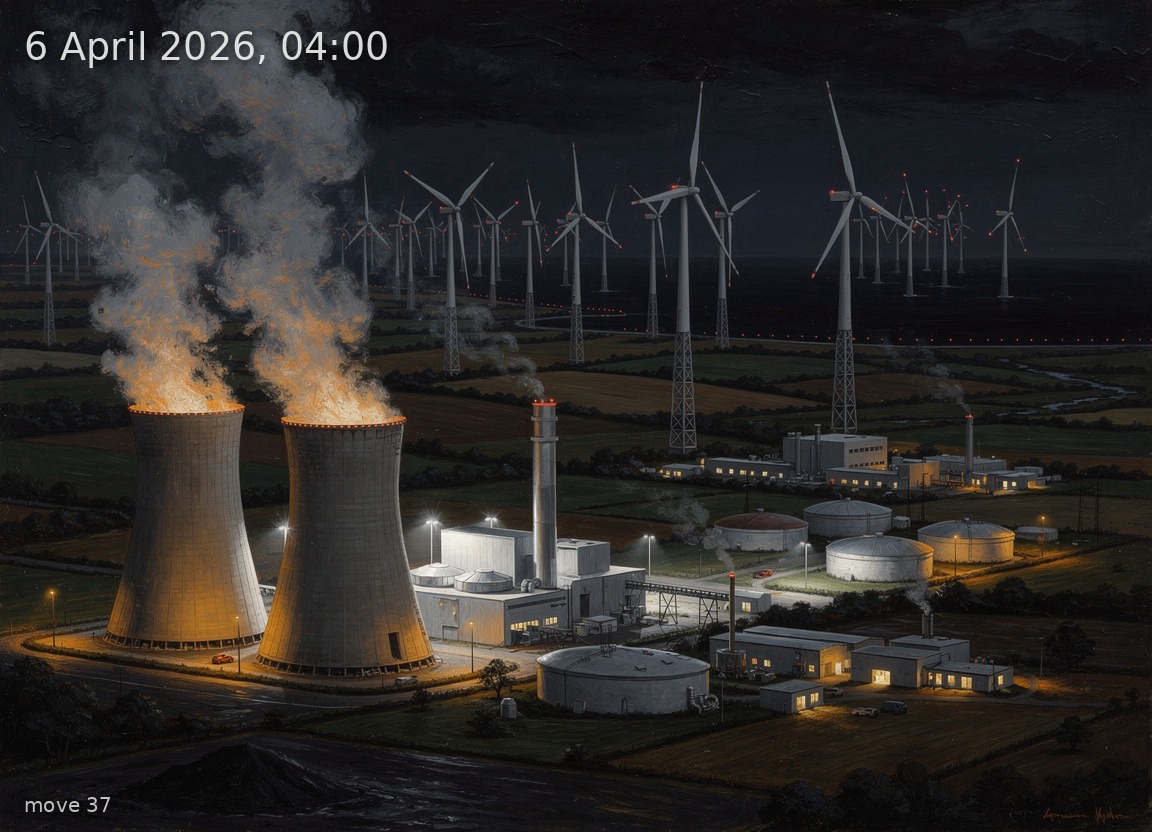
Wind power at 32.4 GW drives overnight oversupply, collapsing prices as Germany net-exports 4.2 GW.
Back
Generation mix
Wind onshore 61%
Wind offshore 14%
Biomass 10%
Hydro 3%
Natural gas 5%
Hard coal 3%
Brown coal 5%
87%
Renewable share
32.4 GW
Wind (on + offshore)
0.0 GW
Solar
43.4 GW
Total generation
+4.2 GW
Net export
1.1 €/MWh
Day-ahead price
6.5°C / 15 km/h
Temp / Wind speed
Open-Meteo, Kassel (51.3°N 9.5°E)
100.0% / 0.0 W/m²
Cloud cover / Radiation
87
gCO₂/kWh
Image prompt
Wind onshore 26.3 GW dominates the scene, filling roughly 60% of the canvas as vast ranks of three-blade turbines on lattice towers stretching across rolling central-German farmland into deep darkness, rotors spinning briskly in moderate wind. Wind offshore 6.1 GW appears in the far background right as a cluster of larger offshore turbines on monopile foundations, their red aviation warning lights blinking against a black sea horizon. Brown coal 2.1 GW occupies the lower left as a pair of hyperbolic cooling towers releasing thick white steam plumes lit from below by amber sodium lamps. Natural gas 2.2 GW sits beside them as a compact CCGT plant with a single tall exhaust stack and a faint heat shimmer, illuminated by industrial floodlights. Hard coal 1.3 GW appears as a smaller conventional power station with a rectangular boiler house and conveyor belt, its stack emitting a thin grey ribbon. Biomass 4.1 GW is rendered as several mid-sized biomass CHP facilities with squat cylindrical digesters and small chimneys, warm yellow light glowing through facility windows, placed in the centre-right middle ground. Hydro 1.2 GW is a small run-of-river weir with a low concrete dam and turbine house, visible in the foreground where a river crosses the scene, lit by a single security light. Time is 4:00 AM — the sky is completely black to deep navy, no twilight, no moon glow, 100% cloud cover obscuring all stars; the only illumination comes from artificial sources: sodium-orange streetlights along a country road, the industrial floodlighting of the thermal plants, and the red aviation warning lights atop the turbine nacelles. Early spring vegetation: bare deciduous trees with the faintest buds, damp green grass, patches of lingering frost. The atmosphere is calm and tranquil, reflecting the near-zero electricity price — open, unhurried, spacious composition. Style: highly detailed oil painting in the tradition of 19th-century German Romantic landscape masters such as Caspar David Friedrich and Carl Blechen, with rich dark tones, visible impasto brushwork, and deep atmospheric perspective. Each technology rendered with meticulous engineering accuracy — three-blade rotors with correct nacelle housings, aluminium-clad CCGT exhaust stacks, hyperbolic concrete cooling towers with condensation plumes. No text, no labels, no people prominent.