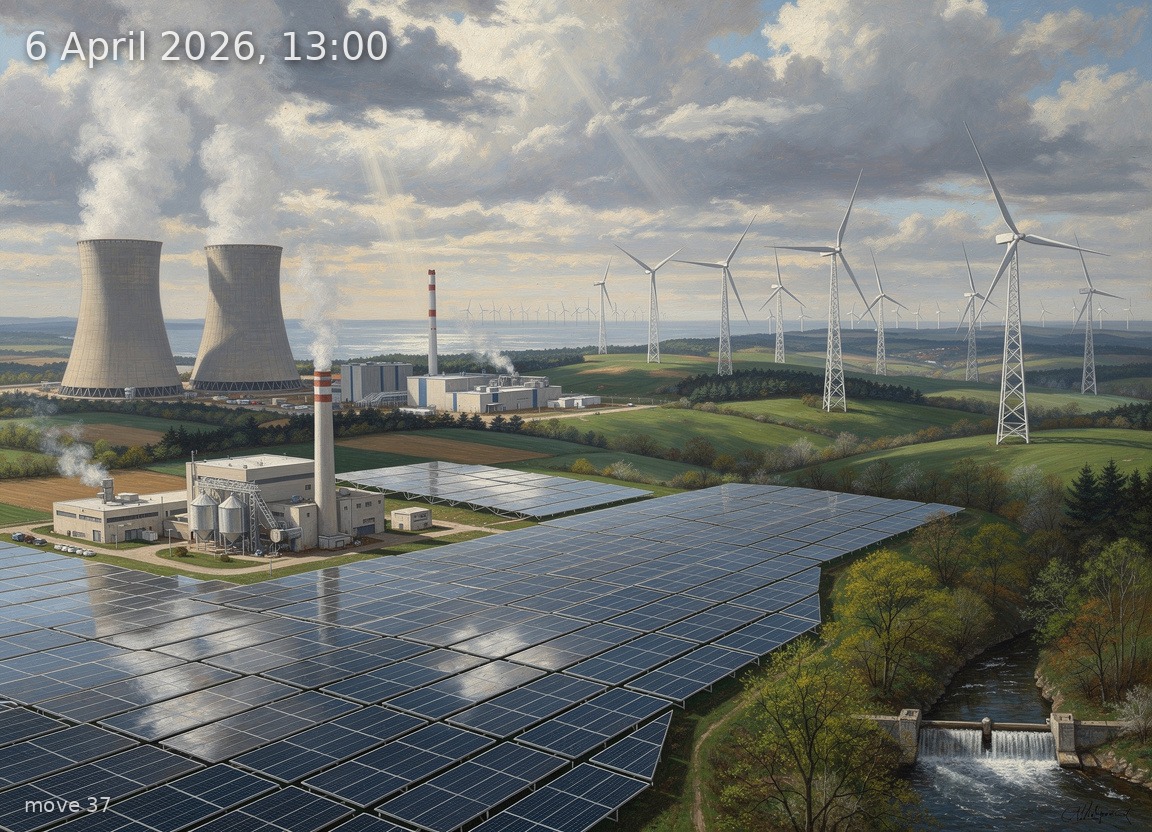
Solar at 44.7 GW and wind at 22.2 GW drive 27.7 GW net export and deeply negative prices.
Back
Generation mix
Wind onshore 24%
Wind offshore 5%
Solar 59%
Biomass 5%
Hydro 1%
Natural gas 2%
Hard coal 1%
Brown coal 3%
94%
Renewable share
22.2 GW
Wind (on + offshore)
44.7 GW
Solar
76.4 GW
Total generation
+27.7 GW
Net export
-125.6 €/MWh
Day-ahead price
12.1°C / 16 km/h
Temp / Wind speed
Open-Meteo, Kassel (51.3°N 9.5°E)
78.0% / 396.0 W/m²
Cloud cover / Radiation
40
gCO₂/kWh
Image prompt
Solar 44.7 GW dominates the scene as a vast expanse of crystalline silicon photovoltaic panels stretching across rolling farmland occupying well over half the canvas; wind onshore 18.4 GW appears as dozens of tall three-blade turbines with white lattice towers marching across gentle green hills behind the panels; wind offshore 3.8 GW is visible as a distant cluster of turbines on the hazy horizon over a sliver of northern sea; biomass 4.0 GW is rendered as a modest wood-chip power station with a tall stack and small steam wisp at the mid-left; brown coal 2.1 GW appears as a pair of hyperbolic cooling towers with lazy steam plumes in the far left background; natural gas 1.8 GW is a compact CCGT plant with a single exhaust stack and thin heat shimmer beside the cooling towers; hydro 1.0 GW is suggested by a small dam and spillway in a wooded valley at the far right edge; hard coal 0.5 GW is a single modest smokestack barely visible behind the biomass plant. Time is 1 PM in early April: full daylight but a high broken cloud layer covers 78% of the sky, letting shafts of bright direct sunlight break through in dramatic crepuscular rays that illuminate the solar panels in brilliant white reflections while other sections sit under diffuse grey-blue cloud shadow. The atmosphere is calm and luminous, not oppressive — the deeply negative price conveyed by an open, almost excessively bright sky with surplus light flooding the landscape. Spring vegetation: fresh pale-green budding trees, wildflowers in meadow strips between panel rows, temperature around 12 °C suggested by people in light jackets. Moderate wind animates the turbine blades and bends young grass. Style: highly detailed oil painting in the tradition of 19th-century German Romantic landscape painters such as Caspar David Friedrich and Carl Blechen — rich layered colour, visible confident brushwork, atmospheric depth with aerial perspective fading distant elements into haze, dramatic chiaroscuro where sunbeams pierce clouds. Every energy technology rendered with meticulous engineering accuracy: turbine nacelles, aluminium PV frames, hyperbolic concrete cooling tower ribbing, CCGT exhaust geometry. The composition feels like a monumental masterwork landscape of an industrial Arcadia — no text, no labels.