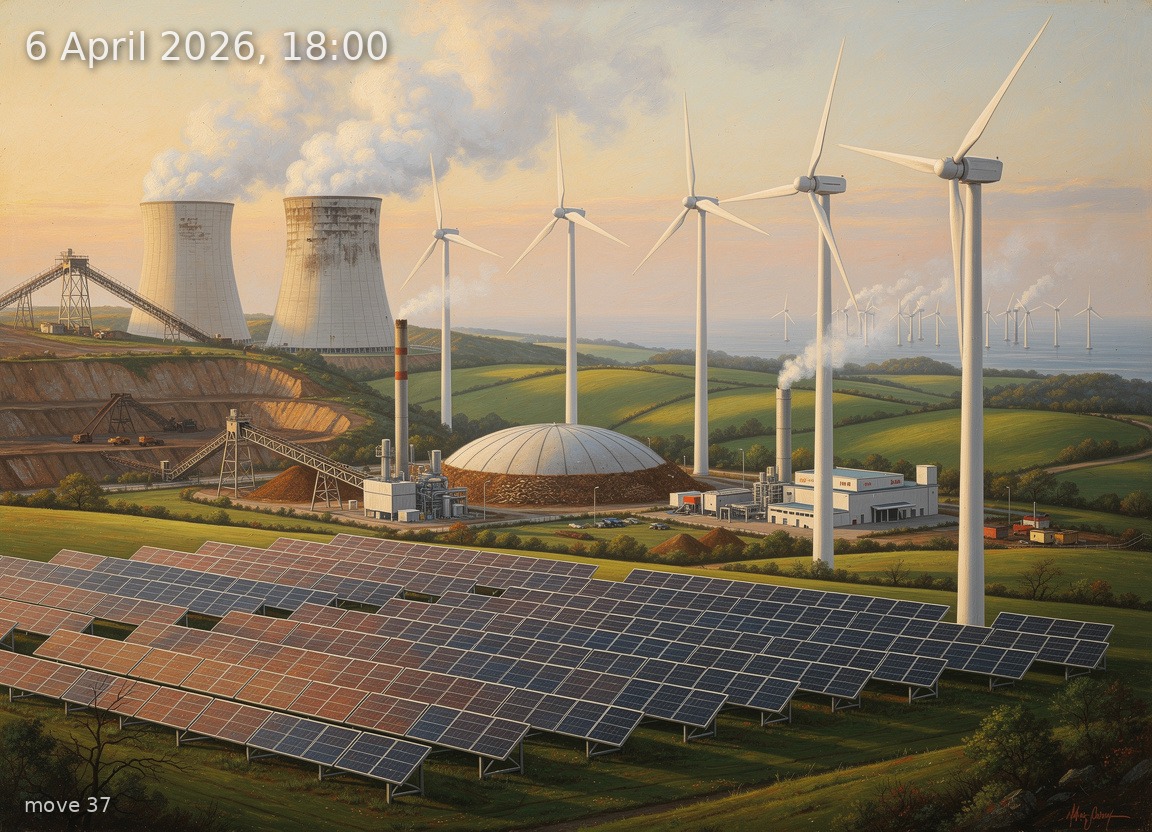
Strong onshore wind and late solar dominate at 88% renewables; 7.4 GW net imports cover the evening demand gap.
Back
Generation mix
Wind onshore 44%
Wind offshore 8%
Solar 23%
Biomass 10%
Hydro 3%
Natural gas 5%
Hard coal 1%
Brown coal 5%
88%
Renewable share
21.6 GW
Wind (on + offshore)
9.6 GW
Solar
41.3 GW
Total generation
-7.4 GW
Net import
48.6 €/MWh
Day-ahead price
13.1°C / 16 km/h
Temp / Wind speed
Open-Meteo, Kassel (51.3°N 9.5°E)
35.0% / 209.0 W/m²
Cloud cover / Radiation
79
gCO₂/kWh
Image prompt
Wind onshore 18.3 GW dominates the scene as vast ranks of three-blade turbines with white tubular towers and detailed nacelles stretching across rolling green hills from the centre to the far right, their rotors turning briskly in moderate wind. Wind offshore 3.3 GW appears as a distant cluster of taller turbines on the hazy horizon over a sliver of grey-blue sea at the far right. Solar 9.6 GW fills the centre-left foreground as extensive rows of aluminium-framed crystalline silicon photovoltaic panels on metal racks across open farmland, catching the last orange-red rays of the setting sun. Biomass 4.2 GW is rendered as a mid-ground industrial facility with a wood-chip storage dome, conveyor belts, and a moderate smokestack with thin white exhaust. Brown coal 2.2 GW occupies the left background as two hyperbolic concrete cooling towers emitting thick white steam plumes, beside a lignite conveyor and a small open-pit mine edge. Natural gas 2.0 GW appears as a compact CCGT plant with a single tall exhaust stack and a modest heat-recovery unit, situated left of centre. Hydro 1.1 GW is a small concrete run-of-river weir with spillway visible along a river in the left foreground. Hard coal 0.6 GW is a single smaller smokestack with dark brick boiler house tucked behind the gas plant. The sky is a dusk scene at 18:00 in early April: the sun sits very low on the western horizon casting a deep orange-red glow along the lower sky, the upper sky transitions from warm amber near the horizon through soft violet to deepening blue overhead, with 35% cloud cover as scattered altocumulus clouds lit golden-pink from below. Spring vegetation: fresh bright-green grass, early leaf buds on scattered birch and linden trees, wildflowers beginning in meadows. Temperature is mild at 13°C—no frost, light jackets weather. The moderate 48.6 EUR/MWh price is reflected in a calm, balanced atmospheric mood—neither oppressive nor blissfully open. Style: highly detailed oil painting in the tradition of Caspar David Friedrich and Carl Blechen—rich saturated colour, visible confident brushwork, deep atmospheric perspective with golden Romantic light—but with meticulous engineering accuracy on every turbine nacelle, PV cell grid, cooling tower ribbing, and industrial detail. No text, no labels, no people prominent.