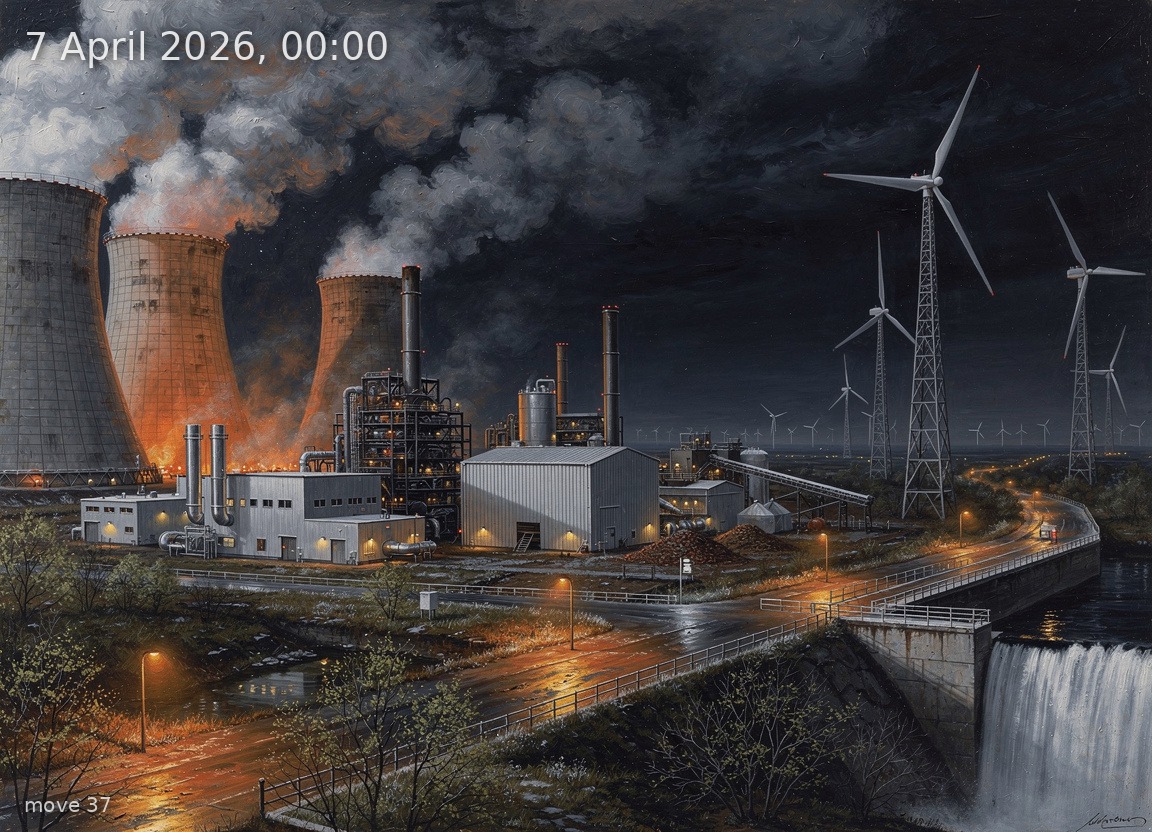
Wind and coal anchor overnight supply while 9.2 GW of net imports fill the gap under high prices.
Back
Generation mix
Wind onshore 34%
Wind offshore 6%
Biomass 12%
Hydro 4%
Natural gas 11%
Hard coal 14%
Brown coal 19%
56%
Renewable share
14.3 GW
Wind (on + offshore)
0.0 GW
Solar
35.8 GW
Total generation
-9.2 GW
Net import
106.4 €/MWh
Day-ahead price
5.8°C / 7 km/h
Temp / Wind speed
Open-Meteo, Kassel (51.3°N 9.5°E)
93.0% / 0.0 W/m²
Cloud cover / Radiation
317
gCO₂/kWh
Image prompt
Wind onshore 12.2 GW dominates the right half of the scene as dozens of tall three-blade turbines with visible nacelles and lattice towers, their rotors turning slowly against the night sky; brown coal 7.0 GW occupies the left foreground as massive hyperbolic cooling towers emitting thick steam plumes lit from below by furnace glow; hard coal 4.9 GW appears just right of the cooling towers as a cluster of dark industrial boiler houses with tall chimneys trailing grey smoke; natural gas 4.0 GW is rendered as compact CCGT units with single polished exhaust stacks and heat-recovery housings near the centre-left; biomass 4.3 GW sits in the centre as a collection of corrugated-metal plant buildings with short stacks and wood-chip conveyors; wind offshore 2.1 GW is visible in the far distance as smaller turbines on a dark horizon line suggesting the North Sea coast; hydro 1.3 GW appears as a concrete dam with a thin veil of white water at the far right edge. The sky is completely dark, deep navy to black, no twilight glow, no stars visible through 93% cloud cover, creating a heavy oppressive overcast ceiling reflecting the high electricity price. Sodium-orange streetlights cast pools of amber on wet early-spring ground with sparse budding trees. Temperature is 5.8 °C: faint frost on metal surfaces, breath-visible air around the cooling towers. No solar panels anywhere, no sunshine. The entire composition rendered as a highly detailed oil painting in the tradition of 19th-century German Romantic landscape painters — Caspar David Friedrich meets industrial sublime — with rich impasto brushwork, deep atmospheric perspective, dramatic chiaroscuro from furnace light against the black sky, meticulous engineering detail on every turbine nacelle, cooling tower flute, and exhaust stack. No text, no labels.