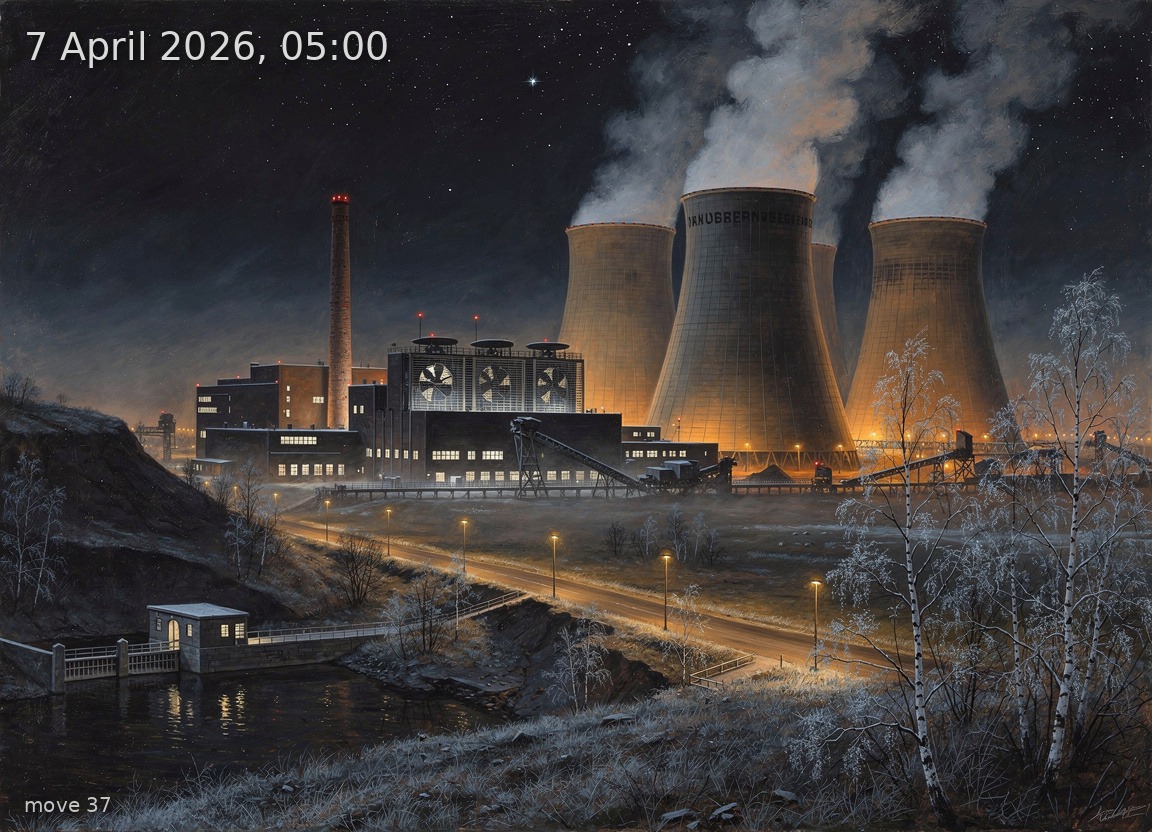
Wind and coal anchor overnight generation while 15 GW of net imports bridge a cold pre-dawn demand gap.
Back
Generation mix
Wind onshore 31%
Wind offshore 5%
Biomass 12%
Hydro 4%
Natural gas 14%
Hard coal 13%
Brown coal 21%
52%
Renewable share
12.3 GW
Wind (on + offshore)
0.0 GW
Solar
34.0 GW
Total generation
-14.9 GW
Net import
117.8 €/MWh
Day-ahead price
1.1°C / 2 km/h
Temp / Wind speed
Open-Meteo, Kassel (51.3°N 9.5°E)
0.0% / 0.0 W/m²
Cloud cover / Radiation
339
gCO₂/kWh
Image prompt
Wind onshore 10.6 GW dominates the right third of the scene as a vast field of three-blade turbines on lattice towers stretching across a flat northern German plain, their rotors turning slowly in barely perceptible air. Brown coal 7.1 GW occupies the left quarter as a massive lignite power station with three hyperbolic cooling towers emitting thick white steam plumes that drift vertically in the still air, lit from below by orange sodium lamps. Hard coal 4.5 GW appears as a coal-fired plant with rectangular mechanical-draft cooling towers and a tall brick chimney just left of centre. Natural gas 4.7 GW sits at centre as a compact CCGT facility with two slender exhaust stacks and gleaming steel turbine housings, vapour trailing upward. Biomass 4.1 GW is rendered as a mid-sized industrial plant with a cylindrical silo and a modest stack near the right-centre. Wind offshore 1.7 GW is visible as a distant cluster of turbines on the far-right horizon over a dark sea inlet. Hydro 1.3 GW appears as a small concrete dam structure nestled in low hills at the far left edge. No solar panels anywhere — it is fully dark. The sky is deep navy-black, completely clear with scattered stars and no hint of twilight yet; the temperature is near freezing, with frost visible on bare early-spring grass and leafless birch branches in the foreground. The atmosphere feels heavy and oppressive, reflecting the high electricity price — a low haze of industrial emissions hangs near the ground, tinted amber by sodium streetlights lining a road that cuts diagonally through the scene. Transmission pylons with high-voltage lines cross the middle distance, symbolising the heavy import flows. Style: highly detailed oil painting in the tradition of 19th-century German Romantic landscape painters — rich, dark colour palette of Prussian blue, burnt sienna, and amber; visible impasto brushwork; atmospheric depth with layers of industrial haze; meticulous engineering detail on every turbine nacelle, cooling tower, and exhaust stack. The mood is solemn and monumental, an industrial nocturne. No text, no labels.