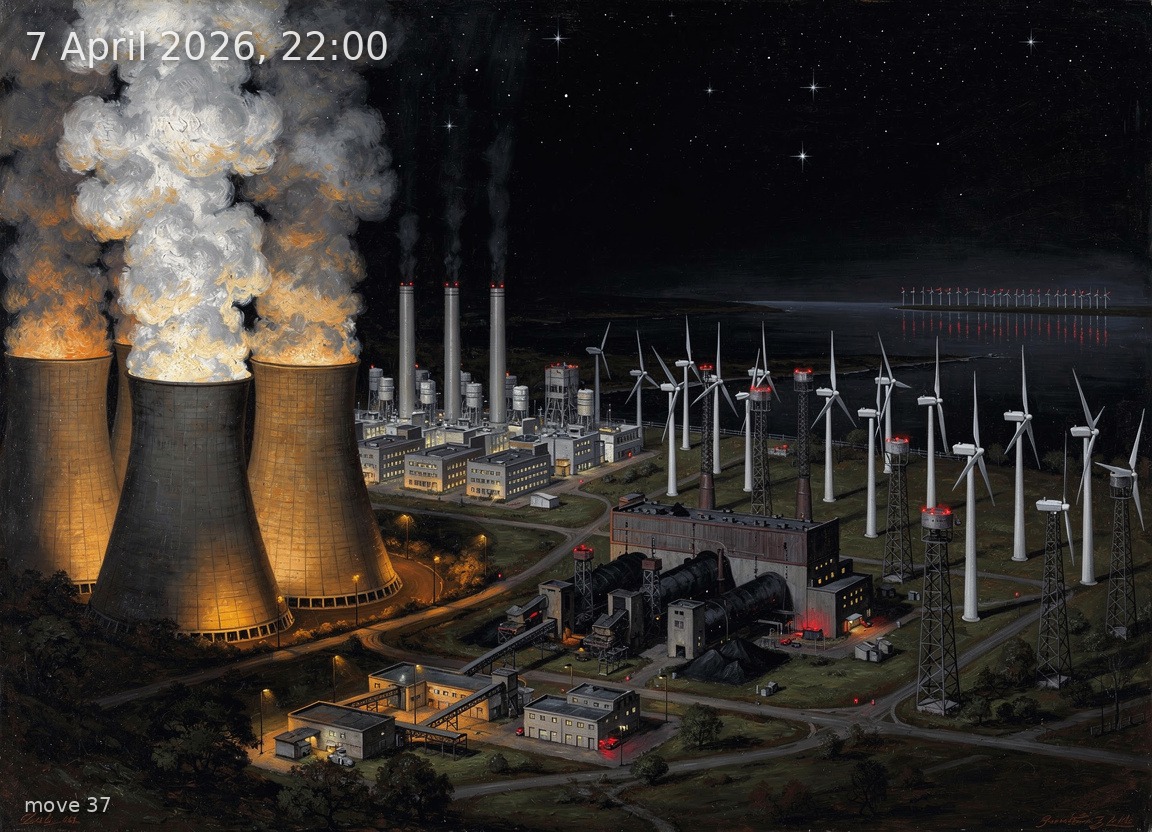
Wind leads renewables at 13.3 GW while brown coal, gas, and hard coal fill the nighttime gap requiring 13.2 GW net imports.
Back
Generation mix
Wind onshore 30%
Wind offshore 3%
Biomass 11%
Hydro 3%
Natural gas 18%
Hard coal 16%
Brown coal 20%
47%
Renewable share
13.4 GW
Wind (on + offshore)
0.0 GW
Solar
41.2 GW
Total generation
-13.2 GW
Net import
129.0 €/MWh
Day-ahead price
9.5°C / 11 km/h
Temp / Wind speed
Open-Meteo, Kassel (51.3°N 9.5°E)
0.0% / 0.0 W/m²
Cloud cover / Radiation
368
gCO₂/kWh
Image prompt
Brown coal 8.1 GW dominates the left quarter as a cluster of massive hyperbolic cooling towers with thick white steam plumes lit from below by orange sodium lamps; natural gas 7.5 GW occupies the centre-left as a row of compact CCGT plants with tall single exhaust stacks emitting thin vapour; hard coal 6.4 GW sits centre-right as a heavy industrial complex with large rectangular boiler houses and conveyor belts carrying dark fuel, chimneys glowing dull red at their tips; wind onshore 12.2 GW spans the entire right third and recedes into the deep background as dozens of three-blade turbines on tall lattice and tubular towers, their red aviation warning lights blinking; wind offshore 1.1 GW appears as a faint line of smaller turbines on the far-right horizon above a dark river or lake reflection; biomass 4.5 GW is rendered as a mid-ground cluster of smaller industrial buildings with wood-chip storage domes and modest stacks; hydro 1.3 GW appears as a low concrete run-of-river weir with illuminated spillway water in the foreground. TIME: 22:00, full night — the sky is completely black with scattered bright stars visible through perfectly clear air (0% cloud cover), no twilight, no sky glow, only artificial light sources. The April landscape shows early spring — bare branches with first small green buds, fresh grass emerging. A moderate breeze animates the turbine blades visibly mid-rotation and ruffles the surface water. ATMOSPHERE: oppressive and heavy despite clear skies — a dense, brooding industrial weight conveyed through thick amber and sulphur-toned artificial lighting, deep shadows, and voluminous steam clouds that pile high and catch the sodium light from below, suggesting high electricity prices and strained supply. Style: highly detailed oil painting in the tradition of 19th-century German Romantic landscape painting — rich impasto brushwork, dramatic chiaroscuro between artificial light pools and surrounding darkness, atmospheric depth with layers receding into the night, meticulous engineering detail on every turbine nacelle, cooling tower flute, and gas stack. No text, no labels.