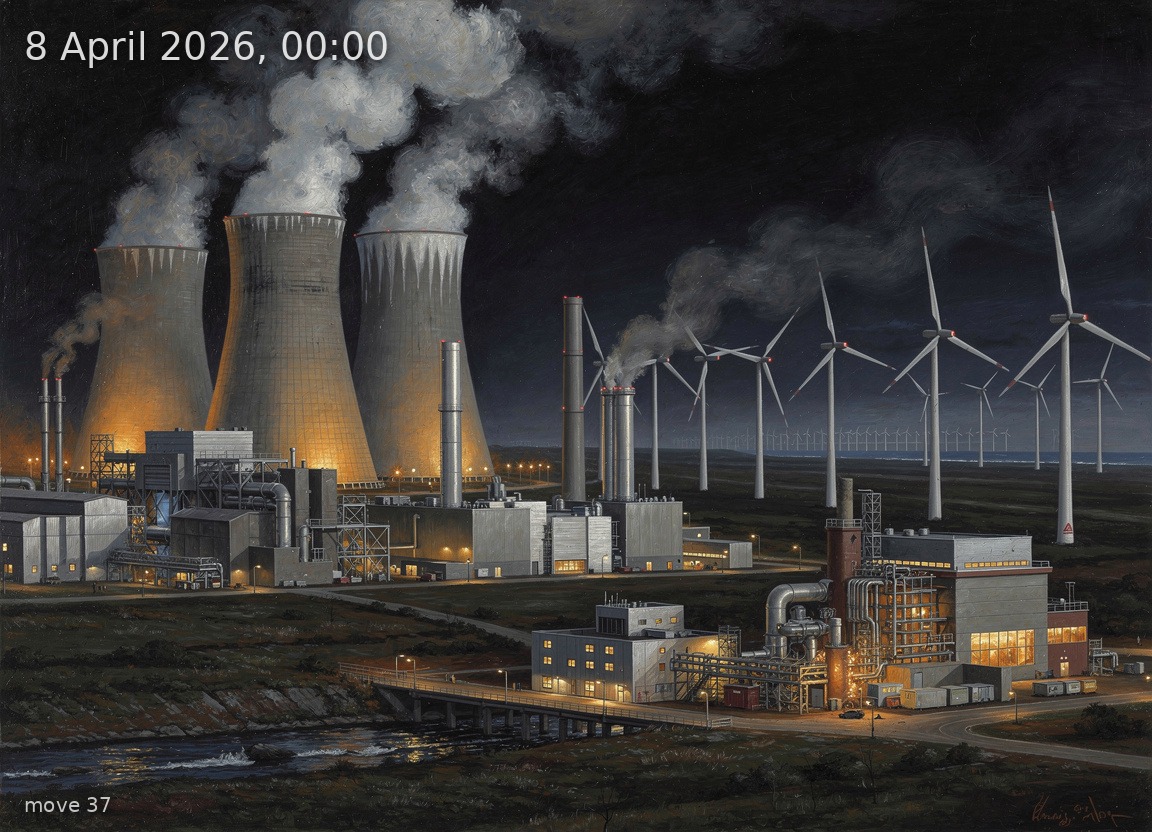
Wind and coal jointly anchor Germany's midnight grid as tight supply drives elevated prices at 107 EUR/MWh.
Back
Generation mix
Wind onshore 31%
Wind offshore 4%
Biomass 10%
Hydro 3%
Natural gas 15%
Hard coal 16%
Brown coal 20%
49%
Renewable share
14.5 GW
Wind (on + offshore)
0.0 GW
Solar
40.9 GW
Total generation
-7.4 GW
Net import
107.2 €/MWh
Day-ahead price
5.4°C / 10 km/h
Temp / Wind speed
Open-Meteo, Kassel (51.3°N 9.5°E)
0.0% / 0.0 W/m²
Cloud cover / Radiation
356
gCO₂/kWh
Image prompt
Wind onshore 12.7 GW dominates the right third of the canvas as dozens of tall three-blade turbines with white tubular towers and slowly turning rotors receding across a dark rolling plain; brown coal 8.2 GW occupies the left quarter as a massive lignite power station with four hyperbolic cooling towers emitting thick white-grey steam plumes lit from below by sodium-orange industrial lighting; hard coal 6.4 GW appears left of centre as a cluster of rectangular boiler houses with tall chimneys trailing thin smoke; natural gas 6.3 GW sits at centre as compact CCGT units with single polished exhaust stacks and visible heat shimmer; biomass 4.3 GW appears as a mid-ground wood-chip-fired plant with a single modest stack and glowing furnace windows; wind offshore 1.8 GW is suggested by a distant row of turbines at the far-right horizon above a faintly gleaming sea; hydro 1.3 GW is a small run-of-river weir in the foreground with water catching reflected industrial light. Time is midnight: the sky is completely black with no twilight, no sky glow, only scattered cold stars and a thin crescent moon near the zenith. All illumination comes from sodium streetlights casting amber pools, red aviation warning lights on turbine nacelles, floodlit cooling towers, and glowing plant windows. Temperature is 5°C in early spring: bare deciduous trees with the faintest buds, frost on dormant grass, patches of mist low to the ground near the river. The atmosphere is heavy and oppressive reflecting the high electricity price — a brooding, dense quality to the air, steam and mist mingling. Style: highly detailed oil painting in the tradition of 19th-century German Romantic landscape painters such as Caspar David Friedrich and Carl Blechen, rich deep colour palette of indigo, amber, slate-grey and cream, visible textured brushwork, atmospheric depth with aerial perspective fading distant turbines into haze, meticulous engineering detail on every technology — lattice tower cross-members, nacelle housings, aluminium panel frames, riveted boiler walls, parabolic cooling tower curves with condensation streaks. The scene reads as a monumental industrial nocturne, a masterwork painting of the modern energy landscape. No text, no labels.