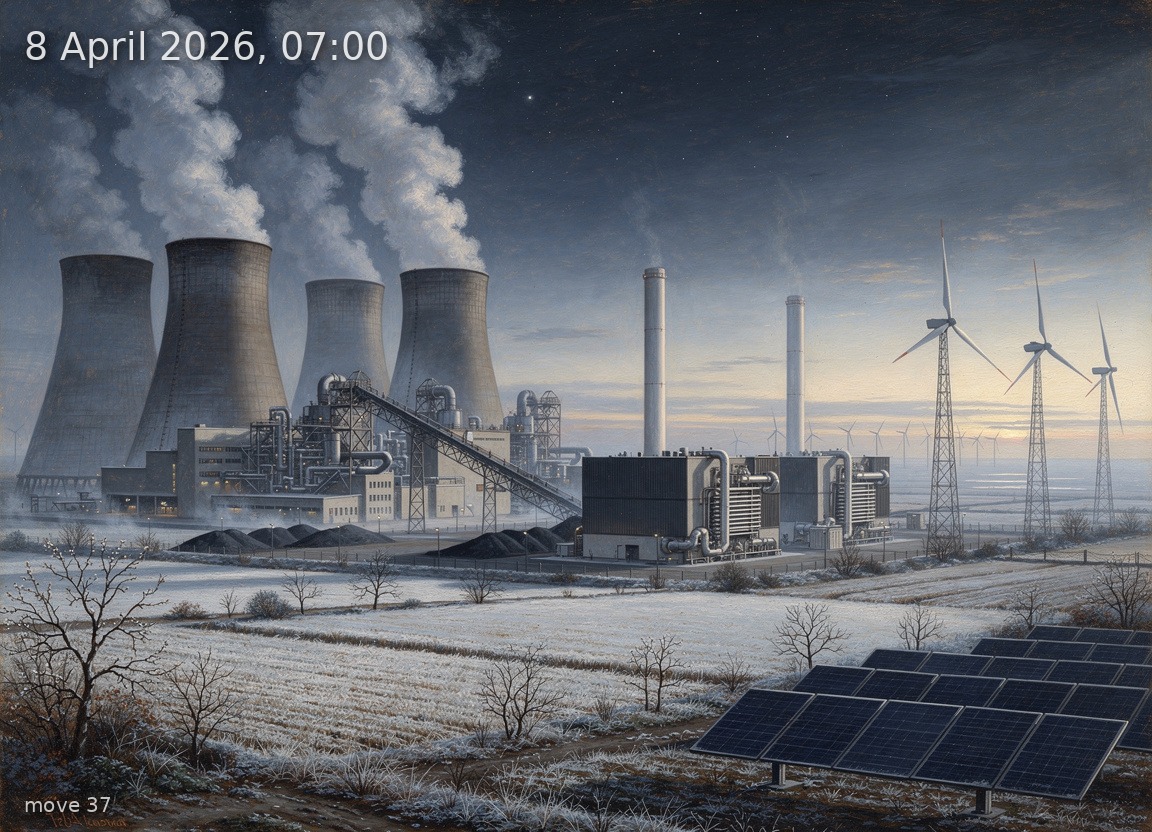
Cold dawn with sub-zero temperatures drives heavy coal, gas, and 20 GW net imports at elevated prices.
Back
Generation mix
Wind onshore 18%
Wind offshore 4%
Solar 11%
Biomass 11%
Hydro 3%
Natural gas 18%
Hard coal 15%
Brown coal 20%
47%
Renewable share
9.1 GW
Wind (on + offshore)
4.7 GW
Solar
41.3 GW
Total generation
-20.1 GW
Net import
168.8 €/MWh
Day-ahead price
-0.5°C / 5 km/h
Temp / Wind speed
Open-Meteo, Kassel (51.3°N 9.5°E)
0.0% / 0.0 W/m²
Cloud cover / Radiation
363
gCO₂/kWh
Image prompt
Brown coal 8.2 GW dominates the left quarter as a massive lignite power station complex with four hyperbolic cooling towers billowing thick white steam into the frigid air; hard coal 6.2 GW sits just right of centre as two rectangular coal-fired boiler houses with tall chimneys and conveyor belts feeding dark fuel; natural gas 7.4 GW occupies the centre-right as a pair of modern CCGT plants with sleek single exhaust stacks venting thin plumes; wind onshore 7.4 GW spans the far right as a line of tall three-blade turbines on lattice towers turning very slowly in near-calm air; wind offshore 1.7 GW appears as a distant cluster of turbines on the far-right horizon; solar 4.7 GW is rendered as a modest field of aluminium-framed crystalline silicon panels in the right foreground catching the first faint pre-dawn glow; biomass 4.4 GW appears as a wood-clad biomass CHP plant with a modest smokestack amid stacked timber in the left foreground; hydro 1.3 GW is a small run-of-river weir with turbine house visible at the bottom edge. Time is 07:00 early April dawn in central Germany: the sky is deep blue-grey with a thin band of pale cold light along the eastern horizon, no direct sunlight yet, stars still faintly visible overhead. Temperature is minus 0.5°C: a hard white frost coats the flat agricultural fields, bare deciduous trees with only the earliest buds, breath-visible cold. Wind is nearly still at 4.6 km/h, so smoke and steam rise almost vertically, lending a heavy oppressive atmosphere reflecting the 168.8 EUR/MWh price. The sky feels weighty and pressured despite being cloudless—a dense cold-air inversion traps steam and exhaust low. Painted in the style of a highly detailed 19th-century German Romantic oil painting—rich, dark palette of Prussian blues, umber, and ochre, visible impasto brushwork, atmospheric depth with industrial sublime grandeur. Meticulous engineering detail on every technology: turbine nacelles, rotor blades, cooling tower parabolic profiles, coal conveyor structures, PV panel grid lines. No text, no labels.