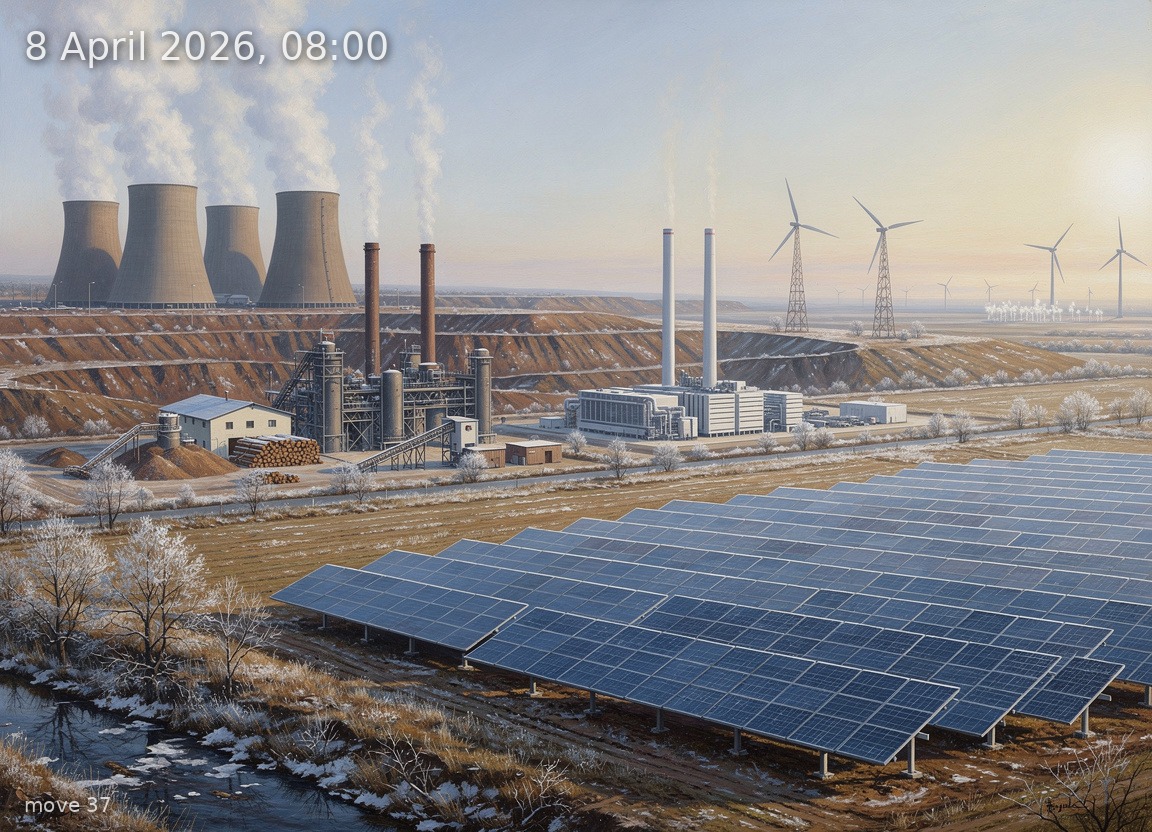
Solar leads at 16.6 GW but weak wind and cold drive 21.9 GW of thermal generation and ~11.8 GW net imports.
Back
Generation mix
Wind onshore 12%
Wind offshore 3%
Solar 32%
Biomass 9%
Hydro 3%
Natural gas 14%
Hard coal 12%
Brown coal 16%
58%
Renewable share
7.9 GW
Wind (on + offshore)
16.6 GW
Solar
52.2 GW
Total generation
-11.9 GW
Net import
138.5 €/MWh
Day-ahead price
0.3°C / 4 km/h
Temp / Wind speed
Open-Meteo, Kassel (51.3°N 9.5°E)
0.0% / 21.5 W/m²
Cloud cover / Radiation
288
gCO₂/kWh
Image prompt
Brown coal 8.2 GW dominates the left quarter as a cluster of massive hyperbolic cooling towers with thick white steam plumes rising into still air, surrounded by open-pit lignite terrain with exposed brown earth terraces. Hard coal 6.2 GW sits just right of centre-left as a bank of tall smokestacks and boiler houses with darker grey exhaust. Natural gas 7.5 GW occupies the centre as sleek combined-cycle gas turbine units with single tall exhaust stacks and slim vapour trails. Solar 16.6 GW fills the entire right third and extends into the midground as vast fields of aluminium-framed crystalline silicon photovoltaic panels angled toward a low eastern sun, catching early morning light with blue-white reflections. Wind onshore 6.2 GW appears as a scattered line of three-blade turbines with lattice towers on gentle hills in the mid-distance, rotors barely turning in near-calm air. Wind offshore 1.8 GW is suggested by a handful of turbines on a hazy horizon line far right. Biomass 4.5 GW appears as a medium-sized wood-chip plant with a modest smokestack and log storage yard nestled between the coal complex and the gas plant. Hydro 1.4 GW is a small run-of-river dam visible at the far left beside a cold stream. The sky is entirely cloudless, a pale clear blue deepening toward the zenith, with the April sun low on the eastern horizon casting long golden shadows across frozen ground. Frost whitens bare-branched trees and dormant grass; temperature near freezing is evident in rime on metal structures and visible breath-like condensation near warm exhausts. The atmosphere feels heavy and oppressive despite the clear sky—a faint haze of industrial exhaust and cold inversion layers traps a subtle amber tint near the horizon, reflecting the high electricity price tension. The landscape is flat central-German terrain with patches of bare agricultural fields. Style: highly detailed oil painting in the tradition of 19th-century German Romantic landscape painters such as Caspar David Friedrich and Carl Blechen—rich layered colour, visible confident brushwork, atmospheric depth with sfumato in the distance, dramatic chiaroscuro from low-angle morning light. Each energy technology rendered with meticulous engineering accuracy: turbine nacelles, three-blade rotors, PV cell grid patterns, cooling tower parabolic profiles, CCGT exhaust geometry. The painting balances sublime natural beauty with unflinching industrial realism. No text, no labels.