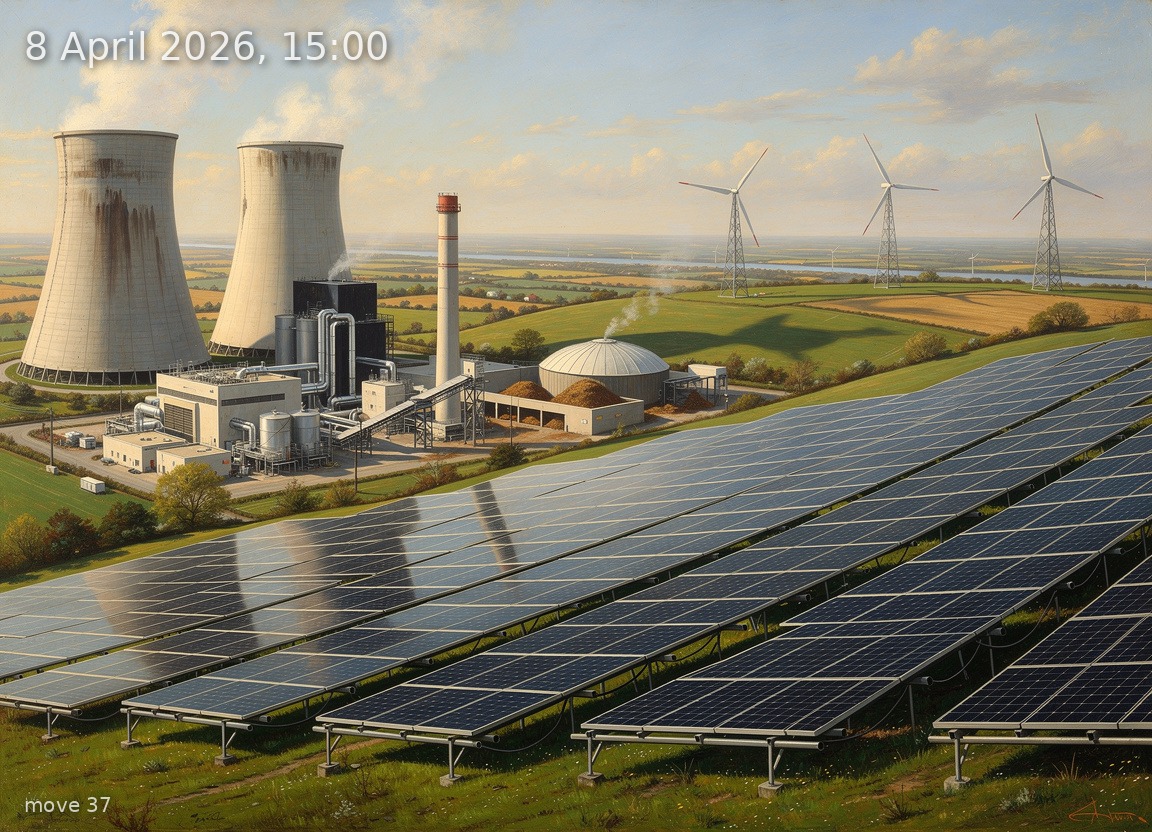
Solar at 45.7 GW overwhelms 60.6 GW demand, driving 4.5 GW net exports and negative prices on a clear April afternoon.
Back
Generation mix
Wind onshore 6%
Wind offshore 4%
Solar 70%
Biomass 6%
Hydro 2%
Natural gas 4%
Hard coal 2%
Brown coal 6%
89%
Renewable share
6.8 GW
Wind (on + offshore)
45.7 GW
Solar
65.1 GW
Total generation
+4.5 GW
Net export
-13.2 €/MWh
Day-ahead price
16.9°C / 7 km/h
Temp / Wind speed
Open-Meteo, Kassel (51.3°N 9.5°E)
28.0% / 577.5 W/m²
Cloud cover / Radiation
78
gCO₂/kWh
Image prompt
Solar 45.7 GW dominates the scene as a vast sweeping field of crystalline silicon PV panels filling the entire right two-thirds of the composition, their aluminium frames glinting under bright afternoon sunshine; brown coal 3.6 GW appears at the far left as two hyperbolic concrete cooling towers with thin white steam plumes rising lazily; natural gas 2.5 GW sits as a compact CCGT plant with a single tall exhaust stack beside the cooling towers; wind onshore 4.0 GW is represented by five three-blade turbines on lattice towers scattered across a gentle hill behind the solar field, blades turning slowly in light wind; wind offshore 2.8 GW appears as a row of distant turbines on the hazy horizon line; biomass 4.1 GW is a mid-sized industrial facility with a wood-chip storage dome and a single chimney producing faint exhaust, positioned between the fossil plants and the solar field; hard coal 1.2 GW is a small coal-fired station with a single square stack visible behind the brown coal towers; hydro 1.2 GW appears as a small concrete dam and spillway set into a river at the bottom-left foreground. Time of day is 3 PM in April — full bright daylight, sun high in the western quadrant, sky mostly clear with 28% wispy cirrus clouds, strong direct sunlight casting crisp shadows from every structure. Temperature is a mild 16.9°C — early spring green vegetation, fresh grass, birch and beech trees just leafing out in pale chartreuse, wildflowers beginning in meadow margins. The negative electricity price is conveyed through a calm, expansive, luminous sky with soft blue gradients and a feeling of serene abundance. Style: highly detailed oil painting in the tradition of 19th-century German Romantic landscape painters such as Caspar David Friedrich and Carl Blechen — rich saturated colour, visible confident brushwork, deep atmospheric perspective with haze softening distant elements, golden light modeling every surface. Each energy technology rendered with meticulous engineering accuracy: turbine nacelles, rotor hubs, PV cell grid patterns, cooling tower parabolic profiles, pipe racks on the gas plant. The composition feels monumental and contemplative, a masterwork landscape of the industrial energy transition. No text, no labels, no human figures.