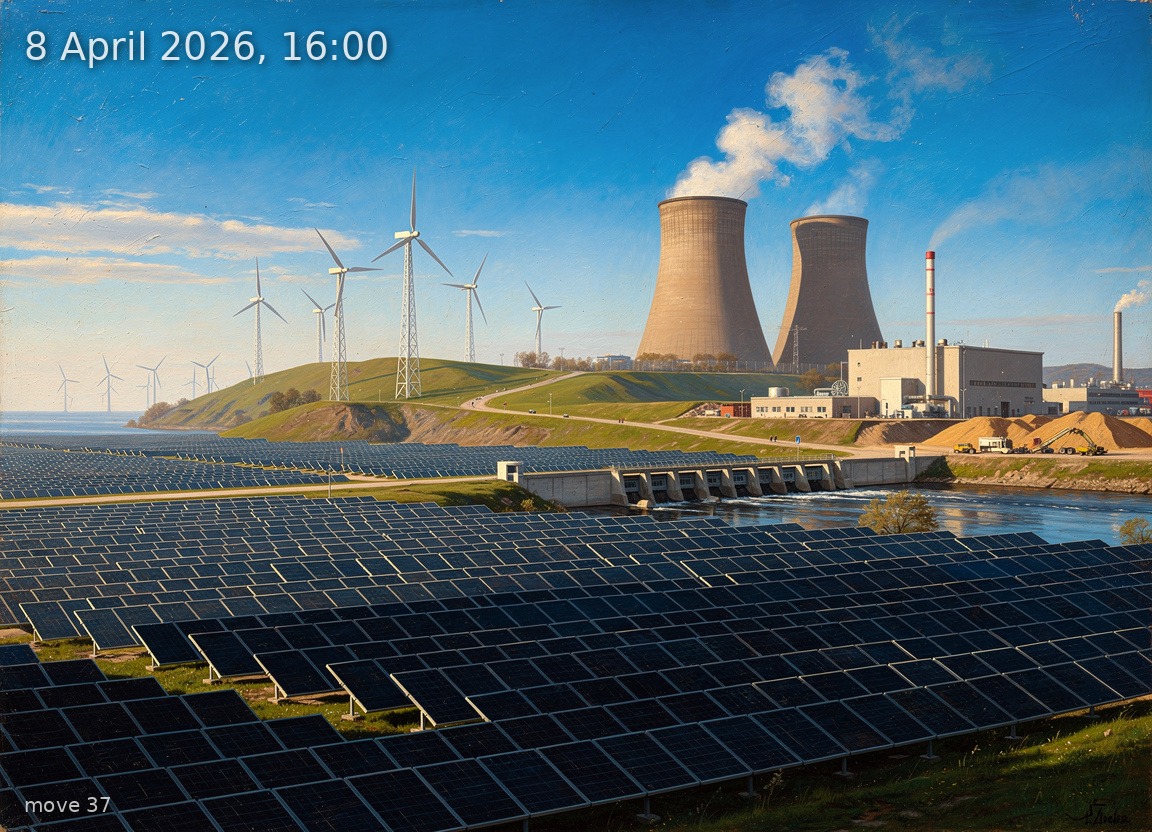
Solar at 36.5 GW drives 87% renewable share under clear spring skies, with modest wind and thermal backup.
Back
Generation mix
Wind onshore 9%
Wind offshore 5%
Solar 63%
Biomass 7%
Hydro 2%
Natural gas 4%
Hard coal 2%
Brown coal 6%
87%
Renewable share
8.4 GW
Wind (on + offshore)
36.5 GW
Solar
57.6 GW
Total generation
-2.5 GW
Net import
13.4 €/MWh
Day-ahead price
17.1°C / 9 km/h
Temp / Wind speed
Open-Meteo, Kassel (51.3°N 9.5°E)
4.0% / 509.8 W/m²
Cloud cover / Radiation
90
gCO₂/kWh
Image prompt
Solar 36.5 GW dominates the scene as an enormous field of crystalline silicon photovoltaic panels stretching across the entire foreground and middle ground, their aluminium frames glinting in brilliant afternoon sun; wind onshore 5.2 GW appears as a cluster of three-blade turbines with white lattice towers on gentle rolling hills at centre-left, rotors turning slowly; wind offshore 3.2 GW is suggested by a distant line of larger turbines on the hazy horizon at far left; brown coal 3.7 GW occupies the right-centre background as a pair of massive hyperbolic cooling towers emitting thin white steam plumes; biomass 4.1 GW sits as a medium-sized wood-chip power plant with a rectangular stack and visible fuel yard at right; natural gas 2.6 GW appears as a compact CCGT facility with a single tall exhaust stack and modest heat shimmer just behind the solar field; hard coal 1.2 GW is a smaller power station with a single squat cooling tower barely steaming at the far right edge; hydro 1.2 GW is represented by a low concrete run-of-river dam visible along a gentle river cutting through the middle distance. The time is 4 PM in early April: the sun is still well above the horizon in full brilliant daylight, casting warm golden-white light from the west-southwest, with long but not extreme shadows; the sky is vast and nearly cloudless at only 4% cover, a luminous cerulean blue with faint wisps of high cirrus. The atmosphere is calm and open, reflecting the low electricity price — no oppressive haze, just clear spring air. Vegetation is early spring: fresh bright green on deciduous trees just leafing out, rapeseed fields beginning to show yellow, grass vivid after rain. Temperature is a mild 17°C — no heat shimmer. Wind is light, visible only in gently swaying grass and the slow rotation of turbine blades. Highly detailed oil painting in the tradition of 19th-century German Romantic landscape painters such as Caspar David Friedrich and Carl Blechen — rich saturated colour, visible impasto brushwork, atmospheric depth and luminous sky treatment — but with meticulous modern engineering accuracy: correctly rendered three-blade rotor assemblies with nacelle housings, aluminium-framed PV modules in orderly rows, hyperbolic concrete cooling tower geometry with realistic steam dynamics, proper CCGT exhaust stack proportions. The composition balances the sublime grandeur of a Romantic landscape with the industrial reality of the energy transition. No text, no labels, no human figures prominent.