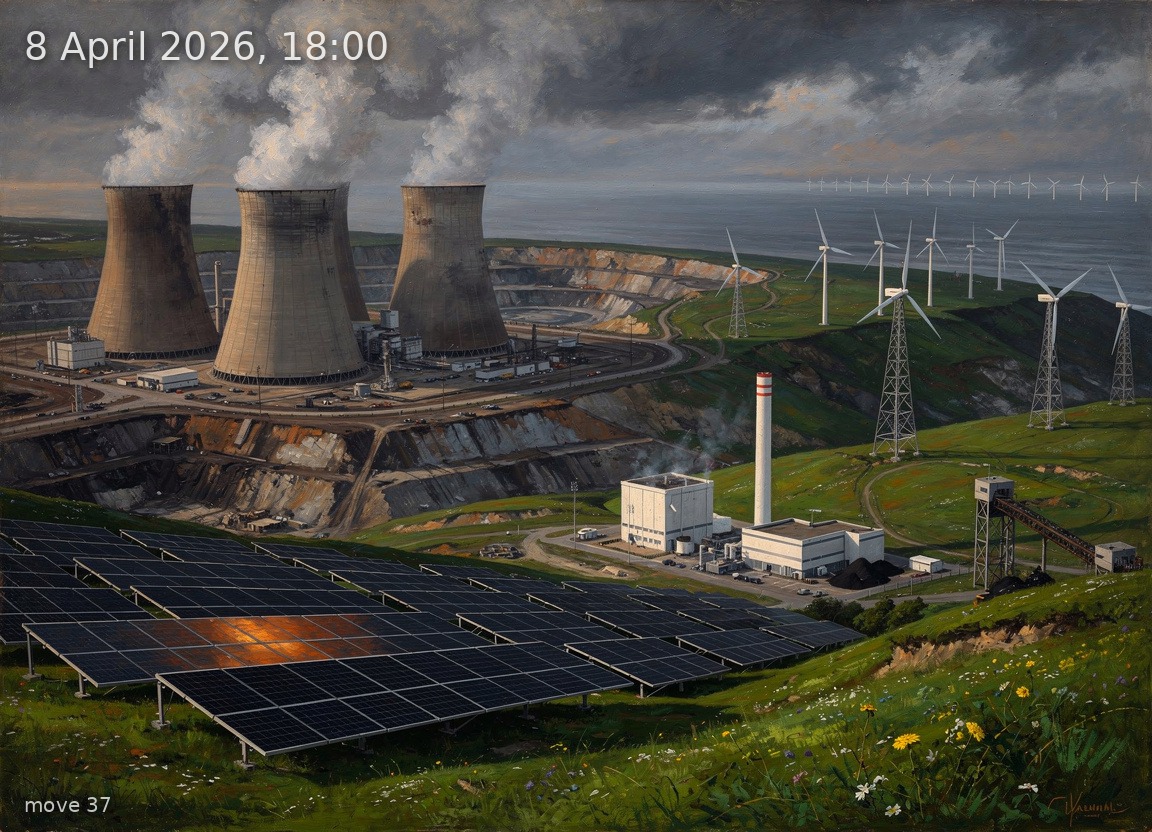
Large net imports of 21.1 GW needed as solar fades and evening demand peaks despite strong wind and significant coal output.
Back
Generation mix
Wind onshore 19%
Wind offshore 10%
Solar 26%
Biomass 11%
Hydro 3%
Natural gas 9%
Hard coal 7%
Brown coal 15%
69%
Renewable share
11.7 GW
Wind (on + offshore)
10.5 GW
Solar
40.3 GW
Total generation
-21.1 GW
Net import
134.2 €/MWh
Day-ahead price
16.2°C / 14 km/h
Temp / Wind speed
Open-Meteo, Kassel (51.3°N 9.5°E)
100.0% / 221.5 W/m²
Cloud cover / Radiation
221
gCO₂/kWh
Image prompt
Brown coal 6.1 GW dominates the left foreground as a cluster of four massive hyperbolic cooling towers with thick white-grey steam plumes rising into heavy overcast sky, surrounded by open-pit lignite mines with terraced earth walls. Solar 10.5 GW occupies the centre-left as extensive fields of aluminium-framed crystalline silicon photovoltaic panels reflecting the last dim orange glow of dusk, angled on steel racking across gently rolling green spring meadows. Wind onshore 7.8 GW fills the centre-right as dozens of tall three-blade turbines on lattice and tubular towers, rotors turning moderately in the breeze, scattered across low hills with fresh green grass and early wildflowers. Wind offshore 3.8 GW appears in the far right distance as a line of turbines rising from a grey North Sea horizon, barely visible through atmospheric haze. Natural gas 3.5 GW is rendered as two compact CCGT power plants with single tall exhaust stacks and thin heat shimmer, positioned in the mid-ground between the coal complex and wind farms. Hard coal 2.9 GW appears as a smaller coal-fired station with a single square cooling tower and conveyor belt, nestled behind the gas plants. Biomass 4.3 GW is shown as several wood-chip-fueled CHP facilities with modest chimneys and stacked timber stores beside agricultural buildings in the middle distance. Hydro 1.4 GW is a small run-of-river weir and powerhouse visible along a winding river in a valley in the far background. The sky is dusk at 18:00 in April — rapidly fading light, a narrow band of orange-red glow on the lower western horizon, the rest of the sky darkening through deep slate grey to near-charcoal overhead, with complete 100% cloud cover creating a heavy, oppressive, low ceiling that presses down on the landscape, reflecting the high electricity price. Temperature is a mild 16°C spring evening; trees show fresh pale-green buds, grass is vivid green, patches of dandelions dot the foreground. The entire scene is rendered as a highly detailed oil painting in the tradition of 19th-century German Romantic landscape painters — rich, saturated colour palette with deep umbers, ochres, and slate blues, visible impasto brushwork, atmospheric depth with sfumato haze in the distance, dramatic chiaroscuro between the glowing industrial facilities and the darkening sky. Each energy technology is painted with meticulous engineering accuracy: three-blade rotor profiles, nacelle housings, PV panel grid patterns, cooling tower parabolic curves with condensation plumes, CCGT exhaust geometry. No text, no labels.