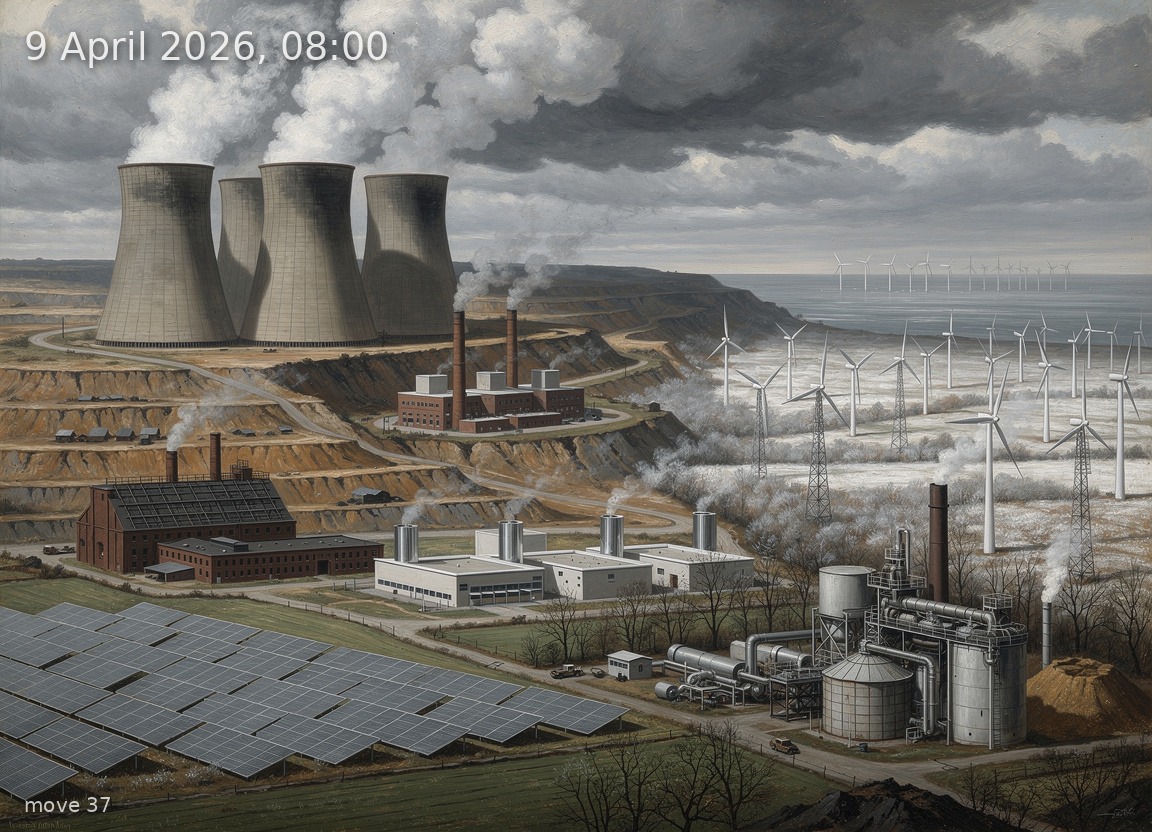
Wind and solar lead at 62% renewables, but cold overcast conditions and 10.9 GW net imports keep coal and gas running hard.
Back
Generation mix
Wind onshore 21%
Wind offshore 10%
Solar 21%
Biomass 8%
Hydro 2%
Natural gas 16%
Hard coal 8%
Brown coal 14%
62%
Renewable share
17.3 GW
Wind (on + offshore)
11.4 GW
Solar
55.4 GW
Total generation
-10.9 GW
Net import
128.1 €/MWh
Day-ahead price
1.7°C / 5 km/h
Temp / Wind speed
Open-Meteo, Kassel (51.3°N 9.5°E)
94.0% / 13.5 W/m²
Cloud cover / Radiation
252
gCO₂/kWh
Image prompt
Brown coal 7.9 GW dominates the left quarter as a cluster of four massive hyperbolic cooling towers with thick white steam plumes rising into heavy grey skies, surrounded by open-pit lignite excavation terraces in ochre-brown earth; hard coal 4.3 GW appears just right of centre-left as a single large power station with tall brick stacks trailing darker smoke; natural gas 8.7 GW fills the centre as three compact CCGT plants with gleaming steel exhaust stacks and smaller vapor wisps; wind onshore 11.5 GW stretches across the right third as dozens of tall three-blade turbines on lattice and tubular towers turning slowly on low-lying frost-tipped farmland; wind offshore 5.7 GW is visible in the far-right distance as a line of turbines standing in a grey North Sea glimpsed through a gap in the terrain; solar 11.4 GW appears as vast fields of aluminium-framed crystalline silicon panels covering gently rolling foreground fields, their surfaces reflecting only the flat grey of the overcast sky with no glint or shine; biomass 4.5 GW is rendered as a medium-sized industrial facility with a wood-chip silo and modest chimney emitting pale smoke, nestled among bare early-spring trees at centre-right; hydro 1.3 GW appears as a small concrete dam and penstock in a wooded valley at the far left edge. The lighting is full daytime but extremely diffuse — a 94% overcast ceiling of thick stratocumulus in layered greys presses down oppressively, no blue sky visible, no sun disk, the atmosphere heavy and muted suggesting high electricity prices. The temperature is near freezing: frost whitens the stubble fields, bare deciduous trees with only the faintest swelling buds line field boundaries, patches of old snow linger in shadows, breath-vapor would be visible. The low wind is suggested by gently rotating turbine blades and barely stirring grass. Painted in the style of a highly detailed 19th-century German Romantic oil painting — rich impasto brushwork, atmospheric perspective with haze softening distant cooling towers, a Caspar David Friedrich sense of sublime industrial vastness, deep tonal palette of slate grey, raw umber, cold blue-grey, and muted green. Meticulous engineering accuracy on every turbine nacelle, every cooling tower hyperbolic curve, every PV panel frame. No text, no labels, no people prominent.