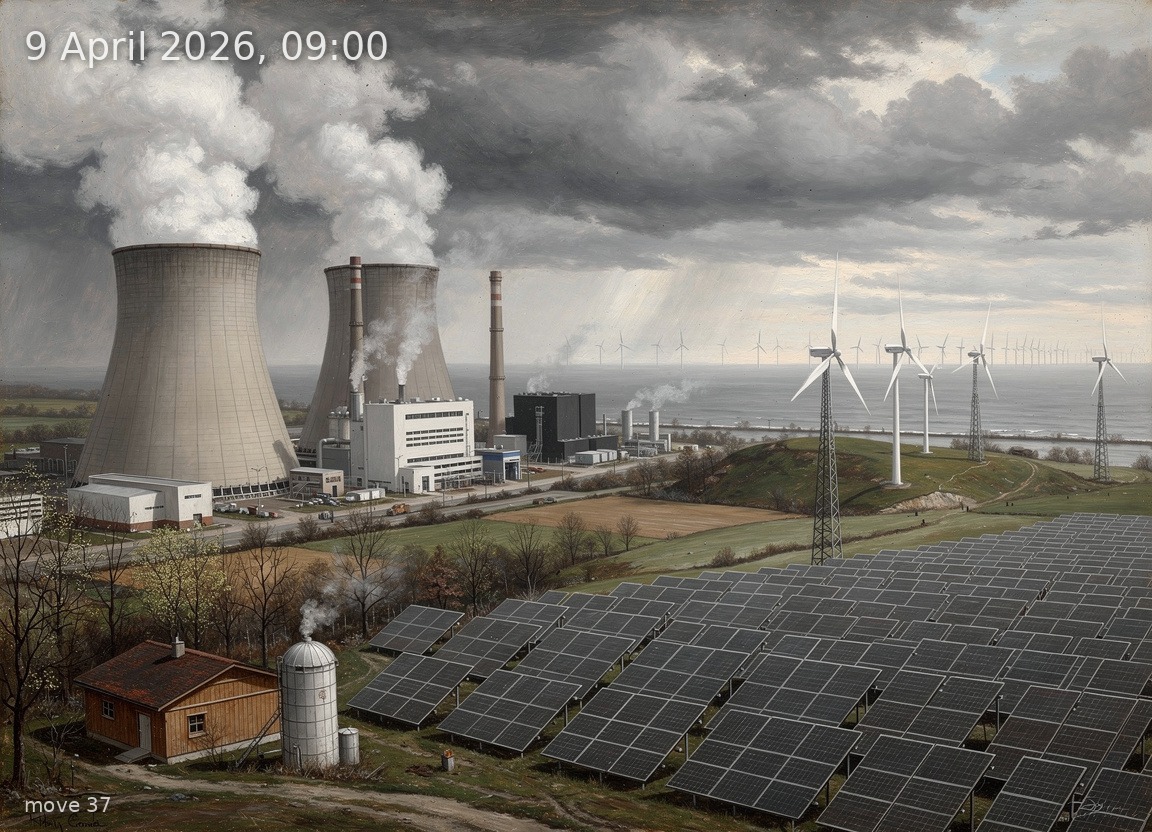
Solar leads at 22.1 GW despite full overcast; firm thermal dispatch and 3.9 GW net imports balance tight supply.
Back
Generation mix
Wind onshore 15%
Wind offshore 9%
Solar 35%
Biomass 7%
Hydro 2%
Natural gas 13%
Hard coal 6%
Brown coal 13%
68%
Renewable share
15.2 GW
Wind (on + offshore)
22.1 GW
Solar
63.1 GW
Total generation
-3.9 GW
Net import
99.7 €/MWh
Day-ahead price
4.9°C / 6 km/h
Temp / Wind speed
Open-Meteo, Kassel (51.3°N 9.5°E)
100.0% / 51.0 W/m²
Cloud cover / Radiation
213
gCO₂/kWh
Image prompt
Solar 22.1 GW dominates the right half of the scene as vast fields of aluminium-framed crystalline silicon PV panels stretching across flat farmland, their glass surfaces reflecting only dull grey light; wind onshore 9.4 GW appears as dozens of three-blade turbines with white nacelles and lattice towers scattered across rolling hills in the centre-right, blades turning slowly in light wind; wind offshore 5.7 GW is visible in the far distance as a row of taller turbines standing in a hazy grey sea on the horizon; natural gas 8.0 GW occupies the centre-left as a cluster of modern CCGT power plants with slim exhaust stacks emitting thin vapour plumes; brown coal 7.9 GW fills the left foreground as massive hyperbolic cooling towers with heavy white steam billowing upward; hard coal 4.0 GW sits behind the brown coal complex as a smaller set of rectangular boiler houses with tall chimneys trailing grey smoke; biomass 4.5 GW appears as a modest wood-clad generating facility with a rounded silo and low steam vent nestled at the edge of a bare early-spring copse; hydro 1.3 GW is suggested by a small concrete dam and spillway in a narrow valley at the far left edge. The sky is entirely overcast, a heavy uniform blanket of low stratus clouds in tones of lead and ash, oppressive and weighty, conveying the high electricity price. Daylight is flat and diffuse—full morning brightness at 09:00 but completely shadowless, with no sun disk visible. The April landscape shows bare deciduous trees just beginning to bud, pale green grass, patches of brown earth, and a cool temperature of about 5 °C suggested by frost lingering in shaded hollows. The atmosphere is thick and humid, with limited visibility toward the horizon. Rendered as a highly detailed oil painting in the tradition of 19th-century German Romantic landscape masters—rich layered colour in muted earth tones and slate greys, visible confident brushwork, deep atmospheric perspective, meticulous engineering accuracy on every turbine nacelle, every cooling tower's parabolic curve, every PV panel's cell grid. No text, no labels.