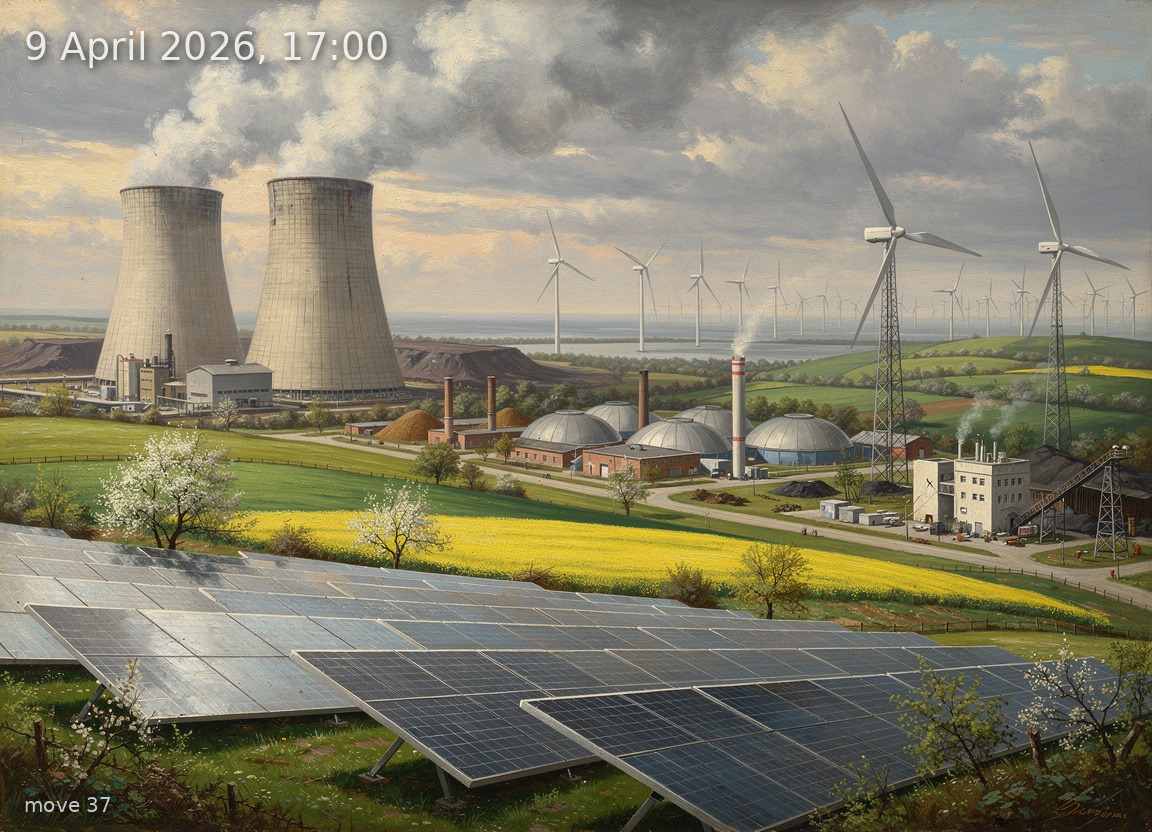
Solar and wind dominate at 82% renewables, but 14.3 GW net imports are needed as evening demand peaks.
Back
Generation mix
Wind onshore 19%
Wind offshore 11%
Solar 41%
Biomass 8%
Hydro 3%
Natural gas 7%
Hard coal 3%
Brown coal 8%
82%
Renewable share
15.2 GW
Wind (on + offshore)
20.2 GW
Solar
49.7 GW
Total generation
-14.3 GW
Net import
82.5 €/MWh
Day-ahead price
16.6°C / 11 km/h
Temp / Wind speed
Open-Meteo, Kassel (51.3°N 9.5°E)
100.0% / 164.0 W/m²
Cloud cover / Radiation
119
gCO₂/kWh
Image prompt
Solar 20.2 GW dominates the foreground as vast fields of aluminium-framed crystalline silicon photovoltaic panels stretching across gently rolling central German farmland, covering roughly two-fifths of the scene. Wind onshore 9.6 GW fills the mid-ground right as dozens of three-blade turbines on lattice and tubular towers scattered across green spring hills, their blades turning slowly in moderate breeze. Wind offshore 5.6 GW appears in the distant right background as a cluster of tall offshore turbines on the hazy horizon line, barely visible through atmosphere. Brown coal 3.9 GW occupies the left middle distance as a lignite power station with two large hyperbolic cooling towers emitting thick white steam plumes. Biomass 4.2 GW sits adjacent as a cluster of medium-sized industrial buildings with low chimneys and wood-chip storage domes. Natural gas 3.6 GW appears as a compact CCGT facility with a single tall exhaust stack and a thin heat shimmer rising from it. Hard coal 1.3 GW is a smaller facility with a single square cooling tower and a conveyor belt visible. Hydro 1.3 GW appears as a modest dam and spillway in a valley on the far left edge. The sky is entirely overcast at 100% cloud cover, a thick uniform grey-white blanket pressing down with an oppressive heaviness reflecting the 82.5 EUR/MWh price. The time is 17:00 in April dusk: the western horizon glows faintly orange-red beneath the low cloud base, while the upper sky darkens to slate grey and deep blue-grey above. The light is diffuse and fading, casting no hard shadows, with a warm amber tint near the horizon reflecting off the glass surfaces of the solar panels. Spring vegetation: fresh bright-green grass, budding deciduous trees with pale leaves, some yellow rapeseed fields between the panel arrays. Painted in the style of a highly detailed 19th-century German Romantic oil painting—rich layered colour, visible confident brushwork, atmospheric depth and haze, meticulous engineering detail on every turbine nacelle, every panel frame, every cooling tower's concrete ribbing. The mood is grand, contemplative, industrial-pastoral. No text, no labels.