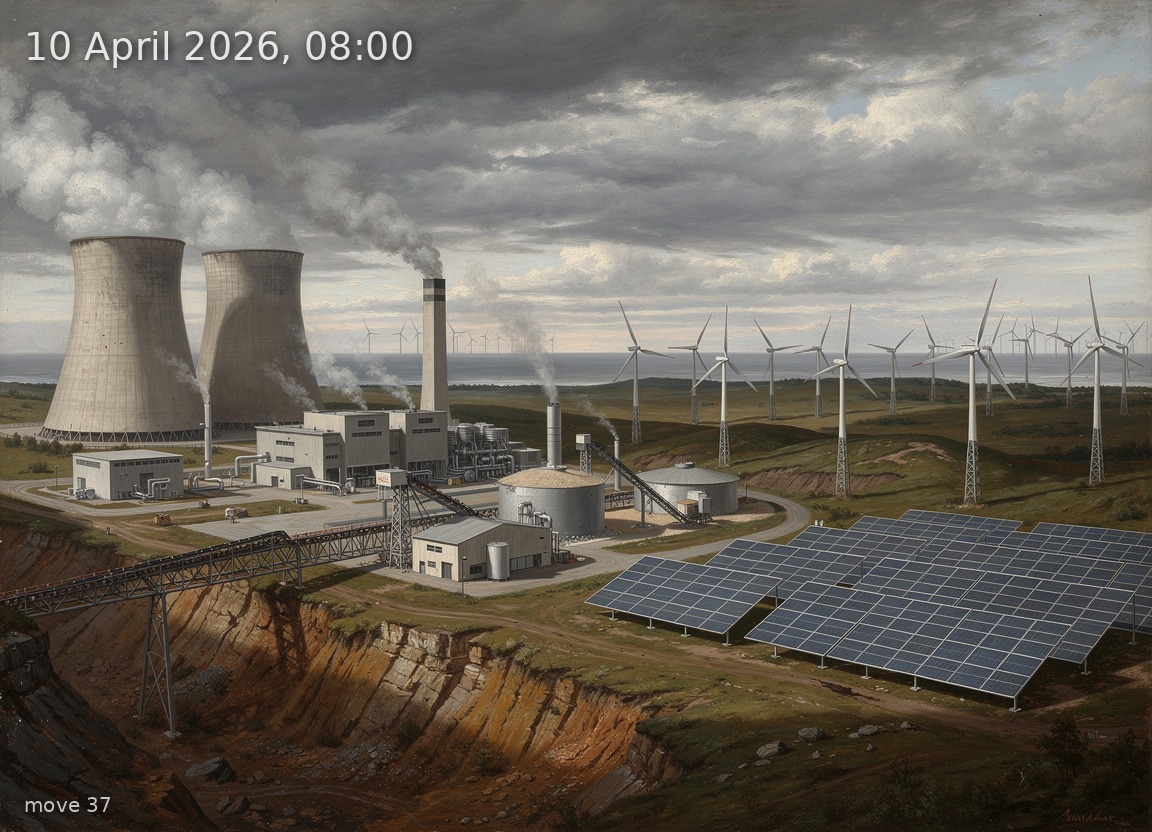
Strong wind and heavy thermal backup meet high morning demand under full overcast, driving elevated prices and net imports.
Back
Generation mix
Wind onshore 30%
Wind offshore 12%
Solar 9%
Biomass 9%
Hydro 2%
Natural gas 12%
Hard coal 10%
Brown coal 16%
63%
Renewable share
21.4 GW
Wind (on + offshore)
4.7 GW
Solar
51.0 GW
Total generation
-11.1 GW
Net import
123.2 €/MWh
Day-ahead price
8.8°C / 32 km/h
Temp / Wind speed
Open-Meteo, Kassel (51.3°N 9.5°E)
100.0% / 0.0 W/m²
Cloud cover / Radiation
261
gCO₂/kWh
Image prompt
Wind onshore 15.5 GW dominates the right half of the composition as dense rows of tall three-blade turbines on lattice towers stretching across rolling green-brown April hills, rotors spinning visibly in strong wind; wind offshore 5.9 GW appears as a distant cluster of turbines on the far-right horizon above a grey North Sea sliver. Brown coal 8.0 GW occupies the left foreground as three massive hyperbolic cooling towers with thick white-grey steam plumes drifting heavily eastward, beside a lignite conveyor and open-pit edge. Natural gas 5.9 GW sits left-centre as two compact CCGT plants with slim exhaust stacks emitting thin heat shimmer. Hard coal 5.2 GW appears centre-left as a large coal-fired station with a tall rectangular stack and coal bunkers. Solar 4.7 GW is represented in the centre-right midground as a field of aluminium-framed crystalline silicon panels on flat ground, their surfaces reflecting only dull grey light — no sunshine, no glint. Biomass 4.5 GW is shown as a medium wood-chip plant with a rounded silo and low steam vent near the coal station. Hydro 1.3 GW appears as a small run-of-river weir with turbine house along a swollen spring river in the left middle distance. The sky is entirely overcast with a heavy, oppressive blanket of low stratus clouds in shades of pewter and slate — no blue visible, no direct sunlight, but full diffuse April daylight illuminating the scene evenly from above. The atmosphere feels weighty and pressurised, hinting at the high electricity price. Vegetation is early spring: bare branches with first pale-green buds, patches of brown grass and wet dark earth. Wind bends the young grass and ripples puddles. Painted in the style of a highly detailed 19th-century German Romantic oil painting — rich impasto brushwork, atmospheric sfumato in the distance, Caspar David Friedrich's brooding scale combined with Menzel's industrial precision. Every turbine nacelle, every cooling tower's parabolic curve, every PV module frame is rendered with meticulous engineering accuracy. No text, no labels.