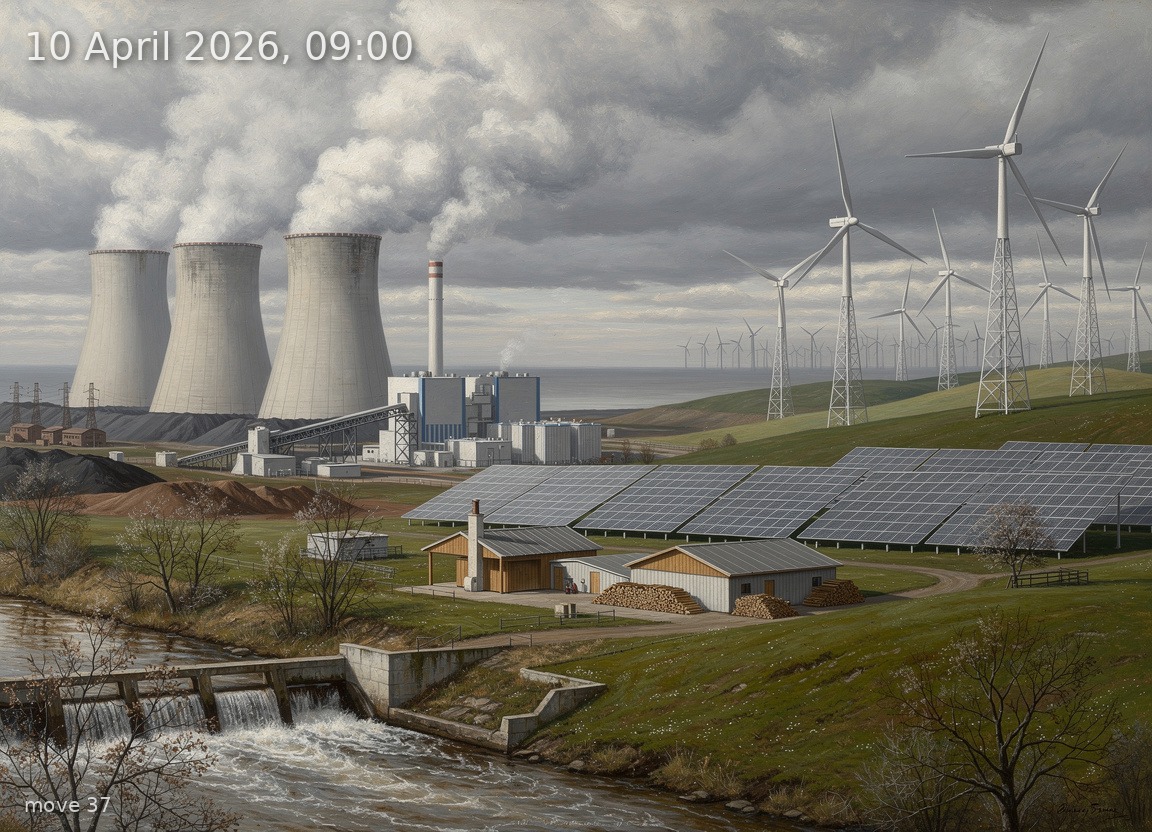
Wind leads at 18.9 GW but full overcast limits solar, keeping coal and gas dispatch high with 10.6 GW net imports.
Back
Generation mix
Wind onshore 26%
Wind offshore 10%
Solar 18%
Biomass 9%
Hydro 2%
Natural gas 12%
Hard coal 9%
Brown coal 15%
64%
Renewable share
18.9 GW
Wind (on + offshore)
9.3 GW
Solar
53.3 GW
Total generation
-10.6 GW
Net import
119.3 €/MWh
Day-ahead price
8.4°C / 29 km/h
Temp / Wind speed
Open-Meteo, Kassel (51.3°N 9.5°E)
100.0% / 1.5 W/m²
Cloud cover / Radiation
251
gCO₂/kWh
Image prompt
Wind onshore 13.6 GW dominates the right half of the scene as dozens of tall three-blade turbines with white lattice towers stretching across rolling green spring hills, rotors spinning briskly in strong wind; wind offshore 5.3 GW appears in the far-right background as a distant cluster of offshore turbines barely visible through haze on a grey sea horizon; brown coal 8.0 GW occupies the left foreground as a massive lignite power station with three hyperbolic cooling towers emitting thick white steam plumes that merge into the overcast sky; solar 9.3 GW is rendered as a mid-ground field of aluminium-framed crystalline silicon PV panels reflecting only dull grey light, no sunlight, panels wet with moisture; natural gas 6.1 GW sits centre-left as two compact CCGT blocks with tall single exhaust stacks venting thin heat shimmer; hard coal 5.1 GW appears left of centre as a darker, older coal plant with rectangular cooling towers and a conveyor belt feeding black coal; biomass 4.6 GW is shown as a modest timber-clad biomass facility with a short chimney and stacked wood-chip piles near the centre; hydro 1.3 GW is a small run-of-river weir with a concrete spillway in the lower-left corner beside a swollen spring stream. The sky is entirely overcast at 100% cloud cover, heavy uniform grey-white stratus pressing low, no sun visible, diffuse flat daylight of a mid-morning April day; the atmosphere feels heavy and oppressive reflecting the high electricity price; bare-branching early-spring trees with the first pale green buds, damp grass of 8°C cool spring, puddles on paths; strong wind bends the grass and whips flags on industrial buildings. Highly detailed oil painting in the tradition of 19th-century German Romantic landscape painters — Caspar David Friedrich meets industrial sublime — rich muted earth tones, visible confident brushwork, atmospheric depth and aerial perspective, meticulous engineering detail on every turbine nacelle, every cooling tower rib, every PV cell grid line. No text, no labels.