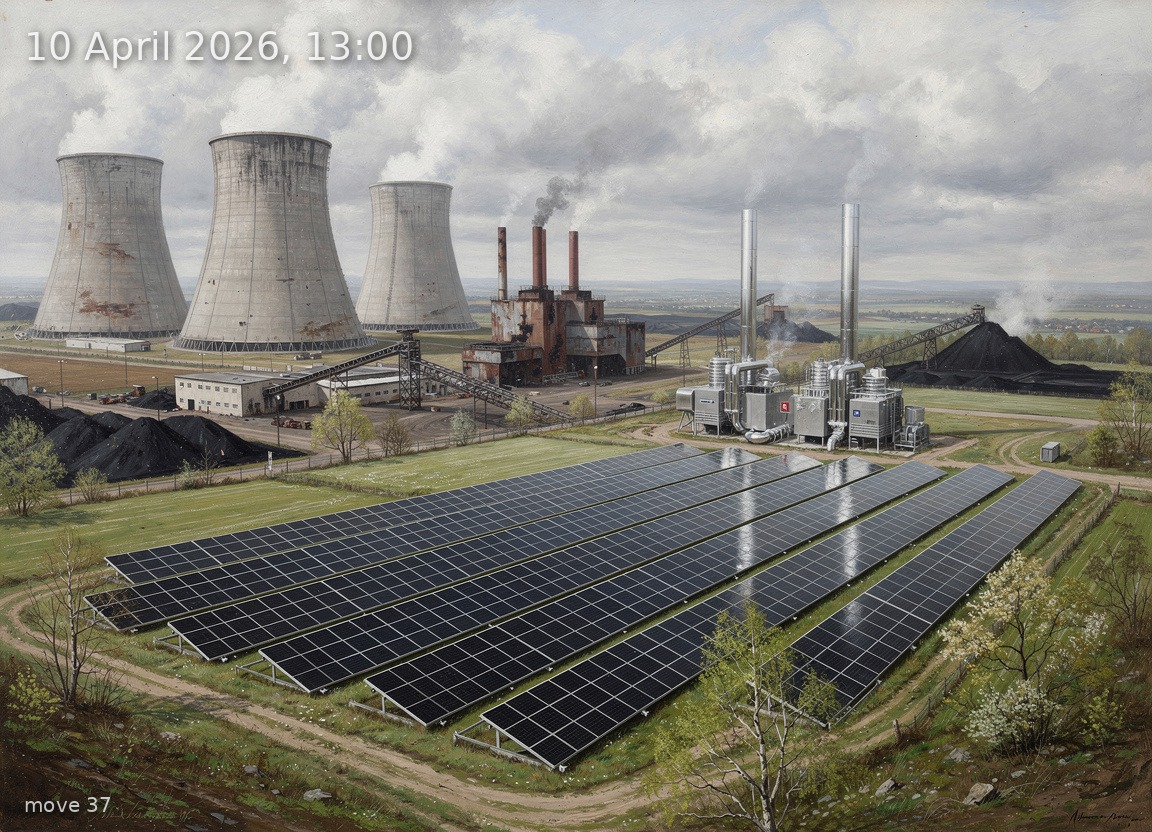
Solar leads at 26.6 GW under overcast skies; brown coal and wind provide significant support at spring midday.
Back
Generation mix
Wind onshore 13%
Wind offshore 4%
Solar 44%
Biomass 7%
Hydro 2%
Natural gas 8%
Hard coal 8%
Brown coal 13%
70%
Renewable share
10.4 GW
Wind (on + offshore)
26.6 GW
Solar
60.1 GW
Total generation
+0.7 GW
Net export
88.9 €/MWh
Day-ahead price
11.2°C / 15 km/h
Temp / Wind speed
Open-Meteo, Kassel (51.3°N 9.5°E)
100.0% / 358.0 W/m²
Cloud cover / Radiation
209
gCO₂/kWh
Image prompt
Solar 26.6 GW dominates the right half and centre of the composition as vast fields of aluminium-framed crystalline silicon PV panels stretching across gently rolling spring farmland, their surfaces reflecting a bright but diffuse white-grey sky; brown coal 8.0 GW occupies the far left as a cluster of massive hyperbolic cooling towers emitting thick white steam plumes rising into the overcast; hard coal 4.7 GW sits just right of the brown coal as a darker, soot-stained power station with tall chimneys and conveyor belts of black fuel; natural gas 5.1 GW appears as two compact CCGT units with slim silver exhaust stacks and modest heat shimmer, positioned between the coal complex and the solar fields; wind onshore 7.7 GW is rendered as a line of tall three-blade turbines with white tubular towers on a ridge behind the solar arrays, their rotors turning moderately in 15 km/h winds; wind offshore 2.6 GW is glimpsed in the far background as a row of turbines on a hazy coastal horizon; biomass 4.1 GW is a wood-clad industrial facility with a short smokestack and stacked timber nearby, nestled among the solar panels; hydro 1.3 GW appears as a small concrete dam and penstock visible in a wooded valley at the far right edge. The sky is entirely overcast at 100% cloud cover yet luminous—a flat, bright white-grey canopy with no blue patches, the midday April light (13:00 Berlin time) still strong enough to cast faint diffuse shadows. The atmosphere feels heavy and slightly oppressive, reflecting the 88.9 EUR/MWh price—humid air, a subtle haze clinging to the cooling towers, the clouds seeming to press down on the landscape. Early spring vegetation: fresh pale-green grass, budding deciduous trees, some bare branches remaining. The temperature of 11°C is conveyed through figures in light jackets. Rendered as a highly detailed oil painting in the tradition of 19th-century German Romantic landscape painters—rich, layered colour with visible brushwork, atmospheric perspective with depth receding to the misty horizon, dramatic chiaroscuro despite the overcast conditions, meticulous engineering detail on every turbine nacelle, every PV panel frame, every cooling tower's parabolic curve and reinforced concrete ribs. No text, no labels.