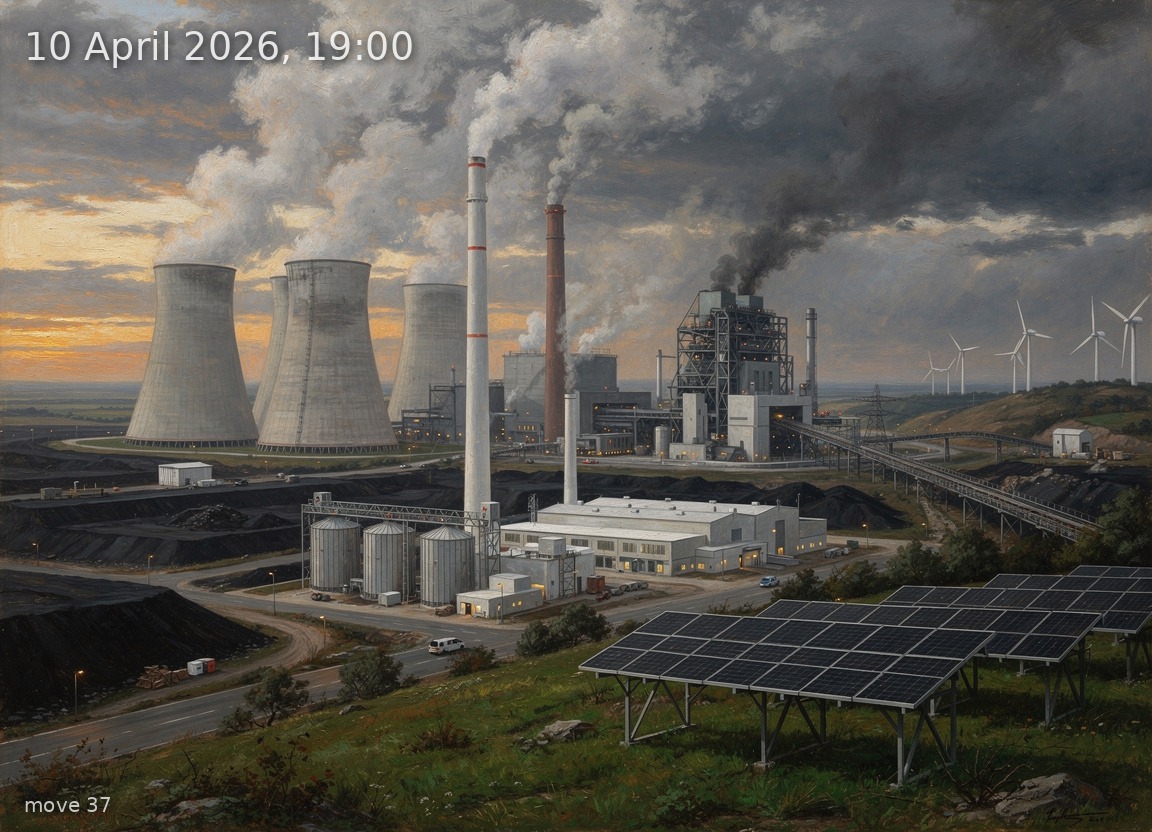
Gas, brown coal, and hard coal dominate a 33 GW generation mix while 24.5 GW of net imports fill the evening demand gap.
Back
Generation mix
Wind onshore 8%
Wind offshore 2%
Solar 5%
Biomass 14%
Hydro 4%
Natural gas 27%
Hard coal 16%
Brown coal 24%
33%
Renewable share
3.3 GW
Wind (on + offshore)
1.6 GW
Solar
33.0 GW
Total generation
-24.5 GW
Net import
227.8 €/MWh
Day-ahead price
11.4°C / 10 km/h
Temp / Wind speed
Open-Meteo, Kassel (51.3°N 9.5°E)
100.0% / 95.0 W/m²
Cloud cover / Radiation
451
gCO₂/kWh
Image prompt
Brown coal 8.0 GW dominates the left quarter as a cluster of massive hyperbolic cooling towers with thick white-grey steam plumes rising into the overcast; natural gas 8.8 GW occupies the centre-left as a row of compact CCGT power blocks with tall single exhaust stacks venting heat shimmer; hard coal 5.3 GW appears centre-right as a heavy industrial plant with large boiler houses and conveyor belts feeding dark fuel; biomass 4.6 GW is rendered as a mid-ground facility with cylindrical wood-pellet silos and a modest smokestack; wind onshore 2.7 GW shows as a small group of three-blade turbines on a low ridge in the right background, blades turning slowly in light wind; solar 1.6 GW appears as a small field of aluminium-framed crystalline silicon panels in the right foreground, their surfaces dull and reflecting no sun; wind offshore 0.6 GW is a barely visible pair of offshore turbines on a far horizon line; hydro 1.3 GW is suggested by a concrete dam spillway nestled in a valley at the far right edge. TIME OF DAY: late dusk at 19:00 in April — the sky is a band of deep orange-red glow compressed along the low western horizon, rapidly giving way to dark slate-blue and charcoal grey overhead; full 100% cloud cover creates a heavy, oppressive ceiling with no stars visible; the last fading light catches steam plumes in amber tones. The atmosphere is dense and weighty, conveying the 227.8 EUR/MWh price through visual heaviness — low clouds pressing down, hazy industrial smoke merging with overcast. Temperature is mild spring at 11.4°C: fresh green grass and early leaf buds on scattered deciduous trees, but the landscape feels subdued under the grey pall. Transmission lines with lattice pylons stretch toward the horizon in multiple directions, symbolising import flows. Style: highly detailed oil painting in the tradition of 19th-century German Romantic landscape painters — rich impasto brushwork, dramatic chiaroscuro between the glowing horizon and the darkening industrial silhouettes, atmospheric depth with layered smoke and cloud, meticulous engineering detail on every turbine nacelle, cooling tower, and exhaust stack. The scene evokes Caspar David Friedrich's sense of sublime scale but applied to a modern thermal-industrial panorama. No text, no labels.