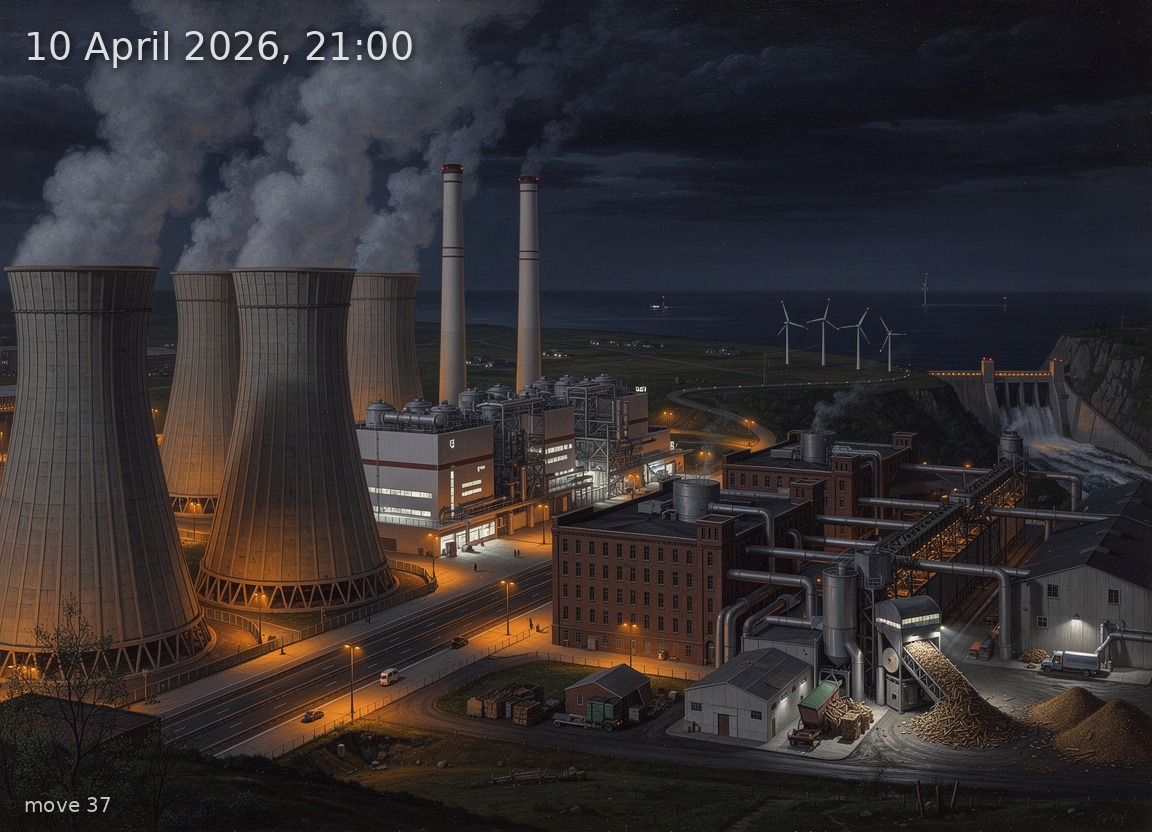
Coal, gas, and large net imports cover evening demand as wind falters and solar is absent after dark.
Back
Generation mix
Wind onshore 8%
Wind offshore 1%
Biomass 15%
Hydro 5%
Natural gas 30%
Hard coal 16%
Brown coal 25%
29%
Renewable share
2.9 GW
Wind (on + offshore)
0.0 GW
Solar
32.0 GW
Total generation
-21.1 GW
Net import
176.5 €/MWh
Day-ahead price
9.4°C / 8 km/h
Temp / Wind speed
Open-Meteo, Kassel (51.3°N 9.5°E)
100.0% / 0.0 W/m²
Cloud cover / Radiation
473
gCO₂/kWh
Image prompt
Brown coal 8.1 GW dominates the left third of the scene as a cluster of massive hyperbolic cooling towers with thick white-grey steam plumes rising into darkness; natural gas 9.5 GW fills the centre-left as a row of modern CCGT power plants with tall single exhaust stacks emitting faint heat shimmer, lit by harsh sodium-orange industrial floodlights; hard coal 5.2 GW occupies the centre-right as older brick-and-steel power station buildings with twin chimneys trailing pale smoke; biomass 4.8 GW appears as a series of medium-scale industrial boiler buildings with timber-chip conveyor belts visible under spotlights on the right side; wind onshore 2.5 GW is represented by a small cluster of three-blade turbines on a distant ridge, their red aviation warning lights blinking faintly; wind offshore 0.4 GW is barely visible as a single turbine silhouette on the far horizon; hydro 1.6 GW appears as a concrete dam spillway in the far right background, floodlit from below. The sky is completely black — no twilight, no glow, deep-navy to pitch-dark — it is 21:00 in April, fully night. Overcast clouds at 100% coverage are faintly illuminated from below by the orange industrial light pollution, creating a heavy, low, oppressive ceiling that presses down on the landscape, reflecting the extreme 176.5 EUR/MWh price. Temperature is a cool 9°C: bare early-spring trees with only the first tiny buds, damp ground, patches of mist clinging to a river in the middle distance. Wind is calm — no visible motion in the turbine blades, smoke rises nearly vertical. High-voltage transmission lines with lattice steel pylons cross the scene diagonally, cables glinting under the artificial light, symbolizing the massive import flows. Highly detailed oil painting in the tradition of 19th-century German Romantic landscape painters — rich, dark palette of deep indigo, amber, soot-grey, and furnace-orange; visible impasto brushwork; atmospheric depth with industrial haze layering the distances; meticulous engineering accuracy on every turbine nacelle, cooling tower fluting, and gas-stack detail. The mood is weighty and industrially sublime. No text, no labels.