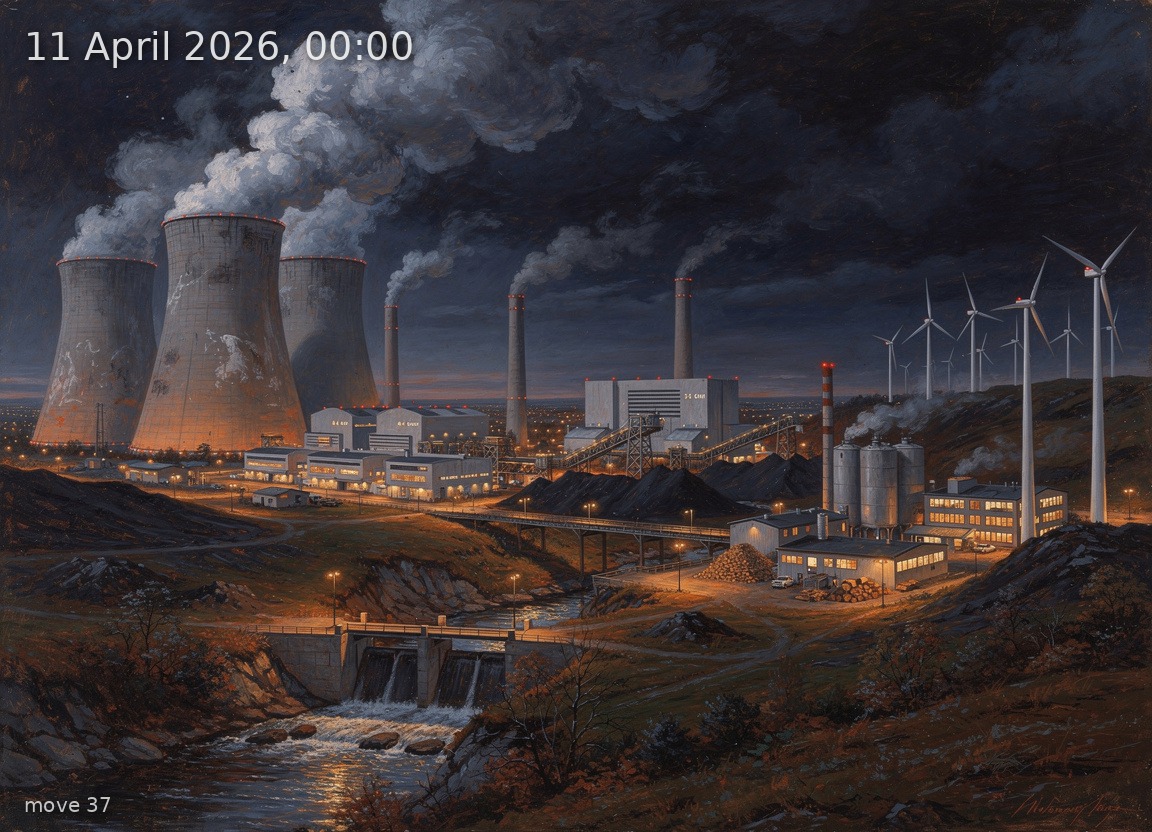
Thermal plants dominate midnight generation as low wind and absent solar drive high prices and 13.4 GW net imports.
Back
Generation mix
Wind onshore 13%
Wind offshore 1%
Biomass 14%
Hydro 4%
Natural gas 27%
Hard coal 16%
Brown coal 25%
32%
Renewable share
4.3 GW
Wind (on + offshore)
0.0 GW
Solar
31.5 GW
Total generation
-13.5 GW
Net import
134.0 €/MWh
Day-ahead price
5.5°C / 8 km/h
Temp / Wind speed
Open-Meteo, Kassel (51.3°N 9.5°E)
71.0% / 0.0 W/m²
Cloud cover / Radiation
457
gCO₂/kWh
Image prompt
Brown coal 7.7 GW occupies the left quarter as a cluster of massive hyperbolic cooling towers with thick white steam plumes rising into the black sky; natural gas 8.6 GW fills the centre-left as a row of compact CCGT plants with tall single exhaust stacks emitting thin grey plumes, illuminated by sodium-orange industrial lighting; hard coal 5.1 GW appears centre-right as a large coal-fired station with rectangular chimneys and conveyor belts under floodlights; biomass 4.4 GW sits in the right-centre as a wood-chip-fed CHP facility with a modest stack and warm amber-lit windows; wind onshore 4.0 GW occupies the far right as a line of three-blade turbines on a gentle ridge, blades turning slowly, red aviation warning lights blinking; hydro 1.4 GW is visible as a small dam structure in the mid-ground with water glinting under artificial light; offshore wind 0.2 GW appears as a single distant turbine silhouette barely visible on the far horizon. The sky is completely dark, deep navy-black with no twilight or glow, heavy overcast clouds at 71% coverage blocking all stars except faint patches. The atmosphere feels heavy and oppressive, reflecting the 134 EUR/MWh price — a thick, brooding industrial haze clings to the middle distance. Early spring landscape: bare deciduous trees with the first tiny buds, cool-toned dormant grass at 5.5 °C, frost forming on metal surfaces. Light wind barely stirs the scene. All facilities are lit by sodium streetlights casting orange pools, with glowing control-room windows. Rendered as a highly detailed oil painting in the tradition of 19th-century German Romantic landscape painters — rich, moody colour palette of deep indigos, burnt oranges, and warm industrial ambers, visible confident brushwork, atmospheric depth with layered smoke and steam receding into darkness, meticulous engineering detail on every turbine nacelle, cooling tower, and exhaust stack. The composition evokes a monumental nocturnal industrial landscape, dramatic yet documentary. No text, no labels.