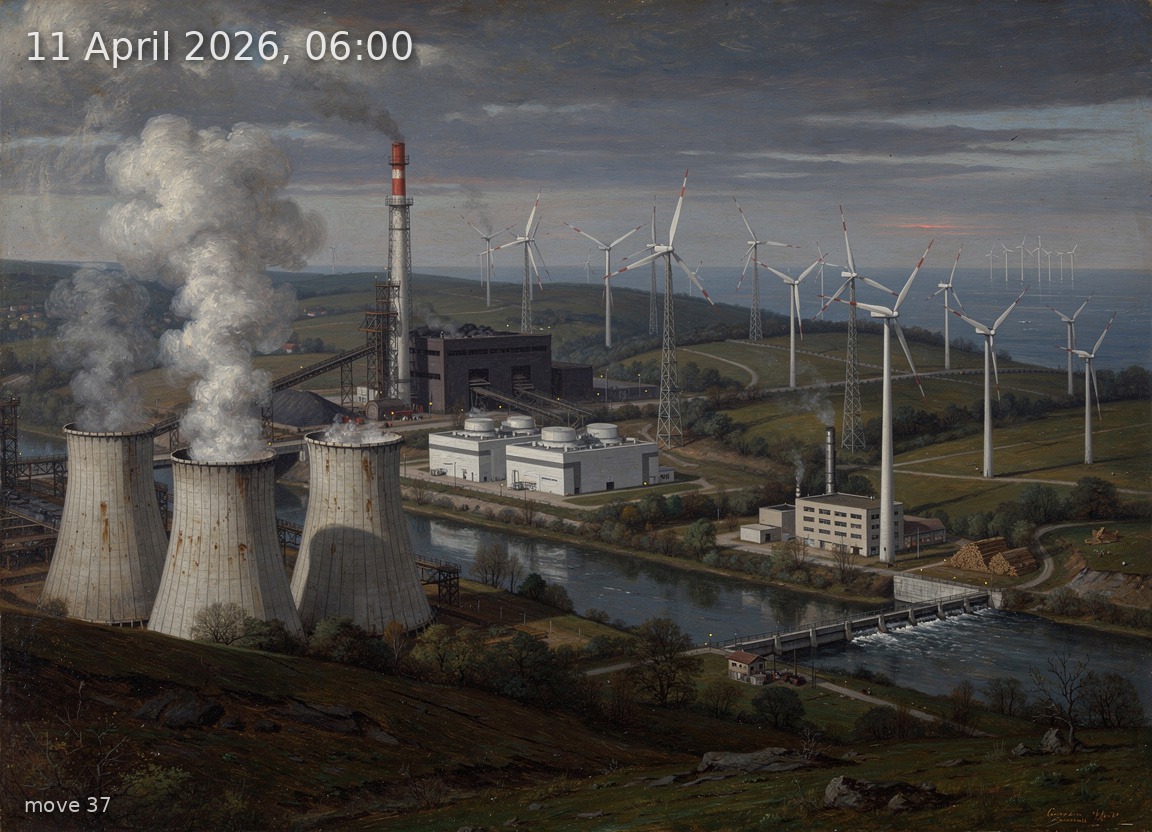
Wind leads at 16.2 GW with heavy coal and gas backup; 6.5 GW net imports cover cold morning demand.
Back
Generation mix
Wind onshore 30%
Wind offshore 11%
Solar 1%
Biomass 11%
Hydro 4%
Natural gas 14%
Hard coal 11%
Brown coal 18%
57%
Renewable share
16.3 GW
Wind (on + offshore)
0.3 GW
Solar
39.2 GW
Total generation
-6.5 GW
Net import
106.6 €/MWh
Day-ahead price
0.1°C / 7 km/h
Temp / Wind speed
Open-Meteo, Kassel (51.3°N 9.5°E)
64.0% / 0.0 W/m²
Cloud cover / Radiation
301
gCO₂/kWh
Image prompt
Wind onshore 11.9 GW dominates the right half of the scene as dozens of three-blade turbines on tall lattice-and-tubular towers stretching across rolling Thuringian hills, blades turning slowly in light wind; wind offshore 4.3 GW appears as a distant cluster of larger turbines on the far-right horizon above a faintly visible North Sea coastline. Brown coal 7.1 GW occupies the left foreground as a massive Lusatian-style lignite complex with four hyperbolic concrete cooling towers issuing thick white-grey steam plumes rising into heavy air. Natural gas 5.6 GW sits centre-left as two compact CCGT power blocks with slender single exhaust stacks emitting thin transparent heat shimmer. Hard coal 4.3 GW appears behind the gas plant as a dark industrial hall with a single large smokestack and coal conveyors. Biomass 4.3 GW is rendered as a mid-ground wood-chip CHP plant with a modest rectangular boiler building and a small plume. Hydro 1.4 GW is a concrete run-of-river weir visible along a narrow river cutting through the valley floor. Solar 0.3 GW is virtually absent — no panels visible, reinforcing the pre-dawn darkness. The sky is deep blue-grey pre-dawn light at 06:00 in April — no direct sunlight, only the faintest pale luminescence on the eastern horizon beneath a 64% overcast layer of stratocumulus clouds pressing low. The atmosphere feels heavy and oppressive, reflecting the high electricity price: mist clings to the valley, steam and haze blend together, sodium-orange industrial lights glow across the coal complex and gas plant. Temperature is freezing — frost whitens the bare early-spring grass and leafless birch trees, patches of old snow linger in furrows. Puddles near the river show thin ice. Painted in the style of a highly detailed 19th-century German Romantic oil painting — rich impasto brushwork, Caspar David Friedrich atmospheric depth and melancholy grandeur — but with meticulous engineering accuracy on every turbine nacelle, every cooling tower ribbing, every CCGT exhaust stack geometry. Deep, moody colour palette of slate blues, warm ambers from artificial light, and cold whites from steam. No text, no labels.