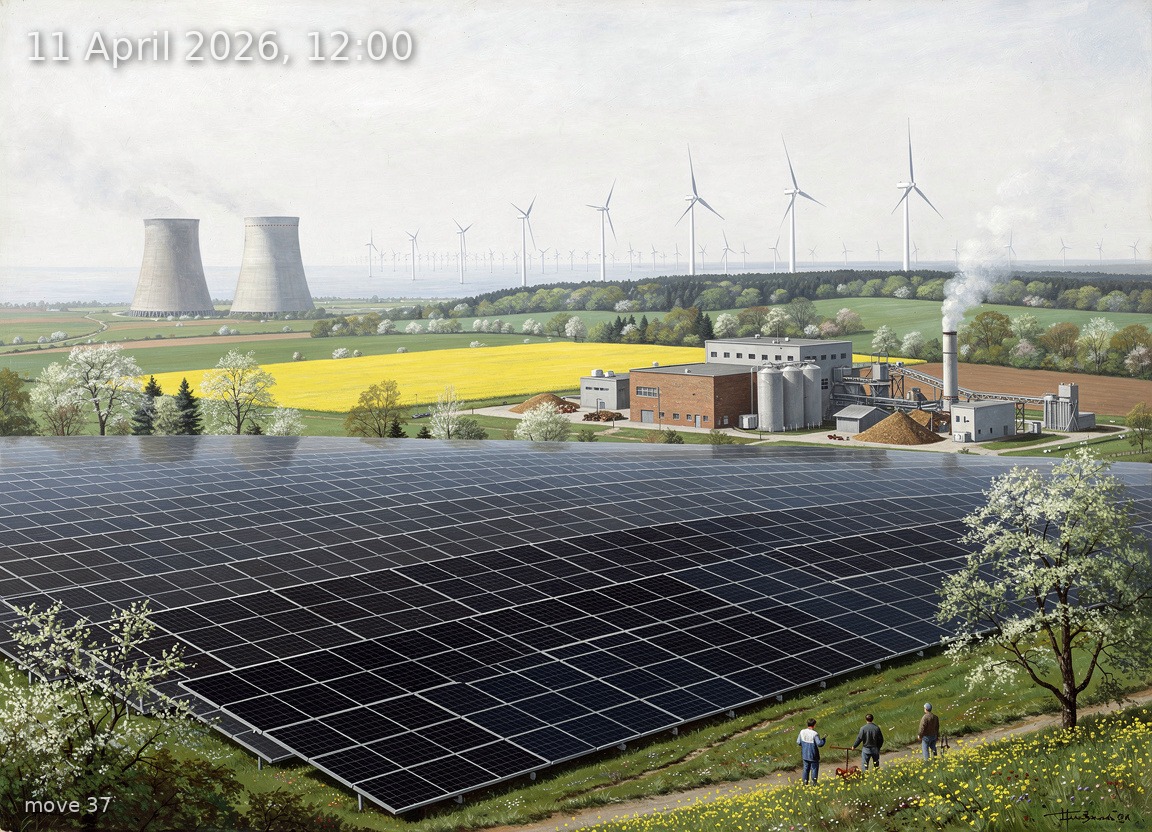
Solar at 49.8 GW and wind at 13.9 GW drive 19.4 GW net exports and deeply negative prices.
Back
Generation mix
Wind onshore 12%
Wind offshore 7%
Solar 67%
Biomass 6%
Hydro 2%
Natural gas 3%
Hard coal 1%
Brown coal 3%
93%
Renewable share
14.0 GW
Wind (on + offshore)
49.8 GW
Solar
74.4 GW
Total generation
+19.4 GW
Net export
-40.3 €/MWh
Day-ahead price
13.7°C / 18 km/h
Temp / Wind speed
Open-Meteo, Kassel (51.3°N 9.5°E)
100.0% / 361.2 W/m²
Cloud cover / Radiation
46
gCO₂/kWh
Image prompt
Solar 49.8 GW dominates two-thirds of the composition as an immense expanse of crystalline silicon photovoltaic panels stretching across gently rolling central German farmland, their aluminium frames catching diffuse midday light under a fully overcast but luminous white-grey sky; wind onshore 8.7 GW appears as a long row of modern three-blade turbines on a ridge in the middle distance, rotors turning steadily in moderate wind; wind offshore 5.2 GW is suggested by a cluster of turbines visible on a hazy far horizon; biomass 4.2 GW is rendered as a mid-ground wood-chip power station with a squat industrial chimney and steam; brown coal 2.4 GW occupies a small left-background zone as two hyperbolic cooling towers with thin wisps of steam, looking diminished; natural gas 2.1 GW appears as a compact CCGT plant with a single tall exhaust stack emitting a faint heat shimmer beside the cooling towers; hydro 1.3 GW is a small run-of-river weir with a powerhouse nestled in a wooded valley at the far left; hard coal 0.6 GW is a single small stack barely visible behind the gas plant. The sky is bright but uniformly overcast — no blue patches, no direct sun disk, yet the landscape is flooded with strong diffuse daylight consistent with noon. Spring vegetation: fresh pale-green leaves on deciduous trees, yellow rapeseed fields beginning to bloom, temperature around 14°C conveyed through light jackets on tiny figures near the solar farm. The atmosphere is calm, open, and spacious, reflecting deeply negative electricity prices. Highly detailed oil painting in the tradition of 19th-century German Romantic landscape painters — Caspar David Friedrich's atmospheric depth fused with meticulous industrial-technical accuracy: visible turbine nacelle housings, transformer substations beside the solar field, lattice transmission towers carrying power away. Rich colour palette of silver-whites, spring greens, and muted industrial greys, with visible confident brushwork and luminous glazing in the overcast sky. No text, no labels.