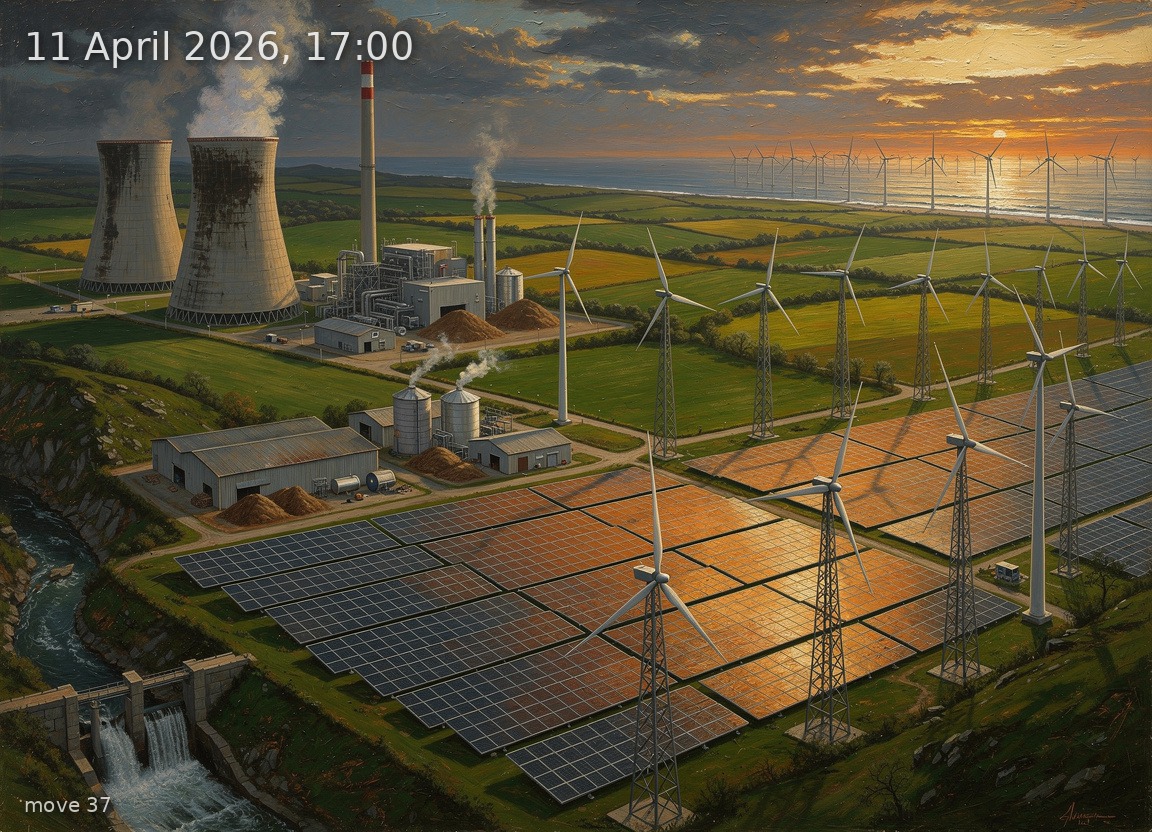
Wind (26.3 GW) and solar (19.3 GW) drive 90% renewable generation, creating 4.9 GW net export at near-zero prices.
Back
Generation mix
Wind onshore 37%
Wind offshore 9%
Solar 34%
Biomass 7%
Hydro 2%
Natural gas 4%
Hard coal 1%
Brown coal 4%
90%
Renewable share
26.4 GW
Wind (on + offshore)
19.3 GW
Solar
56.4 GW
Total generation
+4.9 GW
Net export
-0.7 €/MWh
Day-ahead price
17.3°C / 21 km/h
Temp / Wind speed
Open-Meteo, Kassel (51.3°N 9.5°E)
69.0% / 340.8 W/m²
Cloud cover / Radiation
64
gCO₂/kWh
Image prompt
Wind onshore 21.0 GW dominates the right two-thirds of the scene as vast ranks of three-blade turbines on lattice and tubular steel towers stretching across rolling green April farmland, rotors visibly spinning in strong wind; wind offshore 5.3 GW appears as a distant row of larger turbines on the far-right horizon above a silver strip of sea. Solar 19.3 GW fills the centre-left foreground as expansive fields of aluminium-framed crystalline silicon photovoltaic panels angled toward the low western sun, their glass surfaces catching copper-orange reflections. Biomass 4.2 GW is rendered as a cluster of modest industrial buildings with wood-chip silos and low exhaust stacks emitting thin white vapour in the left-centre middle ground. Brown coal 2.5 GW occupies the far left as two hyperbolic concrete cooling towers releasing slender steam plumes against the darkening sky. Natural gas 2.4 GW appears as a compact CCGT plant with a single tall exhaust stack and smaller heat recovery unit adjacent to the cooling towers. Hydro 1.1 GW is suggested by a small dam and spillway in a valley at the far left edge. Hard coal 0.6 GW is a single small stack barely visible behind the gas plant, with the faintest wisp of exhaust. The sky reflects 17:00 Berlin dusk in mid-April: a vivid orange-red glow hugs the western horizon where the sun has just touched the land, fading upward through amber and rose into deepening slate-blue overhead; 69% cloud cover manifests as broken stratocumulus lit dramatically from below in salmon and gold. Spring vegetation — fresh bright-green wheat fields, budding deciduous trees — covers the gently undulating terrain at 17°C warmth. The atmosphere is calm and luminous, consistent with a near-zero electricity price — open, spacious, unburdened. Rendered as a highly detailed oil painting in the tradition of Caspar David Friedrich and Carl Blechen: rich layered colour, visible impasto brushwork, deep atmospheric perspective, dramatic Romantic light — yet with meticulous engineering accuracy on every turbine nacelle, PV cell grid, cooling tower curvature, and industrial detail. No text, no labels, no people in the foreground.