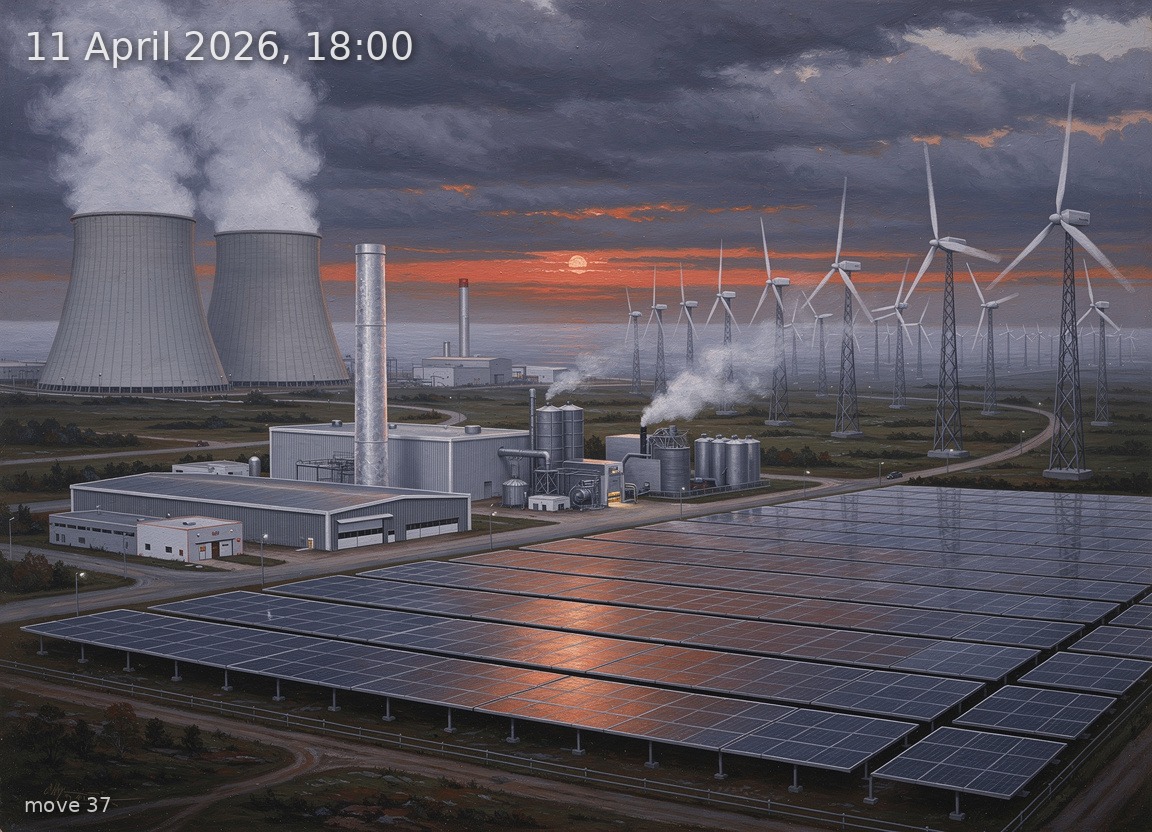
Strong onshore wind at 23.1 GW leads an 87% renewable mix as evening demand slightly exceeds domestic generation.
Back
Generation mix
Wind onshore 47%
Wind offshore 12%
Solar 17%
Biomass 9%
Hydro 3%
Natural gas 6%
Hard coal 1%
Brown coal 5%
87%
Renewable share
29.2 GW
Wind (on + offshore)
8.3 GW
Solar
49.8 GW
Total generation
-2.2 GW
Net import
43.7 €/MWh
Day-ahead price
17.0°C / 20 km/h
Temp / Wind speed
Open-Meteo, Kassel (51.3°N 9.5°E)
86.0% / 141.5 W/m²
Cloud cover / Radiation
84
gCO₂/kWh
Image prompt
Wind onshore 23.1 GW dominates the right two-thirds of the scene as vast rows of three-blade turbines on lattice towers stretching deep into the landscape, rotors visibly spinning in strong wind; wind offshore 6.1 GW appears in the far background as a line of larger offshore turbines along a distant grey sea horizon; solar 8.3 GW occupies the centre-right foreground as fields of aluminium-framed crystalline silicon PV panels catching the last dim orange-red light reflected from the low horizon; biomass 4.4 GW is rendered as a mid-ground cluster of compact biomass power plants with rectangular boiler buildings and single stacks emitting thin white steam; natural gas 3.0 GW appears in the centre-left as two modern CCGT units with sleek exhaust stacks and modest heat shimmer; brown coal 2.7 GW occupies the far left as a pair of hyperbolic cooling towers with dense steam plumes rising into the overcast sky; hard coal 0.6 GW is a single smaller conventional stack tucked behind the brown coal complex with a thin wisp of exhaust; hydro 1.4 GW is suggested by a small dam structure with cascading water in the left foreground. Time of day is dusk at 18:00 in April: the sky is 86% overcast with heavy grey-violet clouds, a narrow band of deep orange-red glow sits on the western horizon, the upper sky is rapidly darkening to slate blue. The atmosphere is moderate, neither oppressive nor serene, reflecting a 43.7 EUR/MWh price. Temperature is a mild 17°C spring evening: fresh green grass and budding deciduous trees, some wildflowers in the foreground meadow. Wind at 20 km/h bends the grass and tree branches, and drives the turbine blades visibly. Style: highly detailed oil painting in the tradition of 19th-century German Romantic landscape painters — Caspar David Friedrich's atmospheric depth merged with meticulous industrial engineering detail. Rich colour palette of dusky violets, slate greys, ember oranges, and spring greens. Visible impasto brushwork in the clouds and steam plumes, fine detail on turbine nacelles, PV panel frames, and cooling tower reinforcement ribs. No text, no labels.