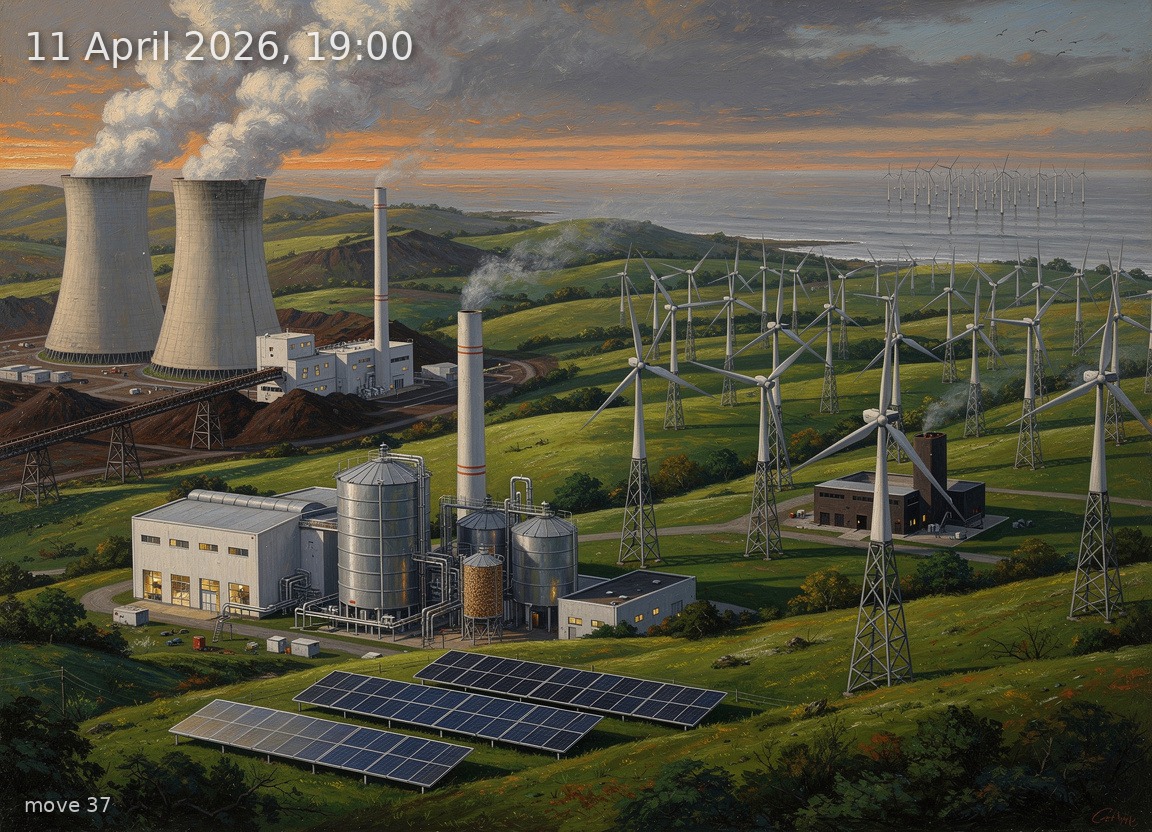
Strong onshore wind leads at 24.9 GW as fading solar and moderate fossil dispatch shape the evening transition.
Back
Generation mix
Wind onshore 53%
Wind offshore 13%
Solar 4%
Biomass 10%
Hydro 3%
Natural gas 8%
Hard coal 2%
Brown coal 8%
82%
Renewable share
31.1 GW
Wind (on + offshore)
1.7 GW
Solar
47.3 GW
Total generation
-4.7 GW
Net import
73.8 €/MWh
Day-ahead price
16.9°C / 20 km/h
Temp / Wind speed
Open-Meteo, Kassel (51.3°N 9.5°E)
42.0% / 78.0 W/m²
Cloud cover / Radiation
120
gCO₂/kWh
Image prompt
Wind onshore 24.9 GW dominates the right two-thirds of the scene as vast ranks of three-blade turbines on lattice towers stretching across rolling green spring hills, rotors spinning briskly in strong wind; wind offshore 6.2 GW appears in the far right background as a cluster of turbines standing in a grey sea on the horizon. Brown coal 3.7 GW occupies the left foreground as two massive hyperbolic concrete cooling towers releasing thick white steam plumes, beside a conveyor belt feeding dark lignite into a powerhouse. Natural gas 3.9 GW sits to the left-centre as a pair of compact CCGT units with tall single exhaust stacks emitting thin pale vapour. Biomass 4.6 GW appears centre-left as a mid-sized industrial plant with rounded storage silos of wood pellets and a modest smokestack. Solar 1.7 GW is represented by a small field of aluminium-framed crystalline silicon panels in the centre foreground, their surfaces dim, catching only the last faint glow of dusk. Hard coal 1.0 GW appears as a single smaller coal plant behind the biomass facility, with a squat square stack. Hydro 1.4 GW is shown as a small concrete dam and spillway nestled in a valley in the mid-distance. The sky is a dusk scene at 19:00 in April: a narrow band of deep orange-red light hugs the lower horizon to the west, rapidly fading upward into dusky violet and then darkening blue-grey overhead; 42% cloud cover shows broken cumulus catching the last orange light underneath while their tops go grey. The atmosphere feels moderately heavy and warm, with a faint haze suggesting the 73.8 EUR/MWh price tension. Spring vegetation—fresh bright-green grass and budding deciduous trees at 16.9°C—covers the hillsides. Wind visibly bends grass and tree branches. A few sodium-orange streetlights begin to glow along a distant road. Highly detailed oil painting in the tradition of 19th-century German Romantic landscape painters—Caspar David Friedrich meets industrial sublime—rich saturated colour, visible impasto brushwork, deep atmospheric perspective, meticulous engineering detail on every turbine nacelle, cooling tower, and panel frame. No text, no labels.