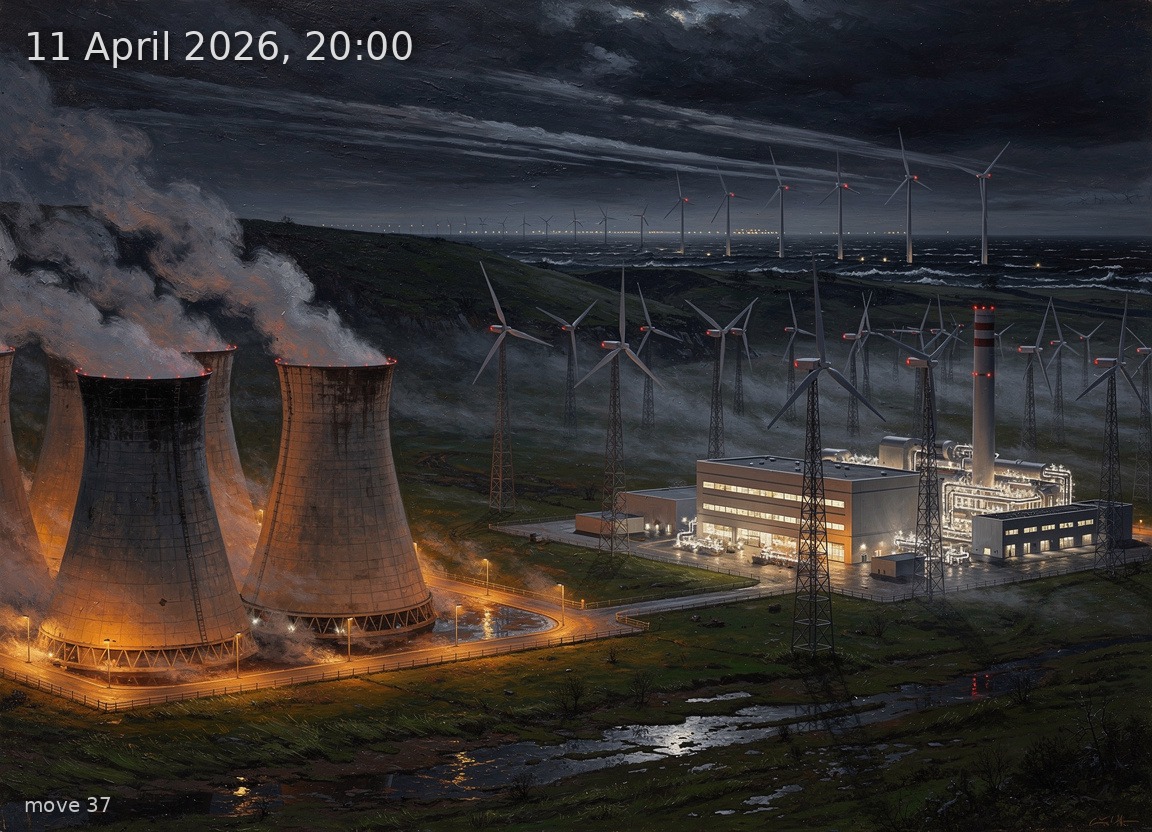
Strong onshore wind dominates at 27.8 GW after dark; thermal plants and imports cover a narrow 1.8 GW gap.
Back
Generation mix
Wind onshore 56%
Wind offshore 12%
Solar 0%
Biomass 9%
Hydro 3%
Natural gas 9%
Hard coal 2%
Brown coal 8%
80%
Renewable share
33.8 GW
Wind (on + offshore)
0.0 GW
Solar
49.7 GW
Total generation
-1.8 GW
Net import
74.8 €/MWh
Day-ahead price
14.7°C / 20 km/h
Temp / Wind speed
Open-Meteo, Kassel (51.3°N 9.5°E)
100.0% / 17.2 W/m²
Cloud cover / Radiation
130
gCO₂/kWh
Image prompt
Wind onshore 27.8 GW dominates the right two-thirds of the canvas as vast ranks of three-blade turbines on lattice towers stretching deep into the scene, rotors spinning briskly in strong wind; wind offshore 6.0 GW appears as a distant line of taller turbines along a far horizon over a dark sea glimpsed through a gap in hills; brown coal 4.1 GW occupies the left foreground as a cluster of massive hyperbolic cooling towers emitting thick pale steam plumes lit from below by sodium-orange industrial lights; natural gas 4.6 GW sits adjacent as a pair of compact CCGT power blocks with tall single exhaust stacks and glowing turbine halls; biomass 4.7 GW appears as a modest wood-chip-fired plant with a rectangular stack and conveyor belt, warmly lit; hard coal 1.2 GW is a smaller conventional boiler house with a single square chimney; hydro 1.4 GW is a concrete dam spillway at the far left edge, water faintly catching light. Time is 20:00 in April — fully dark, deep navy-to-black sky, no twilight, no sky glow, 100% cloud cover obscuring all stars, only artificial lighting. Sodium streetlamps cast orange pools on wet roads, glowing windows in distant village houses, red aviation warning lights blinking atop turbine nacelles. The atmosphere feels heavy and overcast, mildly oppressive, reflecting a 74.8 EUR/MWh price. Spring vegetation: fresh green grass and budding trees visible where light spills, temperature mild at 14.7°C suggesting damp air. Strong wind animates the scene — grass bends, steam plumes shear sideways, turbine blades blur with motion. Style: highly detailed oil painting in the tradition of Caspar David Friedrich and Carl Blechen — rich, deep colour palette of indigo, amber, charcoal, and steel grey; visible impasto brushwork; atmospheric depth with layers of mist between turbine rows; dramatic chiaroscuro between industrial glow and surrounding darkness. Meticulous engineering accuracy on all technology. No text, no labels, no people in foreground.