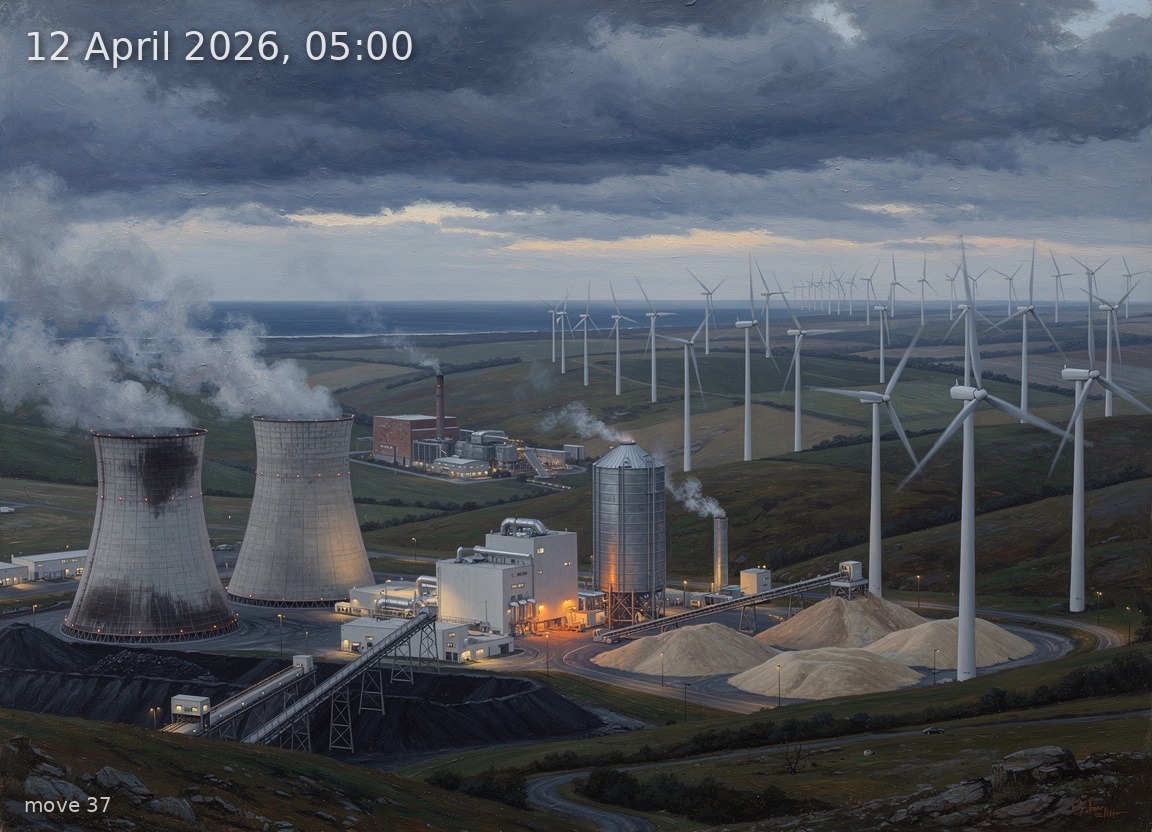
Wind leads at 16.5 GW with brown coal baseload; 11 GW net imports needed to meet pre-dawn demand.
Back
Generation mix
Wind onshore 39%
Wind offshore 15%
Biomass 14%
Hydro 4%
Natural gas 10%
Hard coal 2%
Brown coal 17%
71%
Renewable share
16.5 GW
Wind (on + offshore)
0.0 GW
Solar
30.9 GW
Total generation
-11.0 GW
Net import
98.1 €/MWh
Day-ahead price
6.6°C / 12 km/h
Temp / Wind speed
Open-Meteo, Kassel (51.3°N 9.5°E)
100.0% / 0.0 W/m²
Cloud cover / Radiation
201
gCO₂/kWh
Image prompt
Wind onshore 11.9 GW dominates the right half of the scene as dozens of tall three-blade turbines with white tubular towers and nacelles stretching across rolling hills into the distance; wind offshore 4.6 GW appears as a cluster of larger turbines on the far-right horizon, barely visible through haze above a dark North Sea sliver. Brown coal 5.1 GW occupies the left foreground as two massive hyperbolic cooling towers emitting thick steam plumes, flanked by conveyor belts and lignite stockpiles. Biomass 4.2 GW is rendered as a mid-ground industrial plant with a tall cylindrical silo, wood-chip storage yard, and a single smokestack with faint exhaust. Natural gas 3.0 GW appears as a compact CCGT facility to the left of centre with a slim exhaust stack and visible heat-shimmer. Hard coal 0.7 GW is a smaller, older power station behind the gas plant, with a single squat chimney and a modest coal heap. Hydro 1.3 GW appears as a concrete dam structure nestled in a valley in the far mid-ground, water gleaming faintly. Pre-dawn hour: the sky is deep blue-grey with the faintest pale luminescence along the eastern horizon—no direct sunlight, no warm tones, only the cold suggestion of approaching dawn. Complete overcast: a thick unbroken blanket of cloud presses low, creating a heavy, oppressive atmosphere reflecting the 98.1 EUR/MWh price. Temperature 6.6 °C early April: bare branches on scattered trees, sparse new-green grass, patches of frost on the ground. Wind 11.8 km/h animates the turbine blades with visible rotation blur and bends the steam plumes from the cooling towers slightly to the west. Sodium-orange streetlights and warm industrial lighting illuminate the coal and gas facilities, casting long amber reflections on wet pavement. High-voltage transmission lines cross the scene, symbolising the heavy import flows. Style: richly detailed oil painting in the tradition of Caspar David Friedrich and Carl Blechen—dramatic atmospheric depth, luminous glazing in the sky, visible impasto brushwork on the industrial structures, Romantic grandeur meeting meticulous engineering accuracy. No text, no labels.