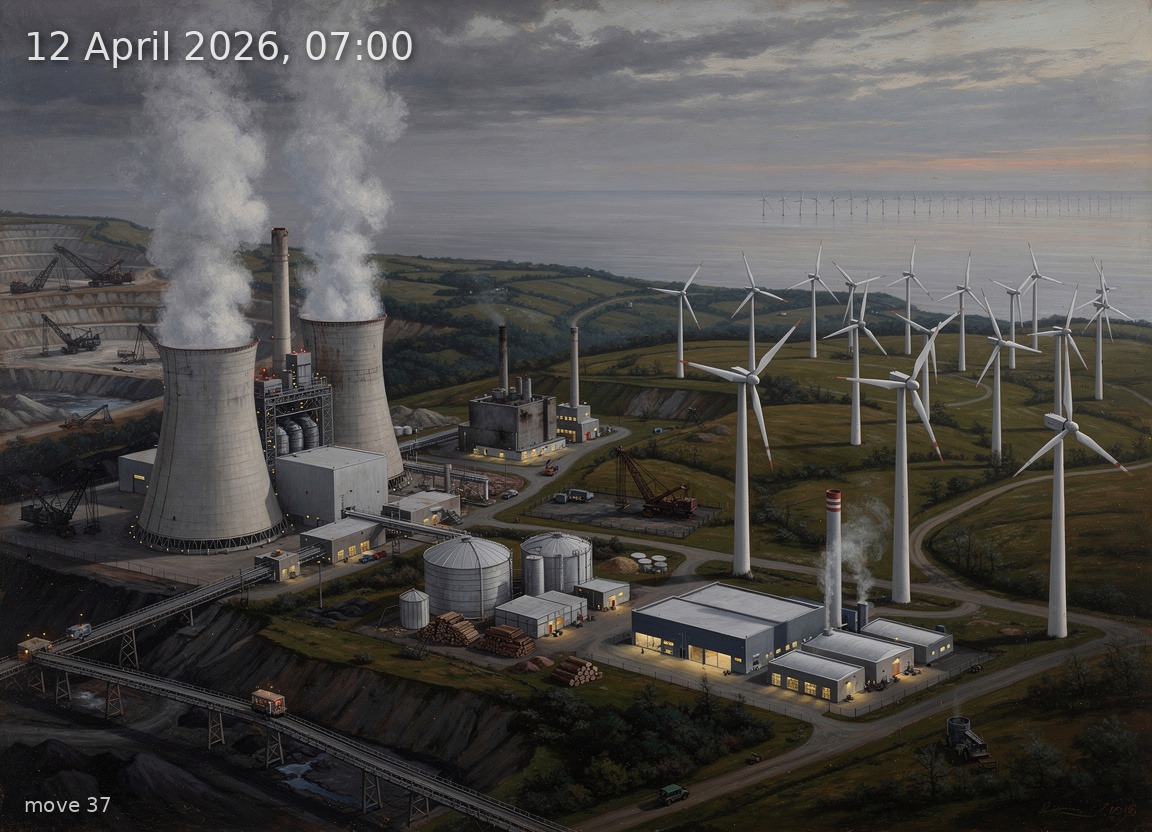
Wind leads at 14.6 GW but heavy overcast and 15.3 GW net imports drive prices above 94 EUR/MWh.
Back
Generation mix
Wind onshore 30%
Wind offshore 17%
Solar 6%
Biomass 14%
Hydro 4%
Natural gas 10%
Hard coal 2%
Brown coal 16%
72%
Renewable share
14.6 GW
Wind (on + offshore)
2.0 GW
Solar
31.2 GW
Total generation
-15.2 GW
Net import
94.3 €/MWh
Day-ahead price
6.3°C / 4 km/h
Temp / Wind speed
Open-Meteo, Kassel (51.3°N 9.5°E)
100.0% / 0.0 W/m²
Cloud cover / Radiation
198
gCO₂/kWh
Image prompt
Wind onshore 9.3 GW dominates the right half of the scene as dozens of three-blade turbines with white tubular towers and large nacelles stretching across rolling green-brown early-spring hills; wind offshore 5.3 GW appears in the far-right background as a line of turbines on a grey sea horizon. Brown coal 5.0 GW occupies the left foreground as a massive lignite power station with three hyperbolic concrete cooling towers emitting thick white steam plumes, conveyor belts carrying dark lignite from an open-cast mine. Biomass 4.5 GW sits centre-left as a cluster of mid-sized industrial plants with wood-chip storage domes and modest chimneys releasing thin grey exhaust. Natural gas 3.1 GW appears centre-right as two compact CCGT units with single tall exhaust stacks and visible heat shimmer. Solar 2.0 GW is shown as a small field of aluminium-framed crystalline silicon panels in the middle ground, their surfaces dull and reflecting only grey sky, no sunlight hitting them. Hard coal 0.7 GW is a single smaller stack behind the brown coal complex. Hydro 1.3 GW is a concrete dam with modest spillway visible in a valley at far left. TIME OF DAY: 07:00 pre-dawn to earliest dawn light — the sky is deep blue-grey transitioning to a pale cold band at the eastern horizon, no direct sunlight, no warm tones, only diffuse grey-blue illumination. Cloud cover is total: a thick unbroken overcast ceiling presses low and heavy, oppressive and leaden, conveying the high electricity price. Temperature is 6.3 °C in early spring: grass is muted green-brown, bare branches on scattered deciduous trees, patches of frost on shadows, breath-like mist near ground level. Light wind barely moves the turbine blades. Transmission pylons with high-voltage lines stretch into the distant haze, symbolising import flows. Style: highly detailed oil painting in the tradition of 19th-century German Romantic landscape painters — Caspar David Friedrich's atmospheric depth merged with meticulous industrial realism — rich dark palette of slate grey, Prussian blue, raw umber, and muted olive, visible textured brushwork, dramatic chiaroscuro between glowing industrial lights and the dim pre-dawn sky. Each technology rendered with correct engineering detail. No text, no labels.