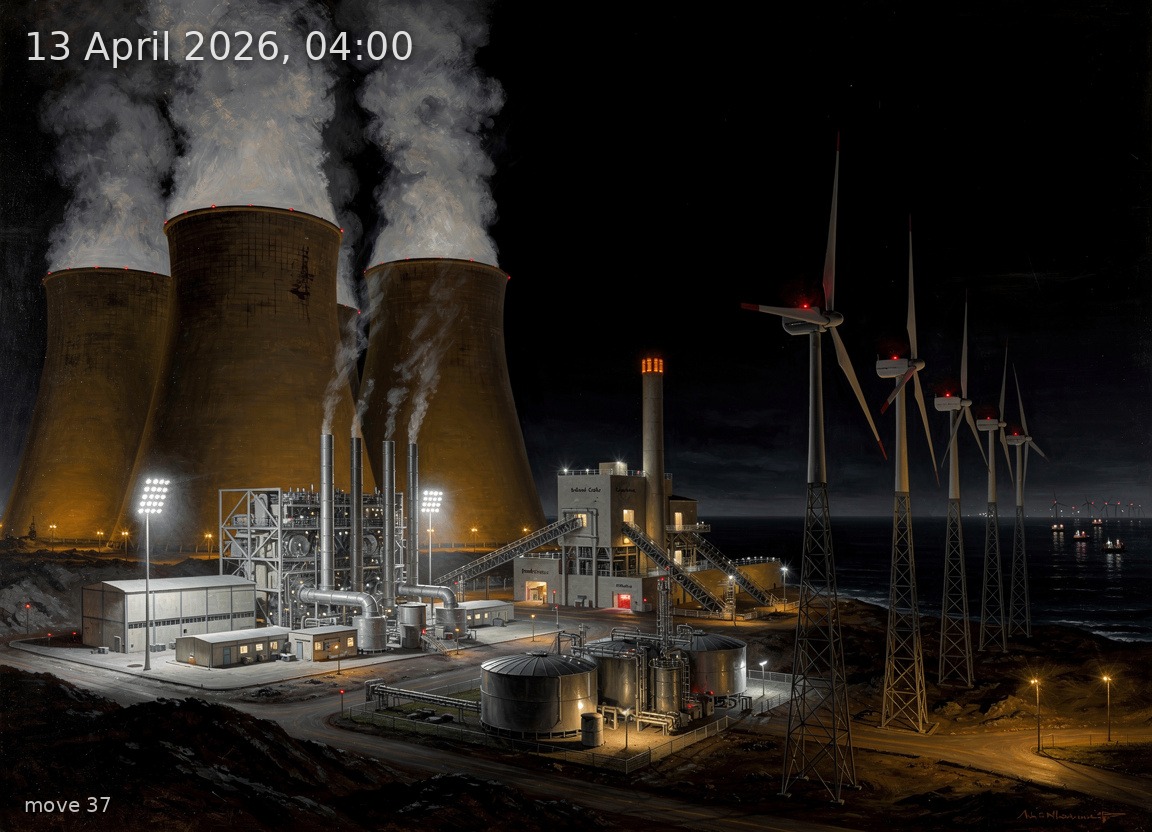
Brown coal, gas, and hard coal anchor overnight supply while 9.3 GW of net imports cover the domestic generation shortfall.
Back
Generation mix
Wind onshore 18%
Wind offshore 7%
Biomass 12%
Hydro 4%
Natural gas 21%
Hard coal 13%
Brown coal 25%
41%
Renewable share
9.0 GW
Wind (on + offshore)
0.0 GW
Solar
35.0 GW
Total generation
-9.2 GW
Net import
110.0 €/MWh
Day-ahead price
8.1°C / 7 km/h
Temp / Wind speed
Open-Meteo, Kassel (51.3°N 9.5°E)
100.0% / 0.0 W/m²
Cloud cover / Radiation
402
gCO₂/kWh
Image prompt
Brown coal 8.7 GW dominates the left third of the scene as a cluster of massive hyperbolic cooling towers with thick white-grey steam plumes rising into blackness, lit from below by amber sodium lamps on the plant grounds; natural gas 7.4 GW fills the centre-left as a compact CCGT facility with tall single exhaust stacks emitting thin vapour trails, illuminated by floodlights; hard coal 4.4 GW appears centre-right as a smaller coal-fired station with rectangular boiler houses, conveyor belts, and a tall chimney glowing faintly orange at its tip; wind onshore 6.5 GW stretches across the right quarter as a row of tall three-blade turbines on lattice towers, their red aviation warning lights blinking in the darkness, rotors turning slowly in light wind; wind offshore 2.5 GW is suggested by distant turbine lights on the far-right horizon over a dark sea; biomass 4.2 GW appears as a mid-ground industrial biogas facility with cylindrical digesters and a modest stack, softly lit; hydro 1.4 GW is a small dam structure in the lower-right foreground with water gleaming under artificial light. The sky is completely black with 100% cloud cover — no stars, no moon, no twilight glow whatsoever, a deep oppressive overcast ceiling pressing down. The season is early spring: bare-branched trees with the faintest suggestion of budding leaves visible near sodium streetlights, damp ground, patches of mist hugging low terrain. The atmosphere is heavy and brooding, reflecting the high 110 EUR/MWh price — dense, humid air trapping the industrial haze. Temperature around 8°C gives a cool, damp feel with condensation visible on metal surfaces. Style: highly detailed oil painting in the tradition of 19th-century German Romantic landscape painters — rich impasto brushwork, dramatic chiaroscuro between deep shadows and amber industrial glow, atmospheric depth with layers of mist and steam receding into darkness. Each energy technology rendered with meticulous engineering accuracy: turbine nacelles and three-blade rotors, aluminium-framed structures, lignite hyperbolic cooling towers with correct proportions, CCGT exhaust geometry. The scene feels like a monumental Caspar David Friedrich nightscape reimagined for the industrial age. No text, no labels.