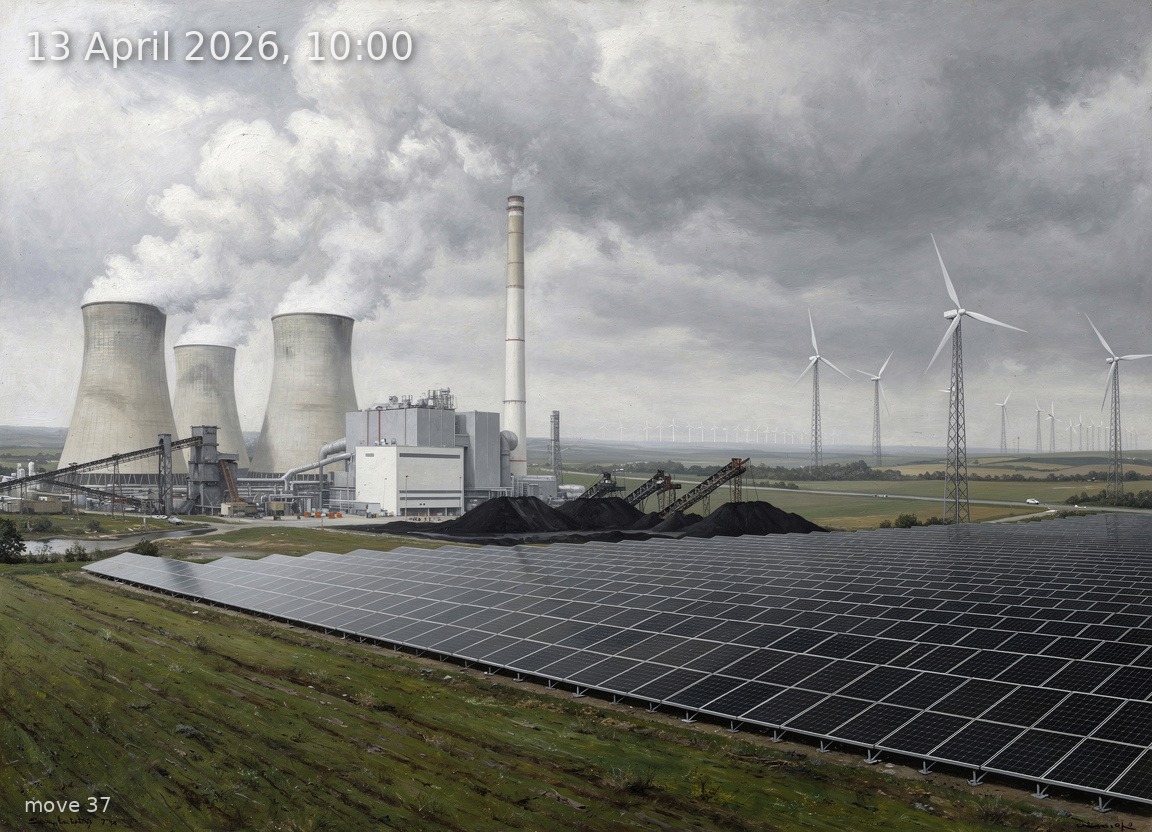
Diffuse solar leads at 17.9 GW under full overcast; heavy fossil dispatch and 12.1 GW net imports meet strong demand.
Back
Generation mix
Wind onshore 12%
Wind offshore 4%
Solar 33%
Biomass 8%
Hydro 3%
Natural gas 16%
Hard coal 9%
Brown coal 15%
60%
Renewable share
8.7 GW
Wind (on + offshore)
17.9 GW
Solar
54.7 GW
Total generation
-12.1 GW
Net import
138.6 €/MWh
Day-ahead price
9.5°C / 10 km/h
Temp / Wind speed
Open-Meteo, Kassel (51.3°N 9.5°E)
100.0% / 3.8 W/m²
Cloud cover / Radiation
272
gCO₂/kWh
Image prompt
Solar 17.9 GW dominates the centre-right as an expansive field of aluminium-framed crystalline silicon PV panels stretching across flat farmland under a uniformly grey, heavy overcast sky—no direct sunlight, only diffuse grey illumination; brown coal 8.2 GW occupies the far left as a cluster of massive hyperbolic cooling towers with thick white steam plumes rising into the oppressive cloud layer, beside conveyor belts feeding lignite into a sprawling plant; natural gas 8.8 GW sits left-centre as two modern combined-cycle gas turbine blocks with tall slim exhaust stacks emitting faint heat shimmer; hard coal 5.1 GW appears behind the gas plant as a smaller conventional coal station with a single large chimney and coal stockyard; wind onshore 6.7 GW spans the right background as a line of three-blade turbines on lattice towers turning slowly in light wind; wind offshore 2.0 GW is suggested by a distant row of monopile turbines on a hazy grey horizon line; biomass 4.4 GW appears as a timber-clad biomass CHP plant with a modest stack and woodchip storage area in the mid-right; hydro 1.5 GW is a small run-of-river weir with a concrete powerhouse beside a green-brown river in the lower-right foreground. The landscape is early-spring central Germany: budding but still bare deciduous trees, damp green pasture, temperature around 9–10 °C conveyed through mist clinging to hollows. The sky is entirely overcast, dense and oppressive, pressing down with a heavy grey-white ceiling suggesting high electricity prices and scarcity—no blue sky visible. Full mid-morning daylight but entirely diffuse, flat, and shadowless. Rendered as a highly detailed panoramic oil painting in the tradition of 19th-century German Romantic landscape art—rich but muted colour palette of slate greys, olive greens, and industrial ochres, visible impasto brushwork, atmospheric aerial perspective fading distant turbines into haze—with meticulous engineering accuracy for every technology element. No text, no labels.