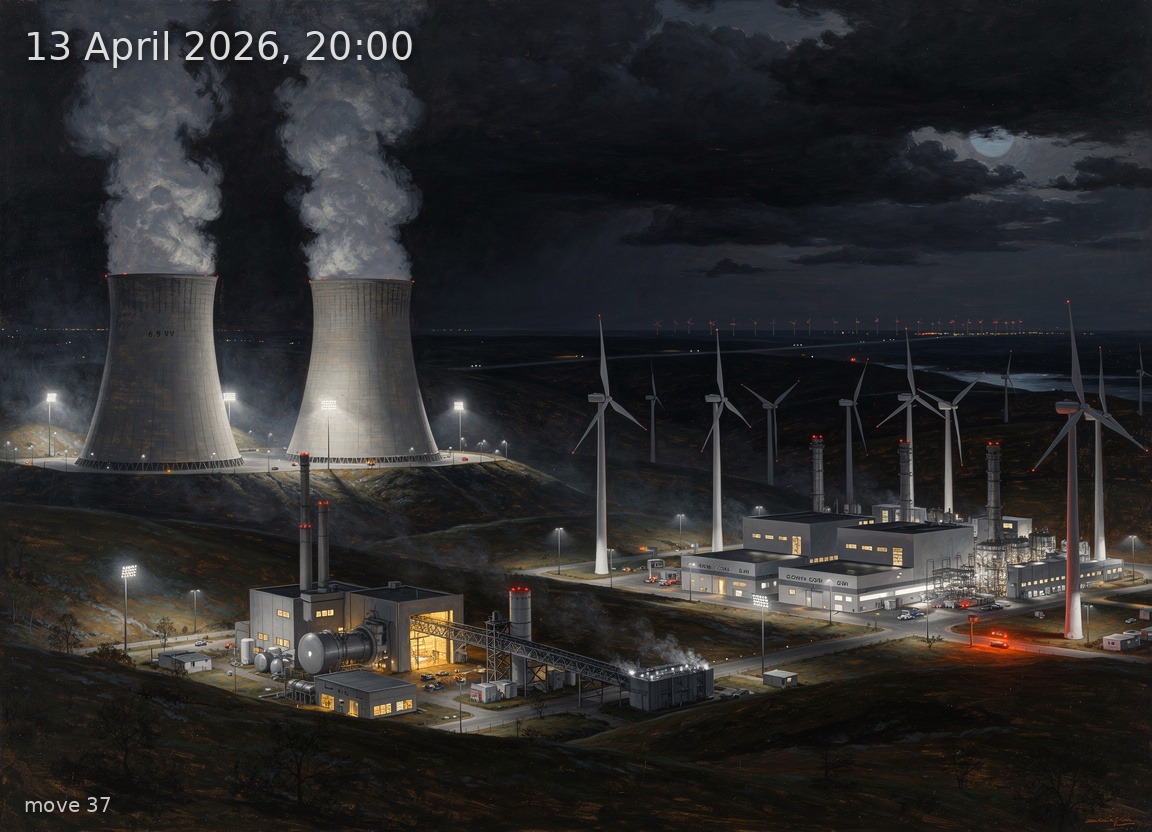
Wind and fossil thermal dominate an import-dependent evening grid at 156.6 EUR/MWh under full cloud cover.
Back
Generation mix
Wind onshore 29%
Wind offshore 5%
Solar 0%
Biomass 11%
Hydro 3%
Natural gas 23%
Hard coal 13%
Brown coal 16%
48%
Renewable share
14.6 GW
Wind (on + offshore)
0.0 GW
Solar
43.4 GW
Total generation
-16.2 GW
Net import
156.6 €/MWh
Day-ahead price
9.6°C / 7 km/h
Temp / Wind speed
Open-Meteo, Kassel (51.3°N 9.5°E)
100.0% / 0.0 W/m²
Cloud cover / Radiation
342
gCO₂/kWh
Image prompt
Wind onshore 12.5 GW dominates the right third of the scene as dozens of tall three-blade turbines with white tubular towers and nacelles stretching across rolling hills into darkness; natural gas 9.9 GW fills the centre-right as a cluster of modern CCGT plants with slim exhaust stacks emitting thin heat plumes, lit by orange sodium lamps; brown coal 6.9 GW occupies the left quarter as massive hyperbolic cooling towers belching thick white steam into the black sky, lit from below by industrial floodlights; hard coal 5.8 GW sits adjacent to the brown coal as a pair of large rectangular power stations with tall chimneys and conveyor gantries, glowing amber from internal lighting; biomass 4.7 GW appears as a compact wood-fired CHP facility with a modest stack and warm golden windows in the mid-ground left; wind offshore 2.2 GW is suggested by distant turbines on a dark horizon line at far right; hydro 1.5 GW is a small run-of-river station with a weir at lower right, water reflecting artificial lights. The time is 20:00 in April — completely dark sky, no twilight remains, deep black-navy overhead with total 100% cloud cover obscuring all stars, heavy oppressive overcast ceiling pressing down conveying a high electricity price atmosphere. Temperature is a cool 9.6°C — bare early-spring trees with only the faintest buds, damp ground, patches of mist near the river. Light wind barely stirs the turbine blades. The entire scene is illuminated only by artificial sources: sodium-orange streetlights along a road in the foreground, white industrial floodlights on the power stations, red aviation warning lights blinking atop turbine nacelles and chimneys. Electrical transmission towers with high-voltage lines connect the facilities, symbolizing grid interconnection. Painted as a highly detailed oil painting in the tradition of 19th-century German Romantic landscape painters — Caspar David Friedrich meets industrial sublime — with rich dark colour palette of deep navy, burnt umber, warm amber, and cool grey, visible expressive brushwork, dramatic chiaroscuro from artificial lighting against total darkness, atmospheric depth with mist and steam dissolving into the night. Meticulous engineering detail on all infrastructure. No text, no labels.