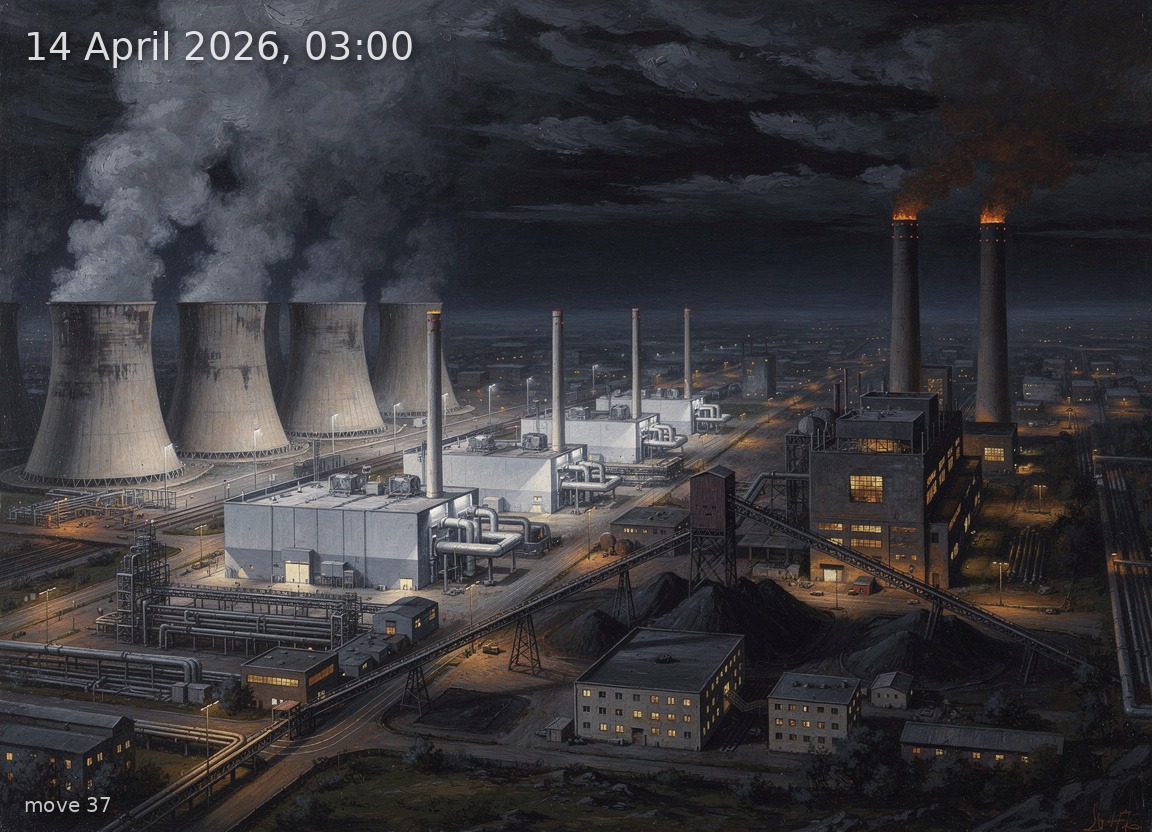
Brown coal, gas, and hard coal anchor overnight supply; moderate wind helps but 7.3 GW net imports fill the gap.
Back
Generation mix
Wind onshore 25%
Wind offshore 4%
Biomass 11%
Hydro 4%
Natural gas 22%
Hard coal 11%
Brown coal 23%
44%
Renewable share
11.7 GW
Wind (on + offshore)
0.0 GW
Solar
39.2 GW
Total generation
-7.3 GW
Net import
113.4 €/MWh
Day-ahead price
7.5°C / 8 km/h
Temp / Wind speed
Open-Meteo, Kassel (51.3°N 9.5°E)
100.0% / 0.0 W/m²
Cloud cover / Radiation
377
gCO₂/kWh
Image prompt
Brown coal 8.9 GW dominates the left third of the scene as a dense cluster of massive hyperbolic cooling towers with thick white-grey steam plumes rising into blackness; natural gas 8.5 GW fills the centre-left as a row of compact CCGT power stations with tall single exhaust stacks and smaller vapour trails; hard coal 4.4 GW appears centre-right as a gritty coal-fired plant with blocky boiler houses, conveyor belts, and a pair of wide chimneys glowing faintly orange at their tips; wind onshore 9.9 GW spans the right third as dozens of three-blade turbines on lattice and tubular towers stretching across rolling hills, their rotors turning slowly; wind offshore 1.7 GW is suggested in the far-right background as a handful of turbines on a dark horizon line above a sliver of sea; biomass 4.1 GW appears as a modest wood-chip-fed plant with a green-tinged exhaust stack near the coal station; hydro 1.5 GW is represented by a small dam with spillway at the far right edge, water glinting under floodlights. TIME: 03:00 Berlin, deep night—sky is completely black, no twilight, no moon visible, heavy 100% overcast ceiling pressing low like a lid. All structures are lit only by sodium-orange and cool-white industrial floodlights, control-room windows glowing, red aviation warning lights on turbine nacelles and chimney tops. Temperature 7.5 °C early spring: bare deciduous trees with faint bud hints, damp grass, mist clinging to the ground between facilities. Atmosphere is heavy, oppressive, dense—reflecting the high 113.4 EUR/MWh electricity price—with industrial haze merging into the low cloud base. Style: highly detailed oil painting in the tradition of 19th-century German Romantic landscape painting—think Caspar David Friedrich meets industrial sublime—rich impasto brushwork, deep chiaroscuro contrasts, atmospheric depth with receding layers of smoke and mist, warm sodium light against cold blue-black shadows. Every technology rendered with meticulous engineering accuracy: turbine nacelles, three-blade rotors, aluminium cooling-tower lattice structures, CCGT heat-recovery steam generators. No text, no labels.